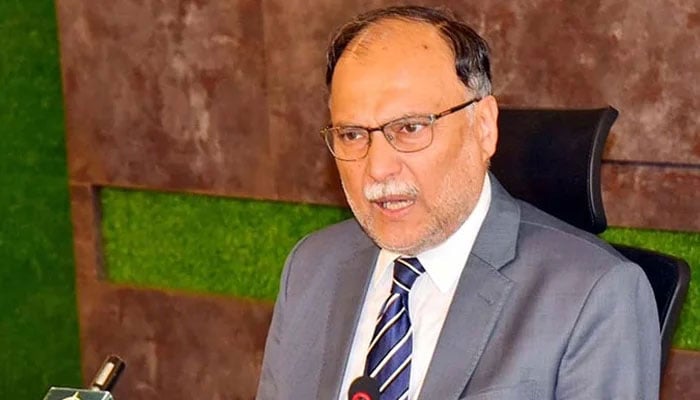
ISLAMABAD: Minister for Planning Ahsan Iqbal Thursday said the growth model relying on import substitution had failed to deliver in Pakistan and advocated adopting an export-led growth strategy to get rid of the IMF programme after the expiry of existing bailout package.
He also conceded that the Neelum-Jhelum Hydropower Project was a classic example whereby the cost was overrun to Rs500 billion, but the project failed to achieve its desired objectives. The PM had ordered an inquiry into who had hired an international consultant, and its recommendations will be implemented to ensure that the lessons were learnt to avoid wastage of the national exchequer for future development projects.
Addressing a news conference here, he said the growth model which was implemented in the last 78 years proved insufficient to deliver sustainable growth and boost exports, warning that the country must raise exports by at least $20 billion over the next four years to move out of recurring balance of payments crises and knocking at the doors of the lender of the last resort known as the IMF.
To a question regarding the future roadmap on the economic front to say goodbye to the IMF after the expiry of existing programme in the presence of Field Marshal Syed Asim Munir, the minister replied that the planning ministry gave 12 recommendations to get rid of the IMF programme.
He said it was a window of opportunity for the next one-and-a-half-year period, whereby the government could overhaul its governance and legal framework to promote investments and move towards a higher growth trajectory. The military and civilian sides are fully on one page, and now the stage is set to jack up exports to $63 billion over the medium term.
On the NFC front, he said he recommended to the PM for granting fiscal share from the divisible pool to AJK, GB and merged districts of KP, and if required, legislation could be passed from the parliament, indicating the possibility of upcoming 28th Constitutional amendments.
However, Ahsan Iqbal acknowledged that exports remained under pressure. He said exports declined by three per cent during July to November, though he expressed the hope that export growth would pick up in the third quarter of the fiscal year. He added the government was targeting $10 billion in services exports during the current financial year.
On development spending, he said the government managed to spend only Rs149 billion on development projects during the first five months of the fiscal year, despite authorising Rs349 billion, reflecting fiscal constraints under the IMF programme.
Ahsan Iqbal said there was a consensus among all the three pillars of the state that economic stability was unavoidable. He noted that Pakistan had developed better economic models than many other countries, but poor implementation had left the country lagging.
He said Pakistan would have to earn foreign exchange to eventually exit the IMF loan programme, adding that the failure to increase exports had forced the country to rely repeatedly on external borrowing. The minister said the government had set a priority target of raising exports to $63 billion by 2029.
He warned that declining exports and rising imports had widened the current account deficit, making the IMF programmes and external borrowing inevitable. He added that Pakistan had also failed to attract productive investment, cautioning that foreign investment that does not generate exports or productivity becomes a liability rather than a benefit.
The minister said the IMF programme had imposed financial discipline, while political and military leadership were working on a strong framework for national development. He said the military leadership was committed not only to strong national defence but also to economic stability. Ahsan Iqbal said it was not sustainable for the prime minister and army chief to repeatedly seek loan rollovers from friendly countries, stressing that Pakistan must shift towards an export-led growth model and place exports at the centre of its economic strategy.
He said he had proposed holding meetings of the National Economic Council on a quarterly basis to better integrate provincial development plans with federal priorities.