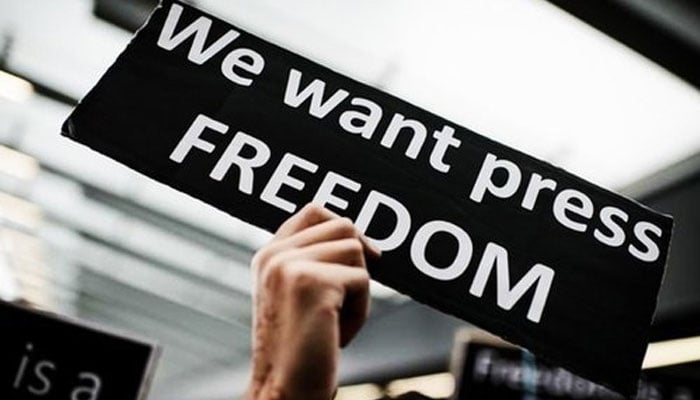
Unesco’s ‘Media Development Report 2022-2025’, released on Monday, shows a 10 per cent drop in freedom of expression over the past decade. The report states that the decline comes amid a concerning pattern of declining public trust, deepening polarisation and weakening of parliaments and judicial institutions. Parallel to this development has been the rise of major tech companies, which have created fertile ground for hate speech and misinformation on their platforms, and the rapid rise of generative AI appears to have accelerated this trend. If one looks at these developments as a whole, a strange dynamic emerges where it simultaneously feels like there are more restrictions on what one can or cannot say than ever before but that it is also easier for people to spew whatever is on their mind behind a veil of anonymity. Caught in the middle are journalists, who seem to be hardest hit by any government restrictions since they are more visible than the average social media troll but are also getting squeezed by a new information ecosystem in which anyone with an internet connection has the power to speak to the world, regardless of accuracy.
Predictably then, the report presents some grim findings on the state of journalism. During the reporting period (2022-25), 186 journalists were killed while covering wars, with 93 losing their lives just this year, as governments waging wars decide they do not want the world to see the truth. The impunity for violence against journalists remains very high (85 per cent in 2024) and media self-censorship has worsened by almost 60 per cent. This is a trend with which Pakistan is well familiar. Between November 2024 and September 2025, there were 30 instances of legal action and 15 arrests and detentions involving journalists. Who wouldn’t self-censor under such conditions? The scope of those seeking to deny freedom of expression and information in the country is now expanding. Last week, the government warned social media platforms to cooperate on regulations or face measures similar to Brazil’s model such as blocking and fines. There are also some indications that the notorious Peca Act, the country’s version of a digital muzzle, will be strengthened to allow the government to go after service providers who fail to comply with a blocking or removal request.
On the surface, this seems like a move to go after exactly the kind of misinformation and hateful content that is creating so many problems. And yet, if this approach had any promise of success, why have the jobs of journalists and other honest and open content creators only become more difficult amid a tightening of national and global restrictions on freedom of expression? The fact is that restricting online content is a tricky business, with a variety of digital tools and limited cross-border accountability mechanisms making it almost impossible to punish truly bad actors. And this is not just a freedom issue anymore. Over 1,000 Pakistani channels have achieved the coveted one-million-subscriber mark on YouTube and 60 per cent of their watch time comes from overseas. This is an indication that online content is fast becoming a valuable digital export for the country and the best content creators are very different from the worst trolls. Attempts to restrict online content will harm them too. The path the state currently appears to be on will reduce trust in honest media and content while still driving people towards exactly what it is trying to stop.