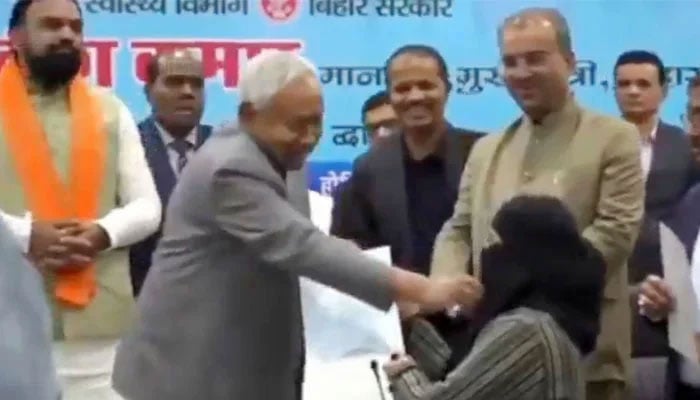
What should have been a routine state ceremony in Indian Bihar turned into a moment of public humiliation, one that lays bare the shrinking space for dignity and religious freedom in India. At an official event at the chief minister’s secretariat, Bihar Chief Minister Nitish Kumar was seen removing the niqab of a newly recruited Muslim doctor as appointment letters were being handed out. The woman, visibly flustered, was hurriedly pulled aside by an official. She did not protest, perhaps because she could not. The imbalance of power was absolute. Amnesty International has rightly called the act “an assault on this woman’s dignity, autonomy and identity”. Such actions, Amnesty says, “deepen fear, normalise discrimination and erode the very foundations of equality and freedom of religion”. Let’s face it: the incident was coercive, public and demeaning. In many democracies, it would have led not just to resignation but to criminal proceedings for harassment, particularly given that the victim belonged to a religious minority.
What makes it even more disturbing is the confidence with which it unfolded. Had a Muslim leader done the same to a member of the Hindu majority, the consequences would have been swift and brutal. The contrast speaks volumes about whose dignity is protected in today’s India and whose is negotiable. The silence or, worse, the justification that followed was equally revealing. Uttar Pradesh cabinet minister Sanjay Nishad’s crass remark – that the chief minister “only touched her hijab” and what might have happened had he touched her elsewhere – shows just how casually Muslim women’s bodies are discussed in today’s India. This is not an isolated incident. Last month, the US Commission on International Religious Freedom concluded in a report that India’s political system now facilitates a climate of discrimination against religious minorities. According to the report, since 2014, policies under Indian Prime Minister Narendra Modi’s BJP have aligned closely with Hindutva ideology, leading to the disenfranchisement of minority communities. In such an environment, there is little incentive for accountability.
The erosion of India’s secular promise is visible not only in symbolic acts of humiliation but in far graver violence. Just days after the Bihar incident, police arrested eight people in connection with the alleged mob lynching of a cloth vendor who died on December 12. He was reportedly tortured, beaten with a burning piece of wood, assaulted with an iron rod and mutilated with pliers. Such horrors have become grimly familiar in Modi’s India, where lynchings and ‘love jihad’ campaigns have normalised the targeting of Muslims. India once prided itself on pluralism and constitutional guarantees of equality. Today, for many of its Muslims, the country feels less like a republic of rights and more like a prison of fear. Islamophobia has moved from the fringes to the centre of power, shaping policy, policing behaviour and public discourse. Muslims are expected to stay silent and to be grateful for the absence of worse violence. The spectacle unfolding in India demands introspection. Unfortunately, all one gets in India these days is silence or applause.