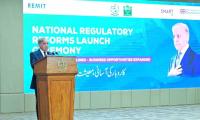
Across Asia, the Gulf and Africa, the fastest-growing states run their economies through a ‘Joint Economic Command’. Vietnam does it. South Korea does it. Rwanda, Singapore, China, Saudi Arabia, the UAE, Qatar and Indonesia do it. One HQ sets direction; multiple formations execute. One brain, many hands. No confusion. No drift. Only delivery.
Pakistan’s problems are not sectoral; they are systemic – fragmented authority, scattered mandates and overlapping veto points. Yes, the 27th Amendment has resolved one part of the puzzle – the security chain of command has been unified. But the economic chain of command remains fractured.
Pakistan’s problem is too many centres of power – finance, energy, commerce, BOI – all operating in silos. No single node owns outcomes. Pakistan needs a unified HQ for economic strategy and execution.
Pakistan’s problem is too many delays. Every decision passes through half a dozen ministries, at least three regulators, and at least two committees. The OODA loop (Observe-Orient-Decide-Act) collapses under paperwork. A single FDI project must go through BOI, FBR, the provinces and the courts.
Pakistan’s problem is too many veto points – courts, provinces, regulators and ministries. They all block, stall, or dilute reforms. No formation has primacy.
Across Asia, the Gulf and Africa, states broke this cycle by centralising authority for economic execution – Vietnam after Doi Moi, Singapore after 1965, Rwanda after 1994, Saudi Arabia after Vision 2030. They converged on the same architecture: one HQ sets direction, multiple formations execute.
What is the commander’s intent? To align mandate with muscle? To translate power into output? To turn plans into outcomes? For that, Pakistan needs an economic structure built for delivery, not debate. In a centralised system, clarity is strength. When execution speed rises, risk premiums fall and investment follows clarity. One brain. Many hands. No confusion.
A ‘Joint Economic Command’ must, as a priority, do four things: cut energy losses, clear investment backlogs, raise exports and shorten decision cycles from months to weeks. Command without metrics is noise. Command with KPIs is delivery. Every successful ‘Joint Economic Command’ (Vietnam, UAE, Singapore) runs on four factors: weekly delivery dashboards, monthly performance scorecards, public KPIs for ministers and secretaries and reward–penalty systems tied to outcomes.
For the record, every FDI investor asks two questions: Are my contracts safe? If something goes wrong, who resolves it and how fast? Pakistan has a serious bottleneck: judicial speed. Will the restructured judiciary deliver commercial certainty at commercial speed? Will it enforce contracts in weeks rather than years?
Centralisation always invites suspicion. A ‘Joint Economic Command’ must tell the public three things: what it will fix, who will benefit, and how quickly results will appear. Without a clear narrative, even well-intentioned reforms can appear to be overreach.
Can the SIFC be turned into a true ‘Joint Economic Command’? The SIFC will need statutory authority to override, direct and enforce. And the four critical formations – finance, energy, exports and investment – must be brought under one operational roof.
Red alert: This isn't socialism or dictatorship, it's pragmatic centralisation for delivery. Without it, we'll remain in drift. With it, Pakistan can join Asia’s next wave of tigers. The time for one HQ is now.
The writer is a columnist based in Islamabad. He tweets/posts @saleemfarrukh and can be reached at: [email protected]