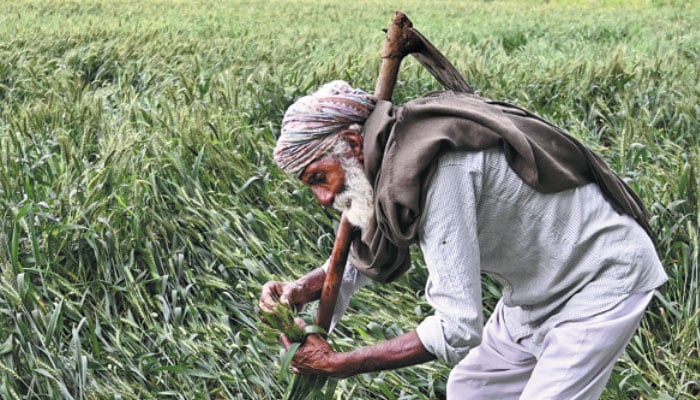
On an early March afternoon near the tail of a distributary in Lower Chenab, the rotation chart on the patwari’s wall still shows that water is due. The wheat crop requires its final irrigation before harvest. On the ground, there is only a thin brown trickle that dies in the channel before reaching the final outlets. “The field needs water, but there is none”, one farmer says quietly. “If we miss this turn, the wheat grain will be light and the harvest will fall”.
We are often told that canals are a gift of nature and a legacy of the British. What they do not say is that for about 2,300 years, from the Mauryas to the British Raj, governments that built large canals never treated irrigation water as a free good.
Kautilya’s Arthasastra demanded a separate ‘water share’ of about 20–33 per cent on crops irrigated from state works. Firuz Shah Tughlaq imposed haqq-i-sharab on his new canals. The Mughals embedded the cost in higher land revenue on irrigated tracts. The British, for example, in the Chenab Colony, charged occupiers about Rs3.75 per acre for wheat when gross revenue from wheat was only around Rs25. A mid-teens percentage for water alone.
Today, the same acre of wheat earns the farmer in the region of Rs80,000 and he pays Rs400 in abiana, about 0.5 per cent. Sugarcane is worse: Rs1,600 against something like Rs280,000 in gross revenue. In real terms, the water charge is now only a small fraction of the effective rate compared to historical rates. This is not tradition. It is a political invention of the last half-century – and it is killing the system.
The numbers are brutal. Punjab requires at least Rs25–30 billion annually simply to desilt, repair gates, and keep the canals flowing at their designed capacity. It collects less than Rs4 billion in abiana. The result is silted channels, broken regulators, and dying tail-ends.
On paper, Punjab has even equipped itself with a modern Punjab Irrigation, Drainage and Rivers Act (2023). It authorises the government to fix water rates and other fees by area, crop, season, use and even volume, and to levy betterment charges on land that benefits from irrigation and drainage works. In other words, the law already allows us to price water more accurately and recover part of the project costs from the very users who benefit. Yet in practice, we still behave as if canal water must remain almost free, even as the canals themselves decay.
Every year, the system quietly loses more carrying capacity. Distributaries that once ran full now limp at perhaps 60–70 per cent of design discharge. Tail-end farmers in systems routinely get less than half of their sanctioned shares. Their response is rational: Around 1.4 million tubewells now pump roughly 50–55 MAF of groundwater every year – about four times the live storage of Tarbela, Mangla and Chashma combined, and nearly nine times Tarbela’s current live capacity. Water tables in parts of Punjab are falling by tens of centimetres each year, and close to a metre in some pockets.
The supposed subsidy for cheap canal water is spectacularly regressive. The biggest beneficiaries are not small peasants but head-reach landowners who pay less than one per cent of their gross income for canal water, while the tail-end tenant pays many times more in diesel and borrowed tubewell water and still gets half the crop.
We have run the most radical fiscal experiment in the history of the Indus basin: trying to operate the world’s largest contiguous irrigation network on symbolic tariffs. The experiment has failed.
The good news is that the fix is modest, fair, and well within the bounds of international and historical practice.
A phased abiana increase to about 6–8 per cent of gross revenue by 2032 would still be only around half of typical colonial-era water-charge burdens, yet it would generate roughly Rs30 billion a year. Make it progressive and cushion the small landholder: 0–5 acres pay 50 per cent of the standard rate, 25–100 acres pay 150 per cent, above 100 acres pay double or more. Give tail-end outlets an automatic rebate if their sanctioned share is not delivered. Ring-fence every rupee in a statutory Punjab Irrigation Maintenance & Development Fund. Link higher abiana to strict groundwater caps and to solar subsidies that are available only with efficient irrigation. None of this requires a new law; it only requires that Punjab use the pricing and betterment powers it has already given itself under the 2023 Act.
Even after such an increase, water would remain cheaper than fertiliser, diesel, pesticides or labour on a per-acre basis. The purpose is not to punish farmers, but to send a clear signal that canal water is scarce, valuable and must be paid for if the system is to survive.
Farmers will accept this, provided they see the money translated into visible desilting and repaired gates before the next increase. History shows they always did: the British collected mid-teens percentages and still turned desert into the breadbasket of India because the canals worked. Contemporary examples from countries like Egypt and Morocco show similar patterns: meaningful but manageable charges, ring-fenced O&M funds and farmer participation in oversight.
The choice is no longer between cheap water and expensive water. It is between paying modestly for a functioning canal system today or paying catastrophically for its collapse tomorrow.
In 1904, a Chenab Colony settler paid what then seemed a stiff Rs3.75 for water and harvested 12 maunds of wheat worth Rs25. In 2025, his grandson pays Rs400 and will soon harvest nothing because the distributary is choked with silt and the aquifer is gone. The farmer at the tail, watching his turn pass with an empty channel, is already living that future.
The myth of cheap water has had a good fifty-year run. It is time to bury it before it buries Punjab’s canals with it.
The writer is a former Punjab minister for irrigation and finance, with extensive experience in Pakistan’s provincial and federal legislatures.