Cities rarely announce their priorities in neat policy papers; instead, they reveal them in the gaps between aspiration and infrastructure. Karach illustrated this tension vividly in the 39-day World Cultural Festival (Oct 30–Dec 7, 2025) recently concluded at the Karachi Arts Council.
Under the indefatigable stewardship of its president, Ahmed Shah, the festival became not only the city’s longest continuous cultural event but one of the longest such festivals held anywhere in the world. That Karachi managed to host an international cultural marathon even as its streets resembled obstacle courses of broken asphalt and cratered diversions is an irony lost on no one. Yet, it also points to something deeper about the city’s stubborn resilience. Karachi’s World Cultural Festival stands out for its diversity and duration.
Edinburgh’s famed International Festival runs for about three weeks; Salzburg lasts just under six; Jaipur’s literary jamboree is a brisk four-day affair; Dhaka Art Summit, though ambitious, is confined to ten. Even the grand European summer circuits, from Avignon to Bayreuth, rarely exceed a month of nonstop programming. Karachi, however, stretched its programme across nearly six weeks – 39 days of performances, exhibitions, dialogues, screenings and cultural diplomacy on a scale few cities with far better civic infrastructure would dare attempt.
If the festival had an animating force, it was Ahmed Shah. Over the past decade, his name has become synonymous with Karachi’s cultural revival – part impresario, part cultural diplomat, part logistical magician. Those who observed him throughout the festival’s run recall not a leader taking ceremonial bows but a manager in perpetual motion. The festival’s success was not accidental. Coordinating artists, performers, curators, designers and intellectuals from over one hundred countries would test even the most well-funded cultural capitals.
Pakistan, with its stringent visa requirements, inconsistent air schedules and unpredictable bureaucratic delays, presents a particularly formidable terrain. That so many delegations arrived, performed, interacted and left with glowing remarks about the hospitality is a testament not only to the Arts Council’s institutional strength but also to Shah’s personal credibility in global cultural circles. Few institutions in the region could have orchestrated such logistical gymnastics. Any account of the festival must acknowledge the Sindh government’s support, especially from its Ministry of Culture. Chief Minister Murad Ali Shah, in particular, has demonstrated a capacity to view culture not as a dispensable luxury but as a strategic public good.
In an era when provincial governments across South Asia routinely slash cultural budgets, Sindh stands out for its relative consistency in supporting arts councils, theatres, film initiatives, and heritage projects. Yet the contrast is impossible to ignore. Just outside the Arts Council, Karachi’s disarray persists: roads broken for months, diversions multiplying without explanation and commuters navigating a labyrinth of half-completed infrastructure schemes. The very audiences that filled the Arts Council’s auditoriums often spent more time reaching their destination than the performers spent on stage.
For some, the festival became a parallel narrative – proof that Karachi can deliver excellence in controlled spaces even as its broader urban fabric crumbles from neglect. This juxtaposition illuminates a paradox of governance. The Sindh government can demonstrate vision in cultural matters, yet struggles with the municipal basics of repair and maintenance. A festival of such scale may inspire civic pride, but it also shows the need for the same discipline and commitment to be directed toward Karachi’s streets, sewage systems, transport networks and public spaces. Culture thrives when a city works; it survives heroically when the city does not.
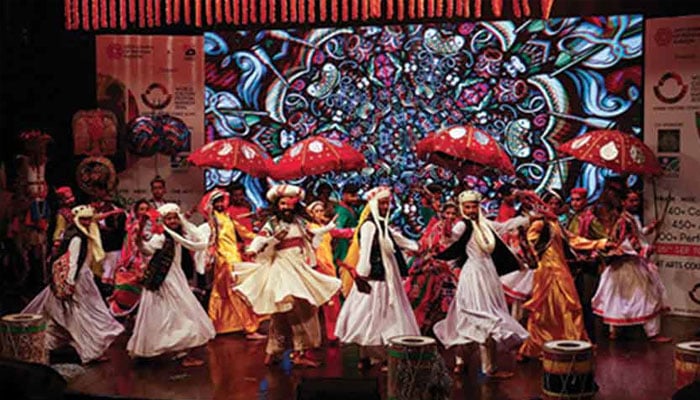
Where the festival truly excelled was in its programming. Over 39 days, the Arts Council transformed its grounds into a miniature world map of cultural expression. There were musical ensembles from Central Asia with their long-necked lutes and rhythmic footwork; Balkan performers who brought the polyphonic choral traditions of their mountains; Latin American dance troupes whose percussive intensity electrified younger audiences; Japanese Taiko drummers whose thunderous precision elicited awe; and Middle Eastern oud virtuosos who infused the evenings with contemplative melancholy.
South Asia, of course, occupied pride of place. From Bangladesh came folk musicians and visual artists; from Nepal and Sri Lanka, storytellers and traditional drummers. Alas, no Indian artists are reported to have actually participated in the festival. While the festival drew performers and delegations from over 140 countries, including many from South Asia and Asia broadly, official statements indicated that Indian artists were not part of the 2025 lineup due to the extremely low level of diplomatic ties between Pakistan and India. Festival organisers said they had hoped to invite Indian writers, filmmakers and theatre practitioners, but this did not materialise because of the political situation between the two countries
Pakistan’s provinces showcased regional diversity. The festival’s visual arts component was equally notable. International painters and sculptors collaborated with local artists in workshops that drew unprecedented crowds. A photography exhibition documenting indigenous cultures from remote corners of the world became a surprising favourite, while film screenings invited spirited post-show discussions. The presence of delegations from over 140 countries elevated the festival from a domestic showcase to a diplomatic arena.
Organising such an event is almost a geopolitical exercise. Each visiting group arrives with its own cultural protocols, dietary preferences, technical requirements and expectations of hospitality. Coordinating their visas, accommodations, transportation, rehearsals, stage management, security arrangements and media interactions is a logistical symphony that must be performed without visible dissonance. Karachi’s festival embraced scale – over a month of programming and representation from continents spanning nearly every cultural tradition imaginable. Such breadth introduces inherent complexity. Beyond its artistic richness, the festival marks a milestone in Pakistan’s cultural diplomacy. At a time when much of the world perceives Pakistan through the narrow prism of security and political instability, the event offered an alternative window.
The timing is significant. As geopolitical realignments reshape South Asia, soft power becomes an increasingly vital currency. India wields its film industry and literary festivals; Bangladesh leverages its cultural diplomacy with Europe; Sri Lanka promotes its Buddhist heritage; Nepal highlights its ecotourism and spiritual traditions. Pakistan, long trapped in narratives of deficit and crisis, needs arenas where it can project confidence and cosmopolitanism. A festival drawing participants from more than 140 countries does precisely that. Karachi itself – often portrayed as chaotic, divided, and ungovernable – also benefits from such reimaginings.
For many foreign visitors, this may have been their first encounter with the city. They departed not with images of political turmoil but with memories of lively stages, generous audiences and conversations that stretched late into the night over Karachi’s eclectic cuisines. These impressions matter. But festivals cannot indefinitely compensate for infrastructural decline. One cannot help but notice that the exuberance within the Arts Council contrasts sharply with the frustration outside its gates. Karachi’s roads, dug up for months without clear timelines, reflect an urban paralysis that contradicts the creative vitality displayed at the festival.
There is also an economic argument. Cultural events generate tourism, stimulate small businesses and enhance a city’s international profile. Yet no tourist, however enchanted by the Arts Council’s offerings, enjoys navigating endless diversions and waterlogged streets. If Sindh’s government wishes to build on the goodwill generated by the festival, it must extend its cultural commitment to urban repair. The same administrative will that facilitated a 39-day festival should be brought to bear on Karachi’s basic civic management – otherwise cultural achievements risk appearing detached from the daily realities of residents.
The World Cultural Festival has demonstrated what Karachi can do when led with clarity and purpose. Ahmed Shah’s leadership offers lessons beyond the cultural sector: meticulous planning, relentless communication, aggressive fundraising, and a refusal to accept bureaucratic inertia. These qualities are equally needed in urban planning, education, health and infrastructure. The festival could also serve as a model for institutional partnerships. Collaboration between the Arts Council, the Sindh government, foreign cultural missions and private sponsors created a network of support that should be sustained year-round.
Karachi’s universities, galleries, theatres and creative hubs could be integrated into future editions, transforming the festival from a centrally located event into a citywide celebration – but for that you need a much better infrastructure across the city.
The writer holds a PhD from the University of Birmingham, UK. He tweets/posts @NaazirMahmood and can be reached at: [email protected]