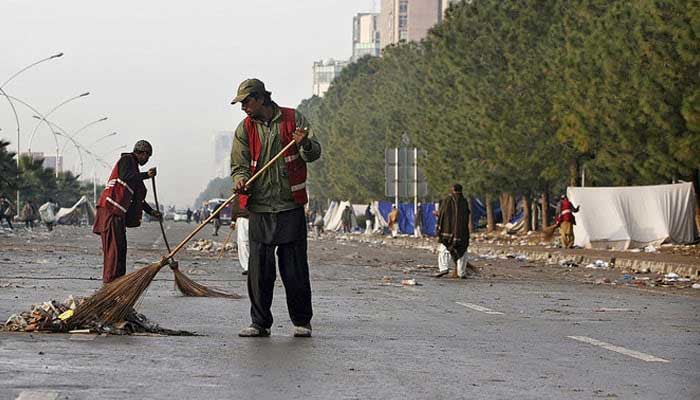
For decades in Pakistan, the people who do the dirtiest and most dangerous work have been treated as though they are not quite equal citizens. The Islamabad High Court’s recent orders directing departments to remove the discriminatory 'Christians only' label from sweeper job ads and insisting on safety measures for sewerage workers are important, overdue steps. But they only skim the surface of a much deeper class and caste-shaped injustice that shapes how we treat those who keep our cities functioning. Sanitation work, which involves climbing into sewers, unclogging drains and handling human waste with barely any protection, is not something anyone chooses out of aspiration. It is work people are pushed into because of poverty, discrimination, and long-standing social hierarchies. Most sanitary workers belong to religious minorities or historically marginalised communities, and the fact that government departments openly advertised these posts for 'Christians only' until now says everything about how entrenched these biases are.
The court was right to call this what it is: a violation of equality and basic human dignity. Replacing the offensive language with 'civilian' and ordering protective gear for workers is a step forward but it certainly cannot be where the conversation ends. Because every year, we continue to see the same grim scenes – workers pulled out of manholes dead, poisoned by toxic gases, sent in without masks, without equipment. These 'accidents' are the predictable result of a state that has never valued working-class lives, especially when the workers in question come from communities deemed expendable. Changing job ads will not fix that. What is required is a fundamental rethinking of labour policy, as well as our social hierarchies. Sanitation work must finally be acknowledged for what it is: essential, hazardous labour that deserves fair wages, guaranteed job security, healthcare, pensions, union rights and enforceable safety protections. This applies to every worker in the sector whether hired permanently or on contract. The right to dignity at work cannot depend on one’s ID card or the faith listed on it.
The government now needs to move beyond piecemeal court directives and create real, comprehensive legislation. That means: first, outlawing manual scavenging and unsafe entry into sewers entirely, with actual enforcement. We have machines that can do this work. That choice is political – and it is indefensible. Second, every sanitation worker must be formalised as an employee with full labour rights. Third, safety standards must be enforced. Gas detectors, PPE, training and emergency response systems are the bare minimum, not luxuries. And yes, dismantling discriminatory hiring practices is essential. Replacing 'Christian only' with 'citizen' is a start, but the country must confront the deeper caste-like hierarchies that dictate whose lives matter and whose labour is taken for granted. Pakistan’s most vulnerable workers should not have to file petitions just to avoid dying on the job. This really is the bare minimum.