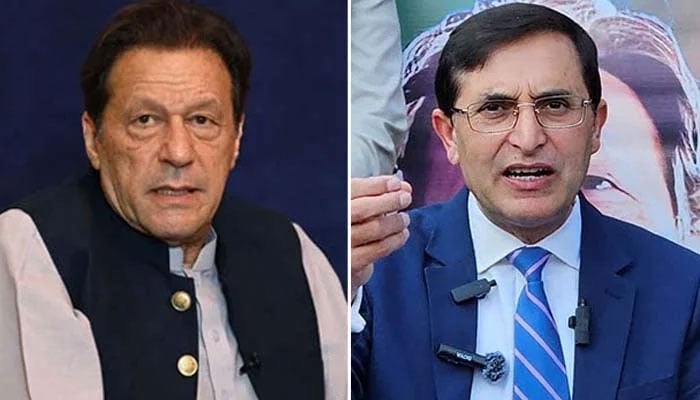
PTI Chairman Barrister Gohar Ali Khan has dismissed any talk that Imran Khan can be ‘minus-ed’ from politics. Yet, ever since the fiery press conference by the director general of Inter-Services Public Relations last week, the political discourse has taken a darker, more coercive turn. Government leaders and their allies have openly floated the idea of sidelining the PTI founder, warning of severe consequences if Imran Khan is not minus-ed. Some have gone so far as to predict the wrapping up of the PTI’s politics altogether should Imran remain part of it. The threats have not been subtle.
Putting it plainly: such a trajectory would be a grave mistake. Political experts have long argued that the so-called ‘Minus Imran Khan’ formula is impractical and a non-starter. Imran Khan is PTI, and PTI is imran Khan; there is no meaningful separation between the two. This reality was evident even after the May 9 incidents, when a crackdown forced many senior PTI figures to leave the party. Despite this, PTI fielded new candidates, won a large number of seats and retained its electoral relevance. Another crackdown may again result in defections, but it will not erase the sentiment on the ground or the support base that continues to rally around Imran. Pakistan’s political history reinforces this lesson. There were times when Nawaz Sharif, Benazir Bhutto and Asif Ali Zardari were each declared ‘finished’ or earmarked for political erasure. None of those attempts worked and all returned with renewed relevance. To imagine that a similar experiment will succeed with the PTI is to ignore both precedent and political reality. Yet, acknowledging the futility of coercion does not absolve the PTI – or Imran Khan himself – of responsibility.
What Pakistan urgently needs is a lowering of the political temperature, and in this regard the burden lies more heavily on Imran than on his party’s second-tier leadership. In the aftermath of the ISPR press conference, PTI leaders displayed an unusually restrained and mature tone, adopting a non-confrontational approach that was widely welcomed. This restraint reflects the shrinking political space the party finds itself in. There is also a persistent concern that Imran does not listen to his own leadership when calls are made to de-escalate. Even senior PTI leaders incarcerated alongside him wrote from jail advocating political dialogue – only to be ignored. This has prompted suggestions that figures outside the PTI but trusted by Imran be allowed to meet him. Imran himself nominated them as leaders of opposition in the National Assembly and Senate. If these leaders can convey the ground realities to Imran – including how confrontation is narrowing space for his party and how regional and global dynamics are shifting, from India and Afghanistan to Gaza and wider geopolitical alignments – there may yet be room for reflection. Pakistan today is deeply polarised, economically fragile and strategically exposed. And a grand national dialogue is now a necessity, both for the survival of democracy and for the continued relevance of all political actors. Minusing won’t work anymore.