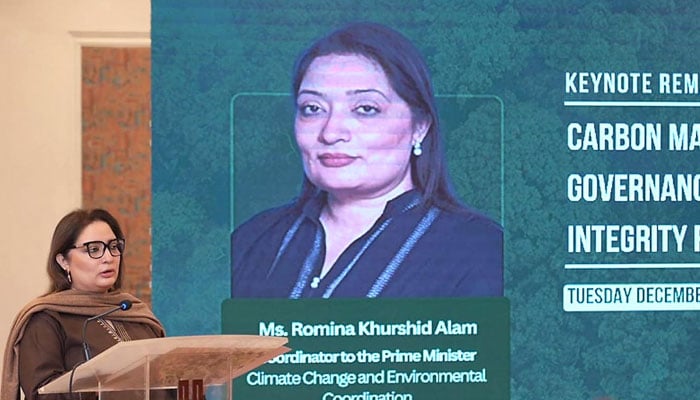
Islamabad:Pakistan is pushing ahead with plans to establish a structured and transparent carbon market framework, coordinator to the prime minister on climate change Romina Khurshid Alam said on Tuesday, underscoring the country’s intention to tap emerging global climate-finance opportunities.
During a workshop organised by Transparency International Pakistan here, Ms Romina said the federal government was steadily moving to operationalise the National Policy Guidelines for Trading in Carbon Markets, approved by the federal cabinet in 2024.
"The decision marked a turning point in the country’s approach to climate finance, opening the door for participation in both voluntary and compliance carbon markets," she said. The event coincided with the launch of Transparency International Pakistan’s flagship study, Carbon Markets Readiness in Pakistan: Addressing Governance Gaps and Safeguarding Against Integrity Risks.
The aide to the PM outlined the government’s ongoing work to translate policy commitments into operational systems. She said the climate change ministry was developing regulatory mechanisms for the generation, approval and transfer of carbon credits, along with a national monitoring, reporting and verification architecture designed to ensure the credibility of emissions-reduction claims.
"A national carbon registry is also under development to prevent double counting and strengthen transparency across transactions," she said. Ms Romina said the government was working to improve coordination among federal and provincial institutions, while also engaging development partners to build technical capacity in areas such as renewable energy, forestry and community-based climate projects.
She said pilot initiatives in those sectors would help Pakistan test new methodologies and demonstrate market-ready models. "The overarching goal is to establish a carbon market that is fair, well-regulated and internationally trusted, enabling Pakistan to attract global investment while aligning fully with Article 6 of the Paris Agreement," she said.
The prime minister's coordinator welcomed the Transparency International report’s recommendations, including clearer institutional mandates, stronger data systems, public disclosure requirements and safeguards to protect community rights in future carbon projects.
Participants, including policymakers, technical specialists, members of civil-society groups and private-sector actors and development partners, underscored that Pakistan must embed accountability and transparency from the outset to avoid governance failures seen in some international carbon markets.
They said credible systems would not only protect Pakistan’s interests but also reinforce its reputation as a responsible recipient of climate finance. The gathering ended with a shared view that coordinated action and sound governance would be essential for Pakistan to advance its carbon-market agenda and position itself effectively in a growing global climate-finance landscape.