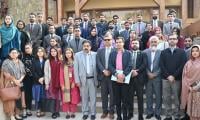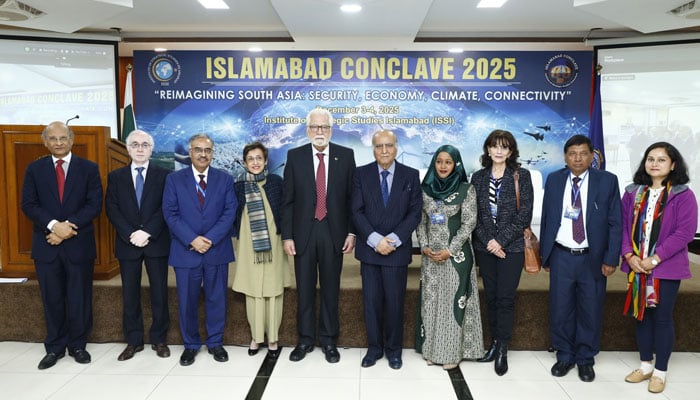
Islamabad:The 5th edition of the Institute of Strategic Studies Islamabad conclave concluded here with a strong call for re-imagining South Asia around security, economy, climate and connectivity.
The two-day event brought together policymakers, diplomats, scholars and civil society to examine how the region can shift from rivalry to cooperative frameworks that deliver tangible benefits.
Speakers agreed that persistent deficits in security, development and regional cooperation continued to limit the region’s potential. Escalating geopolitical tensions, unresolved disputes and the May 2025 Indo-Pak conflict were highlighted as reminders of regional fragility and the need to prioritise institutionalised cooperation, economic integration and climate resilience.
ISSI Director General Ambassador Sohail Mahmood presented the synthesis of the inaugural session and five working groups, saying re-imagining South Asia is both timely and necessary. He emphasised that states in the region had the agency to change the current trajectory and adopt win-win approaches rather than zero-sum strategies.
He recalled Deputy Prime Minister Ishaq Dar’s appeal to fundamentally rethink the architecture of regional cooperation and to pursue pragmatic collaboration through new formats with "variable geometry" that can accommodate different levels of engagement.
Chief guest Ambassador Inamul Haque offered a wide-ranging assessment of the evolving global order and its implications for South Asia. He noted that while the United States remained a dominant power, China was rising and Russia was resurging, and that the final shape of the global order remained uncertain.
“Pakistan should maintain balanced, constructive engagement with all partners while safeguarding national interests,” he said, reaffirming the value of Pakistan’s strategic partnership with China alongside productive ties with Western countries.
The envoy also stressed the importance of stronger regional institutions, inclusive economic strategies, improved connectivity and human-centred development. He underlined the imperative of internal consolidation in Pakistan, calling for sustained attention to economic growth, population management, health sector improvements, education reform and better governance as prerequisites for meaningful regional engagement. Chairman of the ISSI Board of Governors Ambassador Khalid Mahmood praised the Conclave for addressing complex regional dynamics and offering forward-looking insights.