The vibrant celebrations of the World Culture Festival 2025 at the Arts Council of Pakistan Karachi reached their peak as the 33rd day featured the inauguration of an art exhibition “Fading Boundaries.”
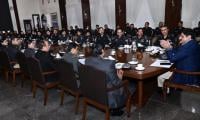
The exhibition was opened by Sindh Minister Culture and Tourism Syed Zulfiqar Ali Shah, accompanied by President Arts Council Muhammad Ahmed Shah and actor Muneeb Butt. The exhibition was curated by Chairman Fine Arts Committee Farukh Tanveer Shahab.
Culture Minister Shah said the credit for the World Culture Festival goes to the “one-man army” Ahmed Shah. He added that Chief Minister Syed Murad Ali Shah and Faryal Talpur are committed to promoting arts and culture. “Karachi is brimming with cultural activities, and many people from around the world are here. This is no small feat. Ensuring their safety is our responsibility. We want to show the world the positive face of Pakistan, and our artists are proving through this festival that Pakistan is a peaceful country,” he stated. He praised the participation of artists from Balochistan, Punjab, KPK, and Sindh, adding that young people should visit the festival and learn from international artists.
He urged parents to enrol their children in the art, music, and dance classes offered by the Arts Council to foster positive change in society. Arts Council President Ahmed Shah said this was the seventh exhibition held under the festival. “Last time as well, Minister Zulfiqar Ali Shah inaugurated the event. Our brilliant artist Muneeb Butt is also here, with his upcoming film on the way,” he added.
Curator Farukh Tanveer Shahab noted that the festival has brought people together like a grand cultural gathering. “Today’s exhibition showcases the work of young Pakistani artists. Through this festival, artists are expressing their voices. The special feature of this exhibition is that it is held at Café de Art, where international artists frequently visit, and the artworks displayed here have captured their attention.”
Actor Muneeb Butt expressed his admiration, saying, “This is the first time I’ve seen an exhibition like this. An artist’s heart beats with another artist’s heart. When people appreciate an artist’s work, it strengthens their spirit. Among the exhibitors, an artist from Balochistan is present here who cannot speak, but his work is so powerful that I felt compelled to encourage him.” The exhibition featured works by Abrar Ahmed, Abbas Kamangar, Aimen Rauf, Aliya Faizi, Amna Suheyl, Bisman Marri, Habiba Safdar, Hajra Khan, Hiba Zehra, Manizhe Ali, Manoj Kumar Khatri, Muhammad Ismail, Neha Ufaq, Nisa Karamatullah, Paul, Mehdi Rizvi, Rajeshwari, Romessa Khan, Sarina Qayyum, Shamama Hasany, Sharjeel Baloch, Sohail Hashmi, Syed a Irfan, Tanweer Farooqi, Tariq Usman Luni, Tooba Zafar, and Yusra Taqi Allaawala.
Earlier, the 33rd day of the festival began with the screening of the Pakistani animated film “The Glassworker.” Renowned musician Ashraf Sharif Khan conducted a workshop titled “Sitar in Global Perspectives,” attended by artists from Pakistan and abroad. Speaking during the workshop, he said he came from a classical music family, where he received his early training. “In South Asian art, the first thing we learn is respect. Our family’s legacy includes sitar-playing and singing,” he added.
Theatre performances from Turkiye and South Africa were also staged. Turkiye presented the play “SUBJ: MEDEA,” written and directed by Özlem Özhabes, a contemporary political drama delivered through a fragmented chorus of mythic, political, and intimate voices. The play combined political inquiry with deeply personal storytelling. South Africa presented “Woman in Waiting,” directed by Hlengiwe Lushaba-Madlala and written by Thembi Heavygale Mtshali-Jones. The powerful solo performance captivated the audience with its portrayal of a woman’s journey, bringing to light the silenced stories of countless women oppressed by systemic injustice and poverty.