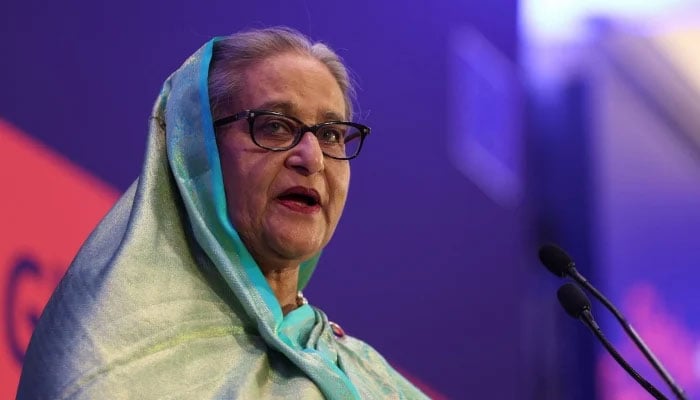
The verdict by the International Crimes Tribunal (ICT) on November 17 to award the death sentence to former Prime Minister Sheikh Hasina on charges of crimes against humanity will have far-reaching implications for the politics of Bangladesh. Ousted on August 5, 2024, after months of violent student agitation against the quota system, Sheikh Hasina fled to India and since then has been living in exile.
Terming the ICT judgment biased and one-sided, Sheikh Hasina and her banned party, the Awami League, have decided to launch a movement against the interim government of Dr Mohammad Yunus and demanded his resignation. Along with her former home minister and the then police chief, the ICT convicted Sheikh Hasina on charges of murder and extra-judicial killings, holding her responsible for the killing of 1,400 people and thousands injured in the July–August 2024 protests.
Bangladesh is expected to go to the polls in February next year. The Awami League will not be able to participate in the coming elections. The interim government has also announced that it will hold a constitutional referendum on Election Day to seek voters’ opinions on the ‘July Charter’. While a majority of Bangladeshi political parties had approved the July Charter, the National Citizens Party (NCP), a recently established youth-based party, refused to support it because it lacked a legal framework and a binding guarantee for implementing its commitments.
With the award of the death sentence to Sheikh Hasina and the banning of the Awami League, one can anticipate a political vacuum in Bangladesh. The Awami League ruled Bangladesh from 1972–1975, 1996–2001, and from 2009 until 2024, and has a large following. The July uprising and the manner in which Sheikh Hasina tried to crush that movement severely jeopardised her popularity. She is accused of severe human rights violations, extrajudicial killings of political opponents, and reducing Bangladesh to the status of a ‘client’ state of India. Although Bangladesh's economy prospered during her rule, her mode of governance alienated a majority of the people.
Immediately after the ICT verdict was released, the government of Bangladesh demanded that India extradite her based on the extradition treaty between the two countries. Reacting to that demand, the Indian Ministry of External Affairs stated that “India remains committed to the best interests of the people of Bangladesh, including in peace, democracy, inclusion and stability in that country. We will always engage constructively with all stakeholders to that end”.
Will Bangladesh plunge into another cycle of political instability and violence, or will her opponents use the award of the death sentence to Hasina by the ICT as an opportunity to undo her legacy? How will religious groups in Bangladesh benefit from the banning of the Awami League and the death sentence awarded to Sheikh Hasina? Will the military step in and take over if the February elections are marred by violence?
Bangladesh is certainly at a crossroads, and its recent political dynamics need to be analysed from three angles. First, despite falling from grace and being deprived of power, Sheikh Hasina and the Awami League still pose a cogent challenge to the interim government, the Bangladesh Nationalist Party, Jamaat-e-Islami and the NCP. Sheikh Hasina and the Awami League have the option to approach the Supreme Court to challenge the banning of the League and the awarding of the death sentence. Certainly, the Awami League is not a dead horse. Despite criticism that it was involved in massive human rights violations, corruption and crushing its opponents, it has a vote bank. According to a BBC report, reacting to the verdict, Hasina said the death penalty was the interim government's way of “nullifying [her party] the Awami League as a political force” and that she was proud of her government's record on human rights: “I am not afraid to face my accusers in a proper tribunal where the evidence can be weighed and tested fairly”.
In 1971, the Awami League was banned by the martial law regime of General Yahya Khan and its leader Sheikh Mujibur Rahman was arrested. He was awarded the death penalty by a military court on charges of sedition but was not executed because Zulfikar Ali Bhutto, who succeeded General Yahya Khan as president and chief martial law administrator on December 20, 1971, released him from jail and allowed him to leave for Dhaka.
Now, after 54 years, the Awami League is again banned, and Mujib’s daughter, Sheikh Hasina, is sentenced to death by the ICT. Sheikh Mujibur Rahman’s house in Dhaka has again been vandalised by the mob as a means to release their anger against Sheikh Hasina for her alleged atrocities. Even then, one cannot underestimate the Awami League because of its grassroots support and close connections with India.
Second, unless the BNP, Jamaat and the NCP are united against Sheikh Hasina and the Awami League, one can expect Bangladesh’s political predicament to deepen. The NCP, led by student leader Nahid Islam, who played a pivotal role in the July monsoon revolution, argues that, like the Awami League, the BNP was involved in corruption and nepotism and that its return to power will not reform Bangladesh.
The problem for the NCP is that, as a new political party, it needs time to organise its rank-and-file. Its predicament is compounded by the fact that major Bangladeshi universities have seen Islami Chhatra Shibir win union elections. At the same time, there is a surge of Islamists like Jamaat and Hifazat-e-Islam in the politics of Bangladesh, which compels the Awami League to blame the caretaker government for giving political space to religious elements.
It is argued that if Islami Chhatra Shibir can win elections in major universities of Bangladesh, Jamaat and Hifazat-e-Islam can also win general elections. Critics maintain that the interim government has failed to prevent the persecution of the Hindu minority and the spread of liberal and secular cultural programmes.
Finally, for stability in Bangladesh, all political parties must reach a consensus on the July Charter. An inclusive mode of governance, rather than an exclusive one, must be pursued. To secure justice, the Awami League should approach the Supreme Court against the ICT verdict and the League's ban. The interim government should stick to its mandate. Otherwise, the military will certainly step in if Bangladesh is plunged into another phase of political violence.
The writer is a meritorious professor of International Relations and a former dean of the Faculty of Social Sciences, University of Karachi.
He can be reached at: [email protected]