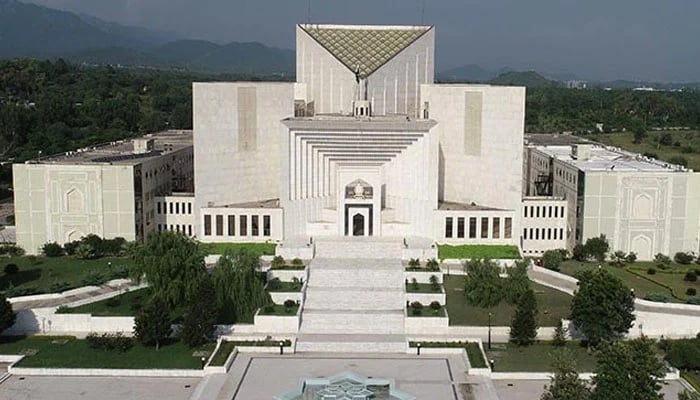
To implement any federal constitution, a Dispute Resolution Mechanism (DRM) is a prerequisite. DRM provisions exist in all constitutions worldwide. Due to the absence of effective DRMs, governments are ‘made’ or ‘un-made’ for and by vested interests. In the process, fundamental rights of ordinary citizens are sacrificed at the altar of autocratic expediency.
Pakistan’s constitution too provides two penultimate forums as DRMs: the Supreme Court of Pakistan and the Council of Common Interests. The ultimate forum remains parliament. However, both of these high forums historically failed to perform their constitutional roles (being unlawfully constituted). As a result, Pakistan faces insurgencies, disaffection and resentment amongst the federating units and between them and Islamabad. It is unending.
Unfortunately, the composition of the Supreme Court was manipulated. Thus, all dispute resolution is weighed in their favour and promotes their vested interests.
Article 184 of the constitution declares clearly that the Supreme Court, to the exclusion of every other court, shall have original jurisdiction in any dispute between two or more governments, whether federal and/or provincial. Similarly, Articles 155 and 157 declare unequivocally that water and electricity disputes between federal and provincial governments shall be resolved by the CCI. The decisions of the CCI can only be reviewed by a joint session of parliament. No court has jurisdiction to interfere in this process.
Our federation faces one festering crisis after another. When the rights of people under the constitution are trampled, they take the law into their own hands. Since the law won't protect them, they don't respect the law. Likewise, when the provinces are unable or reluctant to bring their disputes to the Supreme Court or the CCI, the cohesion within the federation falters. Chaos, instability, disaffection and insurgencies are signs of a suffering and increasingly tenuous federal bond.
The provinces never trusted these two penultimate constitutional forums; hence the demand for the Federal Constitutional Court in the Charter of Democracy (CoD). The very letter and spirit of our 1973 constitution requires that provinces must have an equal number of judges in the Supreme Court and an equal representation in the CCI. However, the composition of both these forums remained blatantly misrepresentative.
So, when an issue of provincial sovereignty arises and the provincial government does not bring the dispute to the Supreme Court, it proves that the Supreme Court and/or the CCI have consistently failed to deliver for the last 51 years. And it is time they are either abolished or replaced with more effective DRMs. The FCC creation ensures equal representation of provinces. But if Islamabad exerts executive control over it, the provinces would again be loath to bring their disputes.
The Supreme Court was primarily tasked with resolving disputes between two or more provincial or federal governments (Article 184), whereas the enforcement of fundamental rights lies within the jurisdiction of the provincial high courts, against which it could only hear appeals.
Article 184(3) entered the constitution in 1973. The constitution also categorically states that this jurisdiction of the Supreme Court in matters of public importance was without prejudice to the provisions of Article 199 (jurisdiction of high courts).
However, to distract from the loss of trust of the provinces, the Supreme Court cleverly assumed the discretionary powers of jurisdiction over the enforcement of fundamental rights under the guise of Article 184(3). This move was to appease an educated, albeit semi-informed, vocal, liberal, civil society agitating for human rights. This assumption of power by the Supreme Court is not provided for or given cover under the constitution. The chief justice of the Supreme Court (through an unconstitutional Law and Justice Commission created under a Zia-era ordinance) has the power to make policy for the provincial high courts.
This is in violation of the constitution. The district judiciary is subordinate to the high courts and not to the Supreme Court (Article 203). Only the provincial legislature can frame such policies for the respective high courts.
Visiting prisons or bringing reforms into the lower judiciary was not the job of the Supreme Court under our constitution. It is the exclusive domain of the provinces and the provincial high courts. The ‘doctrine of necessity’ cannot be applied, citing bad conditions in prisons or in the subordinate judiciary.
The Supreme Court's and the CCI's failures were among the main reasons for the signing of the Charter of Democracy in May 2006. PPP Chairman Bilawal Bhutto Zardari has been consistently warning about the absence of effective DRM, hence the need to establish a Federal Constitutional Court based on the equality of provinces. This has now materialised in the 27th Amendment.
Its second provision regarding the judiciary is the transfer of Judges from one high court to another. Although this is already provided, it required the consent of the concerned judge and was difficult to implement. In India, high court judges are transferred by the president. However, under the 27th Amendment, it provides for transfer by a 13-member Judicial Commission of Pakistan, and it shall also include both the chief justices of the high courts from where the judge is transferred.
Unfortunately, the opposition does not realise the grave constitutional challenge to our delicate federation if an effective DRM is not created forthwith. The challenge was a way bigger than what a ‘bench’ could handle. It required an effective, transparent Federal Constitutional Court, based on unequivocally authentic and equal representation of provinces which is now a reality.
The Council of Common Interests was reformed under the 18th Amendment and the prime minister was to lead it. It comprises eight members, including four chief ministers and one additional member each from the provinces. With one caveat: if a prime minister hails from a particular province then no other member could be appointed from that province other than its chief minister. At present, however, Punjab has four members, Khyber Pakhtunkhwa has two and Sindh and Balochistan one each. The legitimacy of the CCI is in tatters.
No province would bring its dispute to the Council of Common Interests (CCI), where it has only one-eighth representation. This is not only against the very letter and spirit of the constitution but also against universally established norms of dispute resolution. A case in point is the recent water dispute between Sindh and Islamabad. The Sindh government had to rely on its political strength rather than trust in the CCI.
The failure of the Supreme Court and the CCI enabled egregious manipulation of the electoral system and the installation of governments of choice in the provinces. The spirit of the federation continues to be damaged. Enormous power is wielded via the two penultimate forums for dispute resolution. However, the jurisdiction of Article 184 has now been transferred to the FCC.
In both DR forums, there has been a brazen and unconscionable violation of the constitution's letter and spirit. Provinces and citizens would now look to the FCC to meet their expectations and avoid being mired in old practices. The FCC needs to gain the confidence of the provinces and the people.
The writer has served as advocate general of Sindh. He tweets/posts @zamirghumro