ISLAMABAD: Pakistan and the 27-nation European Union (EU) spoke with one voice as they urged the “Afghan de facto authorities” to play a constructive role in achieving the shared goal of eliminating terrorism originating from the Afghan soil.
Pakistan remains the only immediate neighbour of Afghanistan that endures near-daily attacks from multiple terrorist groups operating inside Afghanistan under the patronage of Afghan de facto authorities.
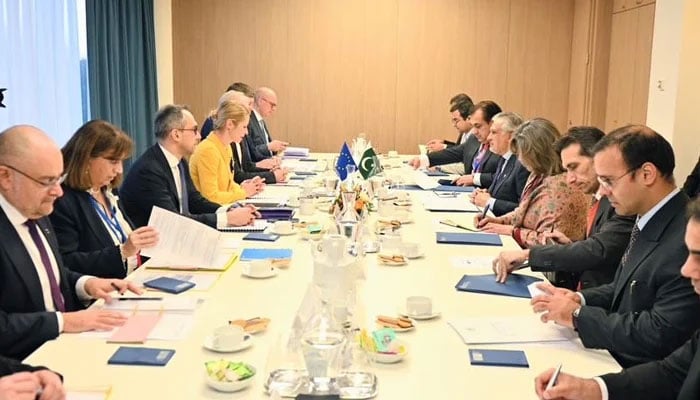
The strong reminder to Kabul was issued in a joint press communiqué following the seventh round of the EU-Pakistan strategic dialogue, held on Nov 21, 2025.
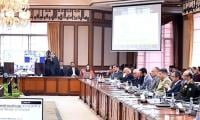
Deputy Prime Minister/Foreign Minister Senator Mohammad Ishaq Dar and the EU’s High Representative for Foreign Affairs and Security Policy and Commission Vice-President, Kaja Kallas, co-chaired the seventh round of the EU-Pakistan strategic dialogue in Brussels. “Expressing concern over Afghanistan’s worsening socio-economic situation, they supported a peaceful, stable and self-reliant Afghanistan contributing to regional stability, advocating a credible political process aligned with the UN-led ‘Doha process’ and consistent with commitments made by the Taliban de facto authorities to the international community,” said the communiqué released simultaneously from Islamabad and Brussels.
Another key issue was the joint emphasis by the European Union and Pakistan on Afghan girls’ education, a demand strongly supported worldwide. “Both sides called upon the Afghan authorities to ensure protection of human rights, especially for women, girls and vulnerable communities,” the communiqué added.
Pakistani leaders have consistently reminded the Afghan de facto authorities that education for girls is an Islamic right and a fundamental guarantee under Islam. Both sides also appreciated Pakistan for hosting millions of Afghan nationals for more than four decades.
However, the EU side stressed that any return must be safe, dignified and consistent with international standards.
In the background is the harsh reality that several European capitals which had earlier pledged relocation for vulnerable Afghans have now retreated, resulting in some Afghans being deported back to Afghanistan. Germany is one EU state which, influenced by far-right groups, is offering Afghans large sums of money instead of relocating them.
The meeting also provided, the communiqué noted, an opportunity to review EU-Pakistan bilateral relations, particularly cooperation under the EU-Pakistan Strategic Engagement Plan of 2019. Both sides agreed to further reinforce collaboration across all areas under the SEP with a view to aligning their broader strategic outlook.
“Both sides welcomed the timely convening of dialogue mechanisms and reaffirmed the importance of sustained cooperation across trade, migration, human rights, political, economic and development domains, including under the EU’s Global Gateway strategy. They agreed to deepen knowledge partnerships through Erasmus Mundus and Horizon Europe and to work jointly on emerging challenges relating to food and energy security and climate change,” the communiqué said.
The EU and Pakistan reiterated the importance of sustained collaboration to promote sustainable growth and expand trade opportunities. In this context, both sides expressed strong political commitment to the Generalised Scheme of Preferences (GSP+), a cornerstone of EU-Pakistan relations.
The High Representative/Vice President (HR/VP) briefed on the ongoing process for adopting a new Generalised Scheme of Preferences. Both sides reaffirmed their resolve to continue working closely for the universal promotion and protection of human rights and fundamental freedoms, consistent with their international obligations.
High Representative Kallas and Deputy PM Ishaq Dar reconfirmed the shared commitment of Pakistan and the European Union to multilateralism, principles of the UN Charter, rules-based international order, and pursuit of global peace, stability and prosperity rooted in shared values and common interests. They stressed the importance of close coordination on regional and global security issues.
Both sides underscored the need for peaceful resolution of conflicts, in full respect of international law and the UN Charter. The EU side briefed Pakistan on Russia’s war in Ukraine, while Pakistan outlined its position on the Jammu and Kashmir dispute.
They also reviewed the evolving situation in the Middle East and welcomed agreement on the first phase of the comprehensive plan to end the Gaza conflict, put forward by President Trump. They urged all parties to honour the ceasefire, implement all phases of the plan and avoid actions that could threaten the agreement. Both sides stressed the importance of Gaza’s stabilisation, transitional governance, recovery, reconstruction and unimpeded humanitarian access.
However, the dialogue stopped short of any explicit condemnation of Israel, whose military actions remain backed by several European capitals. Both sides nevertheless reaffirmed their support for concrete progress towards a two-state solution in line with relevant UN resolutions.