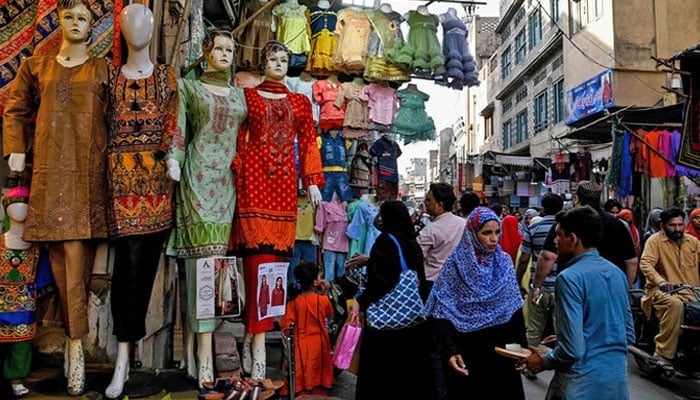
There is a quiet injustice unfolding in Pakistan’s markets, one so normalised that most consumers scarcely notice it. From razors to deodorants, products marketed towards women cost more than that for men.
This hidden surcharge has a name: the ‘pink tax’. It is not a formal tax levied by the government, but a structural one – and it shapes the financial realities of millions of women in Pakistan every single day.
The Pink Tax is not an abstract feminist grievance. It is a measurable economic penalty for being a woman. Over a lifetime, these small differences accumulate into significant financial loss, reducing women’s savings, wealth accumulation, and purchasing power. In a country where women earn 25 per cent less than men (ILO), face structural barriers to financial inclusion, and shoulder disproportionate unpaid care work – 60 per cent spending over 15 hours weekly versus less than 7.0 per cent of men – this invisible cost further deepens economic inequality.
A recent study has mapped this phenomenon empirically in Pakistan. Examining 72 products and services across 13 retail categories, the research found that women pay, on average, 30 per cent more than men for nearly identical goods. The price gaps were staggering in several cases: women’s haircuts and facials cost 88 per cent more than men’s; fitness wear, 64 per cent more; and girls’ clothing, 42 per cent higher than boys’. Even essentials like razors, deodorants and body washes, where the only visible difference is color or packaging, carried markups of 8.0 to 30 per cent.
Among the many forms of gendered pricing, the most glaring is the period tax – the state’s contribution to this inequity. By imposing heavy taxes on menstrual hygiene products, the government effectively penalises women for a biological process. From a jurisprudential standpoint, the right to health is intrinsically linked to the right to life (Article 9) and dignity (Article 14), as health is essential for both.
Article 25 guarantees equality before the law and prohibits discrimination on the basis of sex. Article 37 emphasises social justice, while Article 38 mandates that the state provide basic necessities, including medical care, to citizens facing infirmity or illness. Together, these provisions underscore the importance of protecting women’s health and rights, particularly in the context of menstruation and related health issues. Yet, they often remain confined to the rhetoric of constitutional ideals rather than lived realities.
At the heart of this inequity lies a toxic mix of policy indifference and commercial exploitation, compounded by the absence of laws against gender-based pricing, consumer protections, and formal debate on taxing women’s necessities. The Sales Tax Act, 1990, applies a flat 18 per cent General Sales Tax (GST) on most goods, treating luxury perfumes and sanitary pads alike. Menstrual hygiene products, essential for women’s health and dignity, are excluded from this law’s exempt or reduced-rate schedules. Consequently, sanitary pads face an effective tax burden of about 40 per cent once import duties, regulatory charges and GST are combined.
This burden falls heavily on Pakistan’s 62 million women of reproductive age, yet only a small fraction can afford commercially manufactured sanitary pads. Only about 12 per cent of these women currently use commercially manufactured sanitary napkins, while 66 per cent use cloth and, among them, 49 per cent rewash and reuse it, according to a WaterAid and Unicef study on schoolgirls in South Asia. With an average monthly income of Rs35,000 and a pack of pads costing Rs450, menstrual hygiene remains out of reach for many. A 2023 study found that most girls feel embarrassed discussing menstruation and lack information before their first period, leading to poor hygiene, social exclusion, and missed school days. Many women resort to unsafe alternatives, risking infections and health complications.
On the other hand, globally, governments have begun to recognise and correct this inequity. Kenya abolished VAT on menstrual products as far back as 2004 and allocates millions annually for free sanitary pad distribution in schools. The UK, India and South Africa have all zero-rated menstrual products. Scotland went a step further, passing a landmark law in 2021 guaranteeing free access to period products for all menstruating individuals. Forty-nine countries have already reformed their tax structures to classify menstrual products as essential goods. Pakistan, by contrast, remains a laggard, still taxing periods like a luxury.
The Pink Tax persists due to deep social and institutional blind spots that equate femininity with beauty and upkeep, enabling companies to market everyday products for women as premium. Price Discrimination and Cultural Capital theories reveal how firms exploit women’s perceived willingness to pay more and how social expectations reinforce this behaviour. Beyond corporate practices, the state compounds the injustice by taxing women’s bodies.
Taxing women’s bodies is one of the heinous manifestations of economic GBV and GBD, creating period poverty, perpetuating harmful stigma and exacerbating economic inequality for those who menstruate. Ironically enough, the perpetrator in this case is not a single man but an entire state machinery with a patriarchal mindset dating back ages, projected onto national fiscal policies.
Against this egregious backdrop, a Public Interest litigation was put forward by a lawyer, Mahnoor Omer before the Lahore High Court (Rawalpindi Bench) recently wherein she has challenged the ‘period tax’ on the grounds of it being discriminatory and ultra vires to the fundamental rights to life, dignity, equality and social justice due to discriminatory tax policies and non-compliance with multiple international treaties. The judgment could prove to be a revolutionary precedent in Pakistan’s history.
To address these challenges at the policy level, removing the Pink Tax requires a multi-layered response. Policymakers must begin by zero-rating menstrual hygiene products under the Sales Tax Act. Parliament should consider introducing a clause explicitly prohibiting gender discriminatory pricing practices in consumer protection laws. At the same time, provincial revenue authorities need to review service tax regimes that disproportionately affect female-oriented industries, such as salons and spas.
But legislation alone will not suffice. Awareness is equally critical. Consumer advocacy groups and financial literacy campaigns can educate women about price differentials, encouraging smarter consumption and collective resistance. Educational institutions can integrate discussions on gendered economics into curricula, linking taxation and pricing to broader themes of equality. Feminist movements must also play their part in challenging fiscal injustice and amplifying women’s voices.
Also, civil society and youth networks should mobilise for menstrual equity, pushing policymakers toward fairer fiscal practices. A silver lining in this regard is Mahwari Justice – a student-led period rights organisation founded in 2022 by Bushra Mahnoor – which has filled this vacuum and successfully provided period relief to over 150,000 people. Women should not have to pay for the failures of an unequal tax system, one where elites evade taxes while the marginalised bear the burden. Above all, women must continue to speak, write and litigate, transforming invisible indignities into public issues.
The Pink Tax may appear trivial when viewed in isolation, yet cumulatively, it represents the monetisation of gender bias. It is the quiet arithmetic of inequality, adding up to a lifetime of diminished agency. As other nations move towards fairness, Pakistan must ask itself: why is womanhood still so expensive here? Maybe we can stop taxing it.
Furqan Ali is a Peshawar-based researcher who works in the financial sector. He can be reached at: [email protected]
Amna Khan is a practising lawyer and legal researcher. She can be reached at: [email protected]