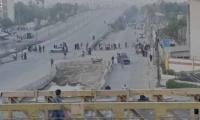
PESHAWAR/ISLAMABAD/LAHORE: Relations between Pakistan and Afghanistan have plummeted to an all-time low, as at least 23 Pakistani soldiers were martyred and more than 200 Afghan Taliban and their affiliated terrorists were killed in fierce overnight clashes along multiple points at the Pak-Afghan border, the Inter Services Public Relations (ISPR) said in a statement on Sunday.
The clashes began late Saturday night when the Afghan Taliban and allied militants launched unprovoked and indiscriminate attacks on Pakistani border posts.
“Exercising their right to self-defence, Pakistan’s armed forces responded with precision strikes and physical raids, decisively repelling the aggression and inflicting heavy casualties on the attackers. More than 200 Afghan Taliban and affiliated terrorists have been neutralised, while the number of injured is much higher,” the statement said.
The “cowardly action” was aimed at destabilising Pakistan’s border regions to facilitate terrorism under the designs of Fitna al-Khwarij (FAK) and Indian-sponsored elements.
“On the night of 11/12 October 2025, Afghan Taliban and Indian-sponsored Fitna al-Khwarij launched an unprovoked attack on Pakistan along the Pak-Afghan border. The cowardly action, which included fire and a few physical raids, was aimed at destabilising the border areas to facilitate terrorism, furthering FAK’s nefarious designs,” the ISPR added.
Pakistan’s armed forces, while exercising maximum restraint, targeted Taliban camps, terrorist training facilities, and support networks operating from Afghan territory, including elements linked to Fitna al-Khwarij (FAK), Fitna al-Hindustan (FAH), and ISKP/Daesh.
“All possible measures were taken to avoid collateral damage and to protect civilian lives,” the statement noted.
As a result of the retaliatory operations, multiple Taliban locations were destroyed along the border, and 21 hostile positions on the Afghan side were briefly captured.
“During the overnight skirmishes, 23 brave soldiers were martyred and 29 injured,” the ISPR said, adding that the infrastructural damage to Taliban posts, camps, and networks ranged from tactical to operational depth.
Fresh clashes between Pakistan and Afghanistan have plunged bilateral relations to a new low, as Pakistan’s firm military response to cross-border aggression has not only repelled multiple attacks but also reasserted its control along key frontier sectors.
The confrontation began three days ago following reports of alleged Pakistani air operations near Kabul, which Afghan officials claimed targeted Tehreek-e-Taliban Pakistan (TTP) chief Mufti Noor Wali Mehsud. While Kabul accused Islamabad of violating its airspace, Pakistan maintained that the strikes were intelligence-based operations directed against militant groups orchestrating terrorist attacks inside Pakistan from the Afghan soil.
Following the escalation, Pakistan sealed all major border crossings with Afghanistan, including Torkham in Khyber, Chaman–Spin Boldak in Balochistan, Angoor Adda in South Waziristan, Ghulam Khan in North Waziristan, and Kharlachi in Kurram, after Afghan border forces resorted to unprovoked firing.
The closures have brought bilateral trade and transit movement to a standstill, leaving hundreds of vehicles stranded on both sides.
The ISPR termed the attacks a grave provocation, noting that they came at a time when the Taliban foreign minister was visiting India, described as “the biggest sponsor of terrorism in the region.”
The statement called upon the Taliban government to take an immediate and verifiable action against terrorist groups operating from its territory, including FAK, FAH, and ISKP/Daesh, warning that “Pakistan will continue to exercise its right to defend its people through persistent neutralisation of terror targets.”
“The people of Pakistan prefer constructive diplomacy and dialogue over violence and belligerence, but we will not tolerate the treacherous use of Afghan soil for terrorism against Pakistan,” the statement said, reaffirming that the armed forces remain fully prepared to protecting the country’s territorial integrity and ensuring the safety of its citizens.
Meanwhile, the Taliban government rejected Pakistan’s account of the clashes, claiming to have inflicted heavy losses on Pakistani forces.
Zabihullah Mujahid, spokesman for the Afghan Taliban, told reporters at a press conference in Kabul that 58 Pakistani soldiers were killed and dozens injured, while nine Taliban fighters lost their lives.
He also claimed that over 25 Pakistani military posts were destroyed and weapons seized by Taliban fighters. Islamabad categorically rejected the Taliban’s claims as “completely false and baseless,” maintaining that Pakistan’s losses and operational outcomes were accurately reflected in the ISPR’s official statement.
The ISPR reiterated that Pakistan’s resolve to defend its borders and eliminate terrorism remains unshaken, stressing that the state and the people of Pakistan will not rest until the terrorism emanating from Afghan soil was completely eradicated.
Muhammad Saleh Zaafir adds: Pakistan will not allow Afghan Foreign Minister Mullah Amir Muttaqi to use its airspace while returning to Kabul from New Delhi on Tuesday, well-placed aviation sources told The News/Jang late Saturday evening.
Muttaqi traveled to New Delhi on his maiden visit from Moscow on Thursday.
Sources said Muttaqi had planned to travel by an Indian special plane.
Pakistan has forbidden the use of its airspace for Indian planes through a NOTAM.
The Indian aviation asked Kabul to obtain permission from Islamabad as a special case for permission to the special plane carrying Afghan foreign minister.
Sources said the recent adverse developments and obnoxious observations given in the joint communique on the conclusion of Muttaqi’s visit constrained Pakistan to disallow the Indian plane from using Pakistan’s airspace.
Meanwhile, the Foreign Office of Pakistan Sunday expressed its deep concern over the unwarranted aggression by the Afghan Taliban, Fitna-e-Khwarij and Fitna-e-Hindustan along the Pak-Afghan border on the night of 11-12 October.
In a statement, the Foreign Office said, “Such unprovoked actions aimed at destabilising the Pak-Afghan border belie the overall spirit of peaceful neighbourhood and cooperative relations between the two brotherly countries.
“Pakistan, exercising its right of self-defence, not only effectively repulsed the assaults all along the border, but also inflicted heavy losses on Taliban forces and affiliated Khwarij, in terms of men, material and infrastructure. These infrastructures were used to plan and facilitate terrorist attacks against Pakistan. In our targeted and precise response, all possible measures were taken to prevent any collateral damage and protect civilians.
“Pakistan greatly values dialogue and diplomacy and a mutually beneficial relationship with Afghanistan. At the same time, the Government of Pakistan continues to closely monitor the situation and would take all possible measures to safeguard its territory and the lives of its people. Any further provocations would be met with an unwavering and befitting response.”
The statement further said, “Pakistan strongly rejects assertions and insinuations by the interim Afghan foreign minister in India to divert attention from the presence of terrorist elements in Afghanistan.
“By making these baseless assertions, the Taliban regime cannot absolve itself of its responsibilities toward regional peace and stability. Continued presence of terrorist elements on Afghan soil and the freedom of activities enjoyed by them in Afghanistan are well documented in UN Monitoring Team reports.
“The fight against terrorism is a common cause. Instead of shifting responsibilities, the Taliban regime should honour its commitment of not allowing its territory to be used for terrorism against other countries, as well as play its due role for achieving peace and stability in the region and beyond.
“Pakistan has repeatedly shared its concerns related to the presence of Fitna-e-Khwarij and Fitna-e-Hindustan operating from Afghan soil. Pakistan expects concrete and verifiable actions against these terrorist elements by the Taliban regime.
“Pakistan, in the spirit of good neighbourliness, Islamic brotherhood, and humanity, has generously hosted around four million Afghans for more than four decades. Pakistan will take all actions to regulate the presence of Afghan nationals on its territory, in accordance with international norms and laws.
“Pakistan is desirous of a peaceful, stable, friendly, inclusive, regionally connected, and prosperous Afghanistan. Pakistan expects the Taliban regime to act responsibly, honour its commitments, and play a constructive role in achieving the shared objective of rooting out terrorism from its soil. We also hope that one day, the Afghan people would be emancipated and they would be governed by a true representative government.”
Asim Yasin adds: President Asif Ali Zardari Sunday reaffirmed that Pakistan remained firmly committed to safeguarding its national interests, regional sovereignty and security.
The president said Pakistan will never accept any disputed or misleading position on Jammu and Kashmir, reiterating that India’s unlawful claims over the territory were contrary to the international law and the United Nations Security Council resolutions.
Zardari said it was unfortunate that the current Interim Afghan administration had turned away from the just struggle of the oppressed people of Indian Illegally Occupied Jammu and Kashmir, thereby doing injustice to both history and the Muslim Ummah.
He noted that the attacks launched from the territory of the interim Afghan government by India-backed Khwarij terrorists were a well-documented reality, confirmed in successive United Nations Security Council monitoring reports.
Pakistan, he said, had repeatedly made it clear that its civilians and security personnel were being targeted through the nexus of the Indian sponsored Khwarij and other terror groups.
Zardari urged the Afghan government to take a concrete and verifiable action against anti-Pakistan terrorist elements operating from the Afghan soil. He emphasized that the terror menace of the Khwarij and other terror groups sponsored by India remained the greatest threat to regional peace and stability.
“Terrorism is a shared challenge and its burden cannot be placed on any single country,” the president remarked. He said Pakistan had demonstrated Islamic fraternity and exemplary neighbourliness by hosting millions of Afghan refugees for over four decades.
The dignified repatriation of Afghan citizens, he added, was in the interest of both countries and essential for sustainable peace.
Zardari reaffirmed that Pakistan will continue to support the educational and humanitarian needs of the Afghan people, but will make no compromise on its national sovereignty.
He recalled that Pakistan had extended every possible facilitation to Afghanistan in trade, economic connectivity, and people-to-people exchanges. Mutual cooperation and economic partnership, he said, were the foundation for lasting peace and regional prosperity.
Zardari underscored that Pakistan desired a peaceful, stable, and prosperous Afghanistan.
Prime Minister Shehbaz Sharif Sunday paid a glowing tribute to the Pakistan Army for its effective and comprehensive response to Afghanistan’s recent provocations and successfully targeting the hideouts of terrorists operating from the Afghan soil and involved in attacks against Pakistan.
In a statement, he deeply appreciated the armed forces’ professionalism and dedication in safeguarding the nation’s borders. He also paid homage to the 23 security personnel, who embraced martyrdom during the successful counter-terrorism operations. He prayed for the elevation of the ranks of martyrs and extended heartfelt condolences to their families.
He also prayed for the speedy recovery of all security personnel injured in the operations against terrorists. “I am proud of the professional excellence of the Pakistan’s armed forces,” the prime minister stated, reaffirming that there would be no compromise on Pakistan’s defence, and every act of provocation would be met with a strong and effective response.
He said the Pakistan Army always gave a befitting reply to every kind of external aggression, adding that the entire nation stood shoulder to shoulder with the security forces in defending Pakistan’s sovereignty and territorial integrity.
The prime minister further said that Pakistan had repeatedly shared information with the Afghan authorities about the presence of terrorist elements such as Fitna-e-Khwarij and Fitna-e-Hindustan, who were using the Afghan territory to launch attacks against Pakistan.
He noted that certain elements within Afghanistan were supporting these terrorist organizations, urging the Afghan interim government to ensure that its soil was not used by any group or individual to carry out terrorism against Pakistan.
In a statement, PPP Chairperson Bilawal Bhutto Zardari expressed deep concern over the recent situation along the Pak-Afghan border and called upon the Afghan authorities to act with restraint and responsibility in the interest of regional peace.
“Unprovoked aggression by the Afghan forces along our border poses a serious threat to regional peace and stability, while undermining collective efforts toward shared prosperity,” he said.
He emphasized that Pakistan’s armed forces had responded with resolve, restraint, and professionalism, reflecting Pakistan’s enduring commitment to peace and stability while safeguarding every inch of the national territory and protecting civilian lives.
“Pakistan desires a peaceful, stable, and prosperous Afghanistan. We urge the Taliban leadership to engage in practical, result-oriented dialogue and cooperation to secure enduring peace and stability in our shared neighborhood,” he said.
PPP Vice President Senator Sherry Rehman Sunday strongly condemned the unprovoked firing from the Afghan side at the Pak-Afghan border, calling it an unacceptable act of aggression.
“Any form of aggression against Pakistan’s sovereign territory will not be tolerated. Pakistan reserves the right to defend itself,” she said in a statement.
“I pay tribute to our security forces for foiling the nefarious intentions of the enemy. The strategy adopted by our armed forces to prevent the movement of terrorists is commendable,” she added.
Senator Sherry further stated, “The Pakistan Army has effectively destroyed several Afghan check posts and inflicted heavy losses on external terrorists.”
Meanwhile, Pakistan’s armed forces neutralised over 50 Afghan posts and gained control of 20 border positions during the recent military operations, utilising advanced drone technology and sub-tactical warfare strategies.
According to a well-placed defence source, Pakistan used less than 0.01 percent of its military capability during the strikes and maintains the operational capacity to continue such actions indefinitely.
“Pakistan can do this with terrorists hiding in Afghanistan forever,” the defence source said, underscoring the limited yet effective use of military assets in the conflict.
Unlike the recent conflict with India, where Pakistan deployed Multi Domain Operations (MDO) involving conventional warfare tactics, the Afghan operations relied on sub-tactical warfare targeting non-state actors and decentralised enemy structures. MDOs are generally used against state militaries, the source explained, whereas operations in Afghanistan were executed almost entirely using UCAVs (Unmanned Combat Aerial Vehicles).
Pakistan deployed the newly introduced Battle Field Management System (BFMS), a software platform that integrates real-time intelligence from ground and air forces. The BFMS enabled command units to determine optimal attack strategies based on HUMINT (human intelligence). Artillery units were also integrated into the system and were used effectively to neutralise border positions of the terrorists.
The source disclosed that four types of drones were employed in the strikes: the Turkish-made Akinci and Bayraktar TB-II, the Chinese Wing Loong II, and Pakistan’s indigenous Shahpar-III Block 2. These platforms were primarily responsible for targeting and destroying enemy hideouts and border posts.
Fighter jets provided aerial reconnaissance to assist UCAVs in locating hidden posts and artillery. In addition, Killer Drones — described as capable of speeds up to 400 kilometers per hour — were used to eliminate individual high-value targets with precision.
Most operations were led by the Pakistan Army’s Drone Command, with tactical support from other branches. Larger targets were taken out by UCAVs, while smaller objectives and personnel were handled by Killer Drones.
On the Balochistan-Afghanistan border, Pakistan utilised Al-Zarrar (Type 56) tanks in place of artillery to dismantle Taliban positions and posts.
The source emphasized the technological edge in these operations and hinted that Pakistan remains capable of sustained, targeted strikes if required.