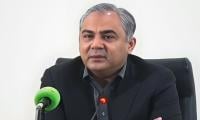
ISLAMABAD: Pakistan and China have shared their security concerns in recent meetings with Afghanistan, stated Deputy Prime Minister and Foreign Minister Ishaq Dar at a press conference at the Foreign Office on Friday.
“Pakistan and China both have security concerns. We clearly told Afghanistan either take decisive action against the TTP [Tehrik-i-Taliban Pakistan], or hand them over to us. The Afghan government has included hundreds pro-TTP elements into its governance fold,” he said, clearing hinting at an all-time low in bilateral ties.
Dar pointed out that he was told during a bilateral meeting with Acting Afghan Foreign Minister Amir Khan Muttaqi in Kabul that Afghanistan had set up 700 border posts to impede cross border infiltration.
“I do not doubt their intentions neither has there been any resistance from the Afghan side on our proposals of action against the TTP. We only had this one demand — action against the TTP,” he added.
When asked about Thursday’s demarche by Afghanistan handed to Pakistan’s ambassador in Kabul, Dar did not outright deny that Pakistan had carried out drone strikes inside Afghanistan.
He responded that there should be investigations regarding Afghanistan’s allegations but, “I have been busy and read through the demarche this morning,” he said.
Afghanistan on Thursday summoned Pakistan’s ambassador in Kabul to lodge a formal protest against, what it claimed, were Pakistani military strikes in Nangarhar and Khost provinces.
In reply to a question about not having a joint statement for the trilateral meeting between China, Pakistan and Afghanistan, Dar replied by saying that the modes of modern diplomacy were changing, each country has spoken to the Press of their own country which is as good as a joint statement. “This should not have any negative impact,” he added.
The foreign minister revealed that China in principle has accepted Pakistan’s proposal to extend CPEC to Afghanistan and they would also consider linking Kabul to Peshawar Highway. While in London, Dar said, he met with Kashmiri leaders and Indus Waters Treaty experts.
He said that Pakistan International Airlines (PIA) is set to commence direct flights from Manchester by September this year.
The foreign minister clarified remarks attributed to him and said that he had clearly stated the government has no authority over the judiciary, when a question regarding jailed leader of Pakistan Tehreek-e-Insaf Imran Khan was raised.
Dar remarked that anyone misunderstanding his statements due to lack of English proficiency should make efforts to learn the language.
Also in a major diplomatic breakthrough, Pakistan is considering full diplomatic relations with Armenia. Pakistan presently is the only country in the world that has not recognised Armenia.
In this regard, Dar said he had held a cordial conversation on telephone with Armenia Foreign Minister Ararat Mirzoyan, and agreed to consider establishing diplomatic relations between Pakistan and Armenia.
“We have been on the side of Azerbaijan, and with Karabakh issue settled, we will consider positively and it will be fast tracked,” said Dar.
On bilateral relations with India, Dar clearly stated, “If India wants to talk, we will have a composite dialogue and not on terrorism only, it will be on equal footing and with mutual respect.”
Later, in a statement, the Foreign Office said that on the invitation of Chinese President Xi Jinping, Prime Minister Shehbaz Sharif is visiting China from Aug 30 to Sept 4 to attend the Shanghai Cooperation Organisation Council of Heads of State Summit being held in Tianjin.
In China, the prime minister would hold meetings with President Xi Jinping and Premier Li Qiang during which multifaceted dimensions of Pakistan-China bilateral cooperation would be discussed.
He would also attend the military parade with President Xi and other world leaders being held in Beijing to commemorate the 80th anniversary of the World’s Anti-Fascist War.
The prime minister would interact with reputed Chinese businessmen and corporate executives to discuss bilateral trade, economic and investment ties. He would also address a Pakistan-China B2B Investment Conference in Beijing.
“The visit is a part of leadership-level exchanges between Pakistan and China. It manifests the importance attached by the two countries to further deepen their ‘All Weather Strategic Cooperative Partnership’, reaffirm support on issues of respective core interests, advance Phase-II of CPEC, and maintain regular communication on important regional and global developments,” said the statement.
APP adds: Foreign Minister Dar said that at the Atlantic Council, his remarks on judicial independence were “misinterpreted” by local political actors.
“The judiciary operates independently in Pakistan. Twisting English remarks for political mileage is unfortunate,” he clarified.
In Bangladesh (August 23, 24), Dar engaged with top leadership from all major parties, including the Bangladesh National Party (BNP) and Jamaat-e-Islami, in a rare full-spectrum diplomatic outreach.
However, six MoUs in multiple domains were signed, including visa waivers, trade cooperation and cultural exchange. He also pushed for Saarc’s revival, stating Bangladesh was supportive but “one state’s resistance remains a hurdle”.
During his August 17-19 visit to the UK, Dar met with Deputy PM Angela Rayner, parliamentarians and the Commonwealth secretary-general, launching major diaspora-focused services at the Pakistan High Commission in London, including: digitised Punjab land records, and ‘’One-Window’’ passport issuance system. Dar confirmed that Pakistan and China will celebrate 75 years of diplomatic relations in 2026, with a series of cultural and economic events planned.
He revealed China’s growing interest in agriculture, mining and industrial investment, and confirmed that 1,000 Pakistani graduates are being sent to China for advanced agricultural education.
Pakistan’s position on “One China Policy” remains unchanged, Dar stressed, noting China’s consistent support on Kashmir in return.
Whether engaging in global peace forums, regional trade initiatives, or conflict mediation, Pakistan, he said, “is back on a confident and proactive diplomatic track.”
“We are not just reacting, we are shaping regional conversations and global dialogues,” Dar concluded.
“Our foreign policy is rooted in principle, backed by experience, and aligned with the aspirations of the Pakistani people.”