KARACHI: Lawyers are divided on the Friday judgment by the SC, some calling it ‘ironic’ while others hailing it as a much-needed correction to constitutional and electoral norms.
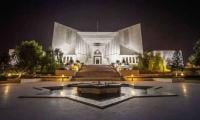
On Friday, the Supreme Court’s Constitutional Bench dismissed the PTI’s petitions in the reserved seats case, declaring that the party is not eligible for them in the national and provincial assemblies.
“The judiciary in Pakistan has historically largely upheld undemocratic interventions, and today marks yet another occasion where an unrepresentative legislature has been imposed on the people”, says Barrister Rida Hosain, adding that “by granting the ruling alliance a greater share of reserved seats, a post-election exercise has altered the election results”.
Regarding what would ‘technically’ be the ‘right’ judgment here, Supreme Court advocate Basil Nabi Malik tells The News that the case can’t really be seen “from the prism of mere technicality. Even if there is a flaw in the judgment, any correction of a flaw that perverts the democratic process and frustrates the will of the people and the representative nature of the process is sheer absurdity”.
Malik says that “settled constitutional principles dictate that any judgment or verdict should do complete justice and ensure and preserve the constitutional order.” So, for him, while the original judgement “did venture much further than would reasonably be expected, to undo the entire basis of the said judgment and disenfranchise a large segment of the public is certainly ironic”.
For Barrister Ali Tahir, on the question of whether this is it for the PTI, the answer is: not really. He says that a study of Pakistan’s constitutional history makes one thing clear -- “nothing here is ever final”. This does not seem like the end of the road for the PTI, though “there’s no doubt the party has suffered a major setback”.
One way this may not be the end of the road could be the case challenging the 26th Amendment, says Tahir, who thinks that if the “amendment is declared ultra vires, then the Friday verdict will also become null and void”.
Friday also saw a lot of conversation regarding the final number of judges on the bench. Would that be a valid critique? Barrister Tahir seems to think so, explaining that the bench was not “properly constituted” since, after Justice Salahuddin Panhwar recused himself, “the bench was reduced to 12 judges, whereas the original decision was issued by a 13-member bench. A smaller bench cannot review the decision of a larger bench. Also, how can a majority decision be reviewed by judges who were in the minority of the original ruling?”
Tahir says that “numerically and constitutionally, the earlier decision by the larger bench still holds more legal authority and should therefore still hold the field”.
But now what? “There’s only one way to undo this: the full court must hear the matter and reverse it” explains Tahir, who also cautions that “until the 26th Amendment and the current Practice and Procedure committee structure are in place, I don’t see that happening”.
However, Supreme Court attorney Hafiz Ahsan Ahmad Khokhar likes the verdict, saying the court has now “rectified the legal and constitutional error in its earlier pronouncements and restored coherence to the scheme of electoral representation”. According to him, the judgment “has correctly applied the constitutional provisions governing reserved seats, particularly Articles 51 and 106. The judgment has also rightly interpreted and enforced the relevant statutory provisions of the Elections Act, 2017 -- especially Sections 66 and 104 -- and Rule 95 of the Election Rules, 2017”.
Rules are rules, says Khokhar, elaborating that there is a “comprehensive constitutional and legal framework for the allocation of reserved seats for women and non-Muslims” and that courts have “consistently held that non-compliance with the election schedule and statutory requirements renders a political party ineligible for such representation... Parties with no parliamentary presence cannot acquire reserved seats by absorbing independent candidates post-election”.
Responding to what legal recourse the PTI may have been left with, high court advocate Hassan Abdullah Niazi says that “as far as the judicial process is concerned, the PTI has no further avenue left to agitate its claim for reserved seats. A review is the final adjudicatory process that can be taken regarding a Supreme Court judgment and now no other judicial forum is left for the PTI to take up this case since under our constitutional scheme, there is no further appeal from an order passed by the Supreme Court of Pakistan in review”.
Niazi says the Friday ruling will “likely be implemented at lightning speed this time around” and calls this “significant” because it paves the way for “future constitutional tinkering akin to the one that gave rise to ‘constitutional benches’ and the selection of chief justices.”
“We got a set of “innovative ‘firsts’” says Niazi: “a 12-judge bench overrules a decision of 13 judges; a case in the court’s limited ‘review’ jurisdiction is heard as if it was an appeal; and, a review petition is heard without the author judge being present in the bench. This completely contradicts a plethora of judgments that lay down how the law of precedent and review works in Pakistan”.
On the issue of who gets to keep the newly-again available reserved seats. PILDAT President Ahmed Bilal Mehboob tells The News that the reserved seats will “go to the parties other than the PTI / SIC in proportion to their strength in the national and three provincial assemblies of Punjab, Sindh and Khyber Pakhtunkhwa”.
This is also important because reserved seats can’t be “kept vacant indefinitely”, adds Mehboob who says that this will also now lead to “the election to 12 vacant Senate seats by the KP Assembly”.
Journalist Majid Nizami adds that regarding these reserved seats, there’s already a notification by the Election Commission of Pakistan from last year which they will now restore. “So PML-N, PPP and other parties will get these seats”. Nizami points to the absurd in all this: “There is an element of the bizarre in all this though. For example, in KP in a house of 145 only 22 belong to the opposition but now these 22 will be given 30 reserved seats...that’s odd”.