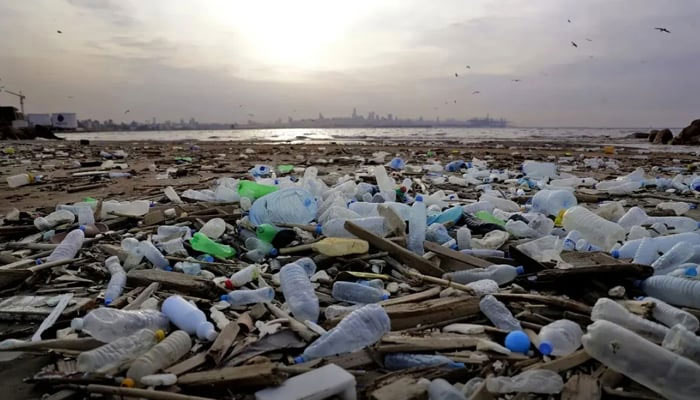
The theme of today’s World Environment Day 2025 is ‘End Plastic Pollution’. This year, the Republic of Korea will host ‘World Environment Day’ to advocate and urge nations to end plastic pollution. This day is celebrated to create public awareness and encourage governments to take concrete steps against plastic pollution.
Plastic pollution is a global problem that requires immediate action to control its impacts on our planet. According to the United Nations Environment Program, “every year 19-23 million tonnes of plastic waste leaks into aquatic ecosystems, polluting lakes, rivers and seas”. It also creates challenges of the degraded ecosystem, alteration in habitat, threats to marine life, human health challenges affecting food production capability, livelihood and environmental damages. According to the UNEP, every year, 19-23 million tonnes of plastic waste leak into aquatic ecosystems, polluting lakes, rivers and seas.
Pakistan is also facing the challenge of plastic pollution. One non-biodegradable plastic bag takes thousands of years to decompose completely. The small pieces and particles remain in the water bodies and soil, choking water animals and contaminating soil. According to the UNDP, “with plastic use increasing by 15 per cent annually – largely driven by single-use products – and plastic making up nearly 40 percent of solid waste in the Indus River, the country faces mounting environmental and public health challenges”.
These plastic bags also block drainage systems to prevent water flow during the rainy season, causing urban flooding. They remain in the air and on roadsides, making the surroundings ugly and unclean. According to the UNEP, “this plastic pollution aggravates the triple planetary crisis of climate change, nature and biodiversity loss, and pollution and waste”. The WWF states, “250 million tons of garbage in Pakistan primarily consists of plastic bags, pet bottles and food scraps”.
According to the World Economic Forum, “In 2019, Pakistan became one of 128 countries with a single-use plastic (polythene) bag ban in place. Pakistan’s ban halted the production of 600,000 kilograms per annum. Pakistan is also taking several initiatives to curb the use of plastic under its National Plastic Action Partnership (NPAP), launched with the support of the UNDP and the World Economic Forum in 2022, to reduce plastic pollution in Pakistan.
The Pakistan National Action Roadmap, a cornerstone of NPAP’s activity, outlines a comprehensive strategy to reduce mismanaged waste by 75 per cent in Pakistan by 2024. The key measures include launching a Plastic Circularity Network, supporting micro, small, and medium-sized enterprises, strengthening waste collection and recycling systems, and rolling out public education campaigns and financial incentives by involving all stakeholders in the plastic value chain, including governments, civil society, academia and the informal economy.
However, we still need to adopt a multifaceted strategy to phase out plastic bags from Pakistan completely. The best methods to reduce plastic use include laws and policy interventions, behaviour change and awareness campaigns. These strategies can be designed and implemented on the principles of refuse, reduce, reuse, recycle and rethink.
First, we must focus on the consumption and production of single-use plastic bags. On the production side, the containment of materials and equipment required to produce single-use plastic bags and bottles can be ensured through proper monitoring and checking mechanisms. Once the supply is reduced, stores, food outlets and small vendors will automatically identify alternative means.
Similarly, on the consumer side, a decrease in demand will also reduce supply. In Pakistan, famous outlets, stores and food chains have already started providing biodegradable shopping bags by adding a minimal cost to the bill. This extra cost of shopping bags also encourages consumers to reuse them. Small vendors still use non-biodegradable plastic bags due to a lack of awareness and the unavailability of cheap alternatives. An awareness campaign for small vendors and shopkeepers should be launched with some affordable and subsidised options.
Other plastics, like bottles and packaging materials, also require immediate attention. The full cycle of plastic from every stage, from production, consumption, reuse and recycling, should be focused on accelerating efforts to end the use of plastics through the collective efforts of government, businesses, and consumers.
We must promote indigenous research to produce innovative solutions to phase out plastic. Education and awareness campaigns can be important tools to generate public awareness about the impacts of plastics on our surroundings. Another significant step can be proper waste collection, segregation, and management, which can help reduce the impact of plastic on our ecosystem and planet. In our personal capacity, we should adopt the habit of using bags and bottles that can be reused and recycled. Online shopping involves extra packaging material and carbon emissions in the delivery and transportation. So, physical shopping can also help reduce plastic utilisation.
In addition, eating at home or physically in food outlets rather than home delivery can also reduce the cost of plastic use. Zero Waste Stores, also known as refillers, are a rapidly growing market of bulk retailers that utilise the ‘weigh-and-pay’ method. This method also helps reduce the consumption of plastic. Buying local products will also reduce plastic pollution caused by international transportation. The habit of repair and less shopping can further minimise plastic use and waste in our daily lives.
World Environment Day 2025 calls for our attention towards the negative impacts of plastic pollution on our environment and socio-economic damages. We need to strengthen our efforts at the international, national and local levels to fight plastic pollution.
The writer is a graduate of the University of Oxford in Public Policy. She tweets/posts @zilehumma_1 and can be reached at: [email protected]