Print Story
X




A monumental new edition of Miraas preserves an oral tradition
| E |
Evidence suggests that Balochi poetry originated in the latter part of the Fifteenth Century, during the era of Mir Chakar Khan Rind. However, this claim remains open to debate. Some argue that a language in its early stages may lack the refinement needed to express complex or subtle ideas, or that poetry itself cannot attain such sophistication during its formative phase. Since research has not yet extended beyond the poetry of that era, we must, for now, accept that the earliest body of Balochi poetry dates back to the Fifteenth Century.
As Balochi had not yet developed as a written language at the time, this poetic tradition was preserved and transmitted orally through generations by performers and minstrels known in Balochi as domb or pahlawan. They were not mere performers but storytellers, historians and custodians of collective memory, carrying the essence of Baloch identity from one generation to the next.
Orientalists played a notable role in preserving this poetic heritage in written form. Among them, LW Dames’s seminal work Popular Poetry of the Baloches is regarded as one of the most authoritative references on the subject. Whatever political motives may have underpinned the research, it helped preserve much of this literature, which had until then survived only in people’s memories. The transcriptions provided a foundation for later scholars to study the linguistic, cultural and historical dimensions of Balochi poetry.
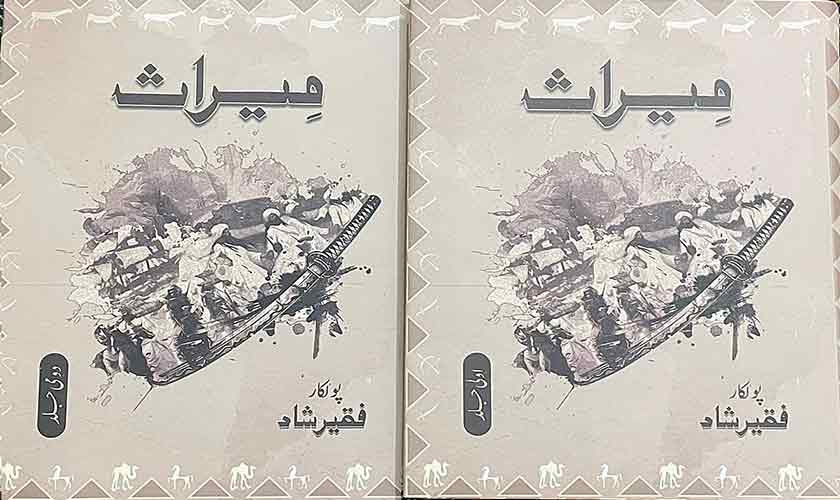
Much of the early Balochi poetry, collected by orientalists and a handful of local researchers, survived through oral transmission and through cassette recordings of traditional singers. Faqir Shad, a dedicated researcher, later compiled this vast poetic heritage into a book titled Miraas (The heritage). The book represents four decades of extensive research. First published in 1998, Miraas has been continually expanded and revised by Shad to preserve the richness of classical Balochi poetry. In September this year, the Balochistan Academy Turbat released its fifth edition.
This latest edition stands out for several reasons. First, it is divided into two volumes spanning more than two thousand pages. The first volume covers poetry from the early period, while the second includes works from the Seventeenth Century onwards.
Second, for the first time, it offers multiple versions of the same poems from different dialects and regions, particularly from Hormozgan, Zahedan and Nimruz.
Third, it provides detailed annotations that explain difficult words and expressions.
Shad has devoted exceptional care to preparing this work. He began by collecting various cassette recordings of singers, listening to them closely and transcribing the poems with meticulous attention. He also gathered verses from individuals and recorded them himself. Each poem in the collection begins with a short prelude and ends with a source reference, reflecting the rigour with which Miraas has been assembled.
By compiling and editing this monumental collection single-handedly, Faqir Shad has established himself as an institution all by himself.
Balochi classical poetry is generally divided into two periods, which Shad has organised into two separate volumes. The first period spans from the Fifteenth to the Seventeenth Century. The poets from this era, known for their long epic and romantic poems, remain anonymous. Most narrative poems are named after their central characters. In romantic poems, the male and female protagonists address one another directly. As a result, the work is attributed to them as though they were the poets — for example, Shay Murid and Haani; Shahdad and Mahnaaz; and Bibagr and Granaz. However, linguistic, stylistic and thematic analysis suggest that many of these poems were likely composed by a single poet rather than by the characters themselves. For this reason, most scholars hesitate to treat the protagonists as actual authors.
Many poems from this period are also regarded as valuable historical sources on Baloch history. The poem Bon Daptaray Laccha (The Chronicle of the Origin) is particularly significant, as it describes the mass migration of the Baloch people from Aleppo, Syria, and the events that followed their settlement in modern-day Balochistan. Another poem, Delhi ay Jangay Sher (The Chronicle of the Battle of Delhi), recounts how Baloch tribes fought alongside Emperor Humayun against Sher Shah Suri in 1540. Similarly, Khan Kalat o Engrezani Jang (The Battle Between the Khan of Kalat and the British) offers a poetic account of the 1839 conflict between the Kalat state and the British Empire, following Mehrab Khan’s refusal to submit to British demands. The battle ended with Mehrab Khan’s martyrdom and the subsequent occupation of Kalat state.
These poems not only record historical events but also celebrate the values of courage, loyalty and love of freedom that form the core of Baloch cultural identity.
In the second period of Balochi poetry, individual expression becomes more pronounced. The leading poets of this era were educated in Arabic and Persian and often used the title Mulla before their names. Among the most notable poets are Mulla Fazul, Mulla Qasim, Mulla Ismaele Pullabadi, Mulla Ragam Washi and Izzat Panjguri. Compared with the earlier period, this phase of Balochi poetry is more reflective and philosophical, marked by a stronger sense of individuality in both thought and style. While the poetry of the first period is known for its emotional sensitivity, the second period adopts a more contemplative tone. Persian and Arabic influences on diction and imagery become increasingly evident, lending the language a richer and more intricate literary texture.
Shad devoted exceptional care to the preparation of this work. He began by collecting cassette recordings of traditional singers, listening attentively and carefully transcribing each poem. He also gathered verses directly from individuals, recording them himself to ensure accuracy. Every poem in the collection opens with a brief prelude and concludes with a reference to its source.
This book preserves the corpus of classical Balochi poetry composed over the past five centuries. It includes nearly five hundred poems, making it one of the most comprehensive efforts to document the Balochi literary heritage. By compiling and editing this monumental collection single-handedly, Faqir Shad has established himself as an institution all by himself, preserving not only poetry but also the cultural memory of the Baloch nation.
Miraas
Edited by Faqir Shad
Publisher: Balochistan
Academy, Turbat
Pages: Vol 01:1198,
Vol 02: 990
The reviewer is a translator and an assistant professor at Atta Shad Degree College, Turbat.