Print Story
X




Rem Koolhaas reimagines the book as a living bridge between civilisations and the human urge to remember
| J |
orge Luis Borges, in his short story The Library of Babel, envisions a perfect library containing every book from every language in the world. In its architectural detail, the library mirrors the universe itself: labyrinthine and infinite. The fiction is born of Borges’s fascination with language, yet it reaffirms another, often neglected fact, that all human invention, imagination, emotion and communication is preserved through words, particularly in writing.
Hence the Sumerian tablets, Egyptian hieroglyphs, Phoenician texts, Chinese writing, Latin script, Hebrew letters, Arabic calligraphy and countless other modes of inscription. Each is a means of solidifying and immortalising transitory sounds. They record heroic anecdotes, battle accounts, religious directives, civic instruction, legal codes and works of poetry, fiction, knowledge, mathematics, science, philosophy, travel and medicine. From the distant past to the present, these records have appeared in many formats: papyrus, animal skins, tree bark, leaves, stone, vellum, paper and, today, digital storage.
The history of language is the history of human beings, made tangible in the form of books. Rem Koolhaas’s National Library of Qatar stands as a reminder of the enduring significance of books in human societies. (In some cultures, even non-religious books are so revered that if dropped on the floor, they are immediately kissed before being picked up.) Books carry the message of God, the words of rulers, the expressions of poets and the inquiries, speculations and observations of countless individuals.
A book, in its very structure, is an embodied secret: you cannot know its content unless you read it from cover to cover. This sense of mystery is reflected in libraries across the world. Tall rows of shelves, packed tightly with volumes, create the feeling of a maze, an unending labyrinth of unopened pages drawn from unfathomable sources. Often dark, dense and difficult to decipher, a library is conceived and treated like a temple. It demands silence, requires courage and entails a quiet risk: the moment you cross its threshold and disturb the arrangement (of books, of knowledge), you must commit to choosing a volume for browsing or borrowing.
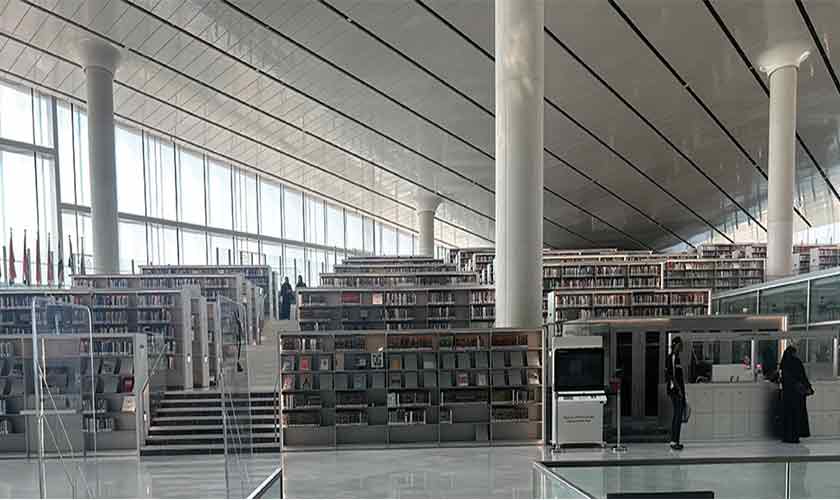
Yet Rem Koolhaas’s National Library of Qatar, which opened to the public in April 2018, offers an entirely different experience. It is welcoming, vast and flooded with natural light, greeting the visitor from one end of its open hall to the other. Alongside its extensive collection of one million books, what sets this library apart is its sense of openness, vitality and continuity, almost like a public park. Here, books do not entomb the past; they signal life.
This act of resurrection is part technological. The library houses 16,660,966 digitised pages of old texts, including works in Arabic, English, French, Spanish, Persian, Urdu, Hindi, Bengali, Malayalam and several other languages from Asia, Africa and Europe. This digital collection, an ongoing project, can be accessed from anywhere in the world without membership.
Moving through its warmly lit passages, work tables and book racks, one feels at home, connected not only to the space itself but to the entirety of human civilisation and to humanity’s enduring need to communicate. That desire, preserved in the form of alphabets, is reflected in one of the library’s most impressive sections: a place where the past is deliberately curated for the present. Koolhaas designed a dedicated area for storing and displaying heritage material on a level lower than the main library floor. Its layout, which directs the visitor to descend, evokes the sense of leaving today’s world before entering the realm of yesterday.
This feeling is reinforced through material and texture. In contrast to the modern finishes elsewhere in the building, the heritage section is built in sandstone, a substance rich in associations. Unlike concrete, sandstone is drawn directly from nature; with its weathered surface, irregular veins and shifting hues, it evokes the passage of time. Its colour not only suggests an excavation into history but also quietly recalls the physical landscape surrounding the library, a city edged by the desert.
Descending into the heritage collection, one encounters numerous manuscripts of the Holy Quran. Originating from the Arabian peninsula and beyond, they reflect the remarkable diversity in the ways the Word of God has been inscribed. Flowing strokes, delicate lines and nuanced calligraphic styles lend a sense of poetry even for those unable to read Arabic. In a way, this mirrors the art of Christian Europe: work once rooted in religious devotion that is now admired as much for its pictorial beauty and formal skill as for its spiritual origins.
This section of the library contains almost two thousand old books, texts, atlases, miniatures and photographs, particularly orientalist imagery. Walking through these aisles, one learns how history unfolds, is filtered and is preserved for posterity. These processes, which appear neutral, honest and scientific, are in fact embedded with intention; each act of representation reveals a viewpoint. This is especially clear in early black-and-white photographs. Among them are images of Egyptian and Palestinian women captured by the British photographer Dorothy M Sands, depicting domestic labour as well as traditional arts and crafts. The display illustrates how perceptions of women have shifted, from symbols of leisure, pleasure and charm to figures of struggle, social change and independent identity. This evolution is captured strikingly in a cinema poster for the 1958 Egyptian film Djamila, The Algerian, which shows the heroine beside her rifle, wrapped in her nation’s flag, embodying Algerian resistance to French occupation.
A library, by its very nature, is linked to a school. Both share a central element: the text, most often in written form. Recently, Rem Koolhaas, in collaboration with Samir Bantal, presented the second iteration of his project Countryside at the Qatar Preparatory School and the Qatar National Museum in Doha. The first version, exhibited at the Guggenheim in New York in 2020, brought together a series of sites from across the world “where the countryside was going through drastic changes and acute upheavals.”
In Doha, the related project The Arc represents what Koolhaas describes as “a contiguous band of ‘countryside’ that runs from South Africa through East Africa, via Qatar and Central Asia, all the way to Eastern China.” It encompasses landlocked rural regions still largely shaped by traditional ways of life in Africa and Central Asia, while the Middle East alone is undergoing rapid modernisation.
Employing multiple formats, from gathering research to materialising data, from remapping the world in terms of information technology, production cycles, political divisions and ecological upheavals, The Arc focuses on vast regions of Africa (shaped like a bow) that “were colonised until the 1960s, and in Central Asia until the early 1990s.” When examined closely, it becomes clear that the old boundaries and binaries between the developed and developing worlds are fading, albeit often in an illusionary way, with the invention, spread and accessibility of digital tools. As the curators note, the “smartphone has had a colossal impact on the Arc, connecting the most isolated cultures, questioning the need to leave the countryside for the city. The handheld internet introduces limitless flows of information, fashion, news and politics, enabling entirely new economies.”
Seen from another angle, the microchip inside a phone held in one’s palm can contain innumerable volumes, from the near to the distant, from the ancient to the new, echoing the spirit of the great libraries of legend: those of Babel, Alexandria, Constantinople, Baghdad, London, Washington DC, Moscow, Shanghai, Paris, Vienna and, now, Doha.
The writer is a visual artist, an art critic, a curator and a professor at the School of Visual Arts and Design, Beaconhouse National University, Lahore. He can be contacted at [email protected]