Print Story
X




Multiple standing ovations and thunderous applause were proof that the city was truly impressed by the performances at the Lahore Kathak Festival
| A |
lhamra Arts Council, Lahore, came alive last week with the sound of ghungroos at the first-ever Lahore Kathak Festival. A first-of-its-kind, the festival brought together performers and connoisseurs of the classical dance form.
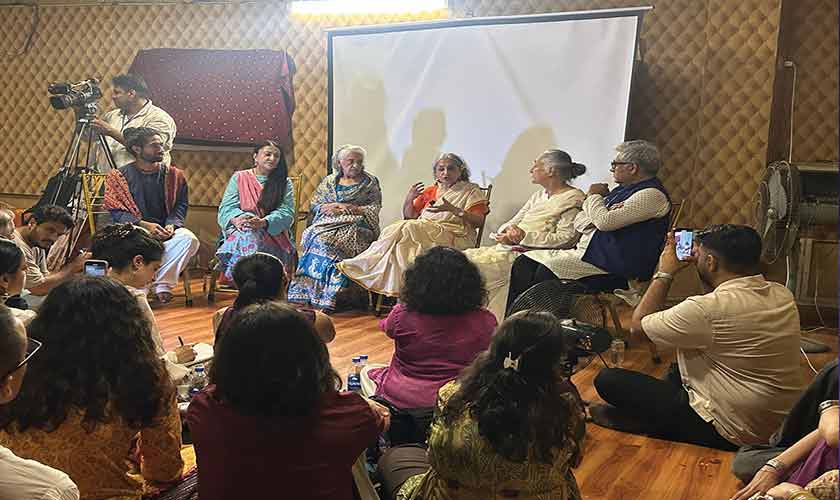
Day 1 of the festival drew a small crowd. The participants had gathered in the Maharaj Kathak Dance Studio, located in the basement of Alhamra. Small in number, but visibly engrossed, the participants had the opportunity to be in the room with Kathak gurus, including Sheema Kirmani, Bina Jawad, Adnan Jahangir and Nighat Chaudhry. At the same time, they got to learn about the ancient dance form in the various workshops offered by the likes of Guru Sujata Banerjee, the event organiser Maan Saeed and the Kathak exponent Hammad Rasheed, a student of the well-remembered Naila Riaz, who herself learned under the tutelage of Maharaj Ghulam Hussain Kathak.
The two sessions, one with the senior dancers and the second with the new lot taking forward the craft, were equally engaging.
Day 2 shifted the scale of the festival, as hundreds lined up to watch live performances. Hall 1 of Alhamra echoed with cheers and claps as Rasheed, Kirmani, Chaudhry, Jahangir and other performers took to the stage. Multiple standing ovations and thunderous applause were proof that Lahoris were truly impressed.
Several performances featuring young teens, duos and solo artists were evocative. Kathak that evening became an expression of identity for many young performers.
Aliza Khalid, a climate journalist, looking ethereal in a white ensemble, danced to a famous Seraiki number, paying homage to her roots. Maan Saeed and Momina Farooq Khan, the young organisers of LKF, who brought masters and learners of the craft together for this two-day event, set the stage on fire with their precise movements.
In his solo performance, Saeed made his body sing, each muscle moving to the rhythms of an ancient tune. School girls and students of Harsukh proved through their footwork that the future of Kathak remains bright.
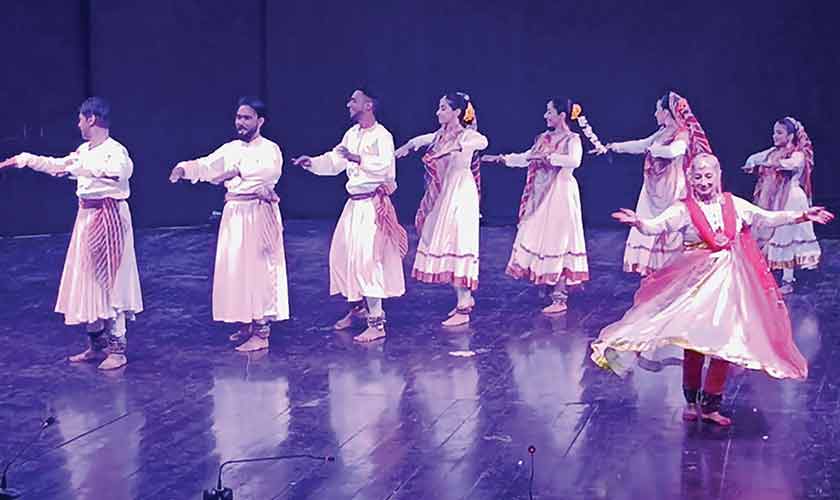
Several performances featuring young teens, duos and solo artists were evocative. Kathak that evening became an expression of identity for many young performers.
| A |
s we speak of the future of dance in this country, it is necessary to reflect on the history of the art form, so it remains a secular practice, as all senior dancers insisted.
Kathak and several other Indian classical dance forms are thought to be associated with a particular religious ethos, often associated with Hinduism. However, the history of Kathak is much more complex and enduring.
As Guru Pali Chandra says, Kathak is one of the eight Indian classical dances. It is the only one that developed nearly 2,000 years ago in the northern parts of the Indian subcontinent. The word Kathak comes from the term Katha, meaning story. The storyteller who would tell this Katha was known as a Kathak.
Kathak is an amalgamation of three performing arts: music, dance and drama. When these three merge, “a Kathak is born,” says Chandra.
The history and evolution of Kathak are quite interesting. It started as a folk dance. The artists would travel from village to village carrying their instruments, performing stories of what they had witnessed on their travels. When these travelling Kathakars came in contact with pundits, who asked them to perform in the temples, the dance form went through its first stage of evolution. The content, context and the dance itself changed. Kathak became more mythologically oriented as dancers began performing stories from the Mahabharata and Ramayana.
Once these performers were invited to the Mughal courts, the philosophy and literature of Kathak evolved further.
The Mughals wanted to use the dance as a form of entertainment, so fashion, instruments and even the language changed as Urdu was introduced to Kathak. The movements became more precise; the technique became critical and focused. This helped enhance the entertainment value of the dance.
Then came the British and dance was forbidden. Kathak dancers, now derogatorily referred to as nautch girls, were economically and socially relegated to the margins. Many were forced into prostitution. It was under such circumstances that these dancers, who had matured during the Mughal era, preserved the culture and gharanas began to form. Jaipur, Lucknow and Banaras, the three prominent schools of Kathak, emerged; each with their specific peculiarities, ethos and philosophy.
Post Partition, India accepted and developed the craft with greater vigour. Institutionalised, Kathak continued to grow.
In Pakistan, the art form faced more challenges. As Kirmani recounted at the festival, “Dance was banned during Zia’s time, but that didn’t deter me. I danced in the face of religio-political persecution.”
A ban was slapped on performers, especially by female dancers, during the period. The panelists agreed that dance had now transformed into a political act. “Dance is resistance,” said Kirmani. “It has given me strength, courage and healing.”
| A |
t another panel discussion at the LKF, the experts noted that dance had the power to enrich the soul. “Raqs ka koi mazhab nahin hai,” (dance has no religion) they said. Jawad, who has been teaching Kathak for decades, also said, “Raqs rooh ki akkaasi karta hai,” (dance reflects the soul). In simpler terms, dance and soul are in harmony with each other.
It was evident that many practitioners had begun learning the craft from an early age. Not everyone had been introduced to it in the same manner. For Rasheed, Kathak was about being joyful. The young boy who came to Alhamra to learn singing because he thought that those coming out of this building “seemed happier, somehow,” landed at the Maharaj Dance Studio where, mesmerised by the elegant Naila Riaz, he decided to stay and become a Kathakkar himself.
Lahore laid an exceptional stage for the promotion of Kathak. The city of courts and culture proved once again that it remembers its history and is willing to preserve it and invest in the future of arts. The LKF was a step in the right direction — a direction that supports performing arts and frees them from the bounds of socio-religious debates by bringing them to the everyday folks.
Over the years, some people have wrongly assumed that Kathak and other classical dance forms are essentially elitist. It would be imprudent to refute that statement altogether. Yes, dance and performing arts have often flourished in privileged communities because of their access to relevant literature and practice venues. It is in the light of such concerns that festivals like the LKF are all the more necessary. They can provide the much-needed access to learning these crafts, and open doors to people from all kinds of socio-economic backgrounds.
To quote Chaudhry, “Kathak is knowledge and learning. It needs to be taught and learned.”
The writer is a staff member