Print Story
X




Amadeus is a stunning but shallow take on history’s greatest rivalry between Mozart and Salieri
Amadeus ☆☆☆
Created by: Joe Barton,
Julian Farino
| O |
ver 40 years ago, Milos Forman and Peter Shaffer adapted the latter’s stage play, inspired by Alexander Pushkin’s 19th-century play, about one of history’s most heated rivalries. The overtly fictionalised retelling of the conflict between the legendary composer Wolfgang Amadeus Mozart and his lesser-known rival, Antonio Salieri, turned court intrigue into a farcical murder plot. Now, a new reimagining of Amadeus arrives to the expectations that come with its legacy, taking Shaffer’s iconic story and filtering it through a more modern, heightened lens.
The series builds on the foundations of the classic film adaptation, but it’s clear that the creative team wanted to push boundaries and see just how far they can suspend belief. This Amadeus is The Great meets Harlots, bawdy, chaotic and packed with absurdity that makes you laugh out loud. The series’ bold, stylised take leans less on historical reverence and more on the theatricality of two composers who are at each other’s throats.
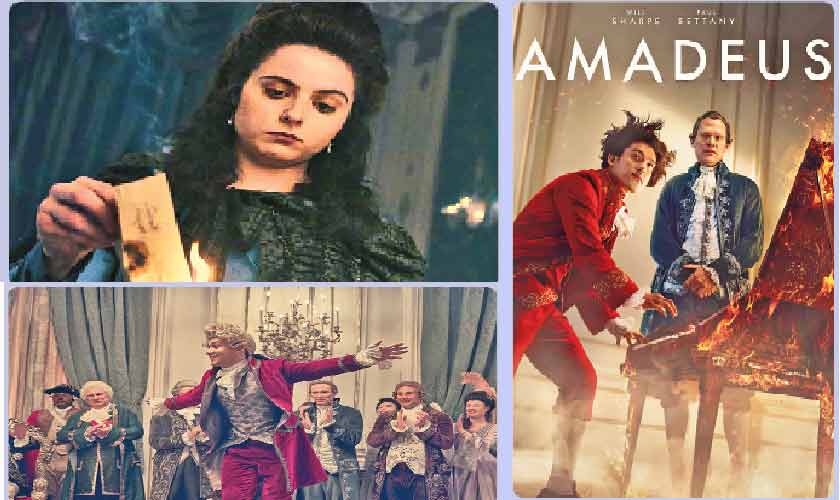
With The White Lotus standout Will Sharpe stepping into the role of Wolfgang Amadeus Mozart and Paul Bettany embodying his rival, Antonio Salieri, there was never a doubt that Amadeus would deliver in the performance department. Across its five-episode run, Amadeus wastes no time announcing its intentions. Mozart’s genius is very much central to the plot, but here it’s wrapped in debauchery, ego and a sort of anachronistic energy that makes it riotously fun to watch him unravel. The storytelling also mirrors this volatility, oscillating between moments of sharp, grounded character insight and sequences that feel far more interested in provoking the audience.
This push and pull, both between Mozart and Salieri as well as the audience and the series itself defines Amadeus as a whole. There’s an undeniable ambition in its presentation of Mozart’s world, with its lavish court settings, decadent parties and a heightened emotional landscape. Yet, for all its grandeur, the series often feels more concerned with spectacle than real depth. It’s unquestionably entertaining, but it doesn’t always dig as deeply as it could into the history of its central figures.
If Amadeus works as well as it does, it’s largely because of its central performances; Sharpe and Bettany anchor the chaos with two wildly different but equally compelling interpretations. Rather than leaning into the more traditionally whimsical or “tortured genius” archetype, Sharpe’s version of the composer is unapologetically impulsive, seizing upon the brilliance and the absurdity of a man who seems incapable of existing within the rigid structures of his time.
Beyond his somewhat one-sided rivalry with Salieri, Sharpe shares really beautiful moments with Mozart’s wife, Constanze (Gabrielle Creevy), which showcase not only volatility but also maturity. It’s through this relationship that we see a lot of Mozart’s inner self and the insecurities that come with that on display. Sharpe leans fully into the role’s theatricality, making Mozart both magnetic and maddening in equal measure, while still managing to find the truth beyond the facade.
Opposite Sharpe, Bettany’s Salieri provides a perfect counterbalance. Where Sharpe is all fire and unpredictability, Bettany is controlled, measured and not-so quietly seething. His Salieri feels like an elder statesman, someone who has spent years mastering restraint, only to find himself unravelling in the presence of Mozart’s unmatchable talent. Bettany brings a magnetic stillness to the role, making even his smallest reactions feel loaded.
Written by Joe Barton (Black Doves) and directed by Julian Farinon (Entourage) and Alice Seabright (Sex Education), Amadeus is nothing short of visually opulent. The series leans heavily into its opulence, crafting a world that is as lavish as it is immersive to watch. The costumes are extravagant, the locations are richly detailed, and the overall aesthetic feels deliberately heightened and surreal. The production design demands attention, reinforcing the sense that this is a story about spectacle as much as it is about music and murder.
At the same time, Amadeus’s emphasis on grandeur can sometimes work against it. Beneath the ornate visuals and bold stylistic choices, the story occasionally feels thin and surface-level in its exploration. The emotional arcs, particularly for supporting characters, don’t always receive the depth that they deserve, leaving certain moments feeling less impactful than they should.
There’s also a sense that Amadeus is so enamoured with its own excess that it loses sight of the quieter, more introspective elements that made the original story so compelling. Mozart’s genius, while ever-present, often takes a backseat to the chaos surrounding him and the rivalry with Salieri, while still very engaging, doesn’t always carry the same emotional weight as its predecessor.
In the end, this version of Amadeus is a spectacle first and a character study second. It’s big and bold and undeniably fun, even when it falters in depth. Sure, Shaffer’s original story was also condemned for its coarse approach to Mozart, but this version pushes past mild discomfort into truly jaw-dropping crude and lascivious behaviour. There’s plenty to enjoy for viewers willing to embrace its theatricality and historical aversion, but those expecting a more nuanced or historically grounded exploration of Mozart will be left wanting more.
Don’t go in expecting a definitive portrait. Be prepared for a series that is here to entertain, provoke and dazzle you.
– Courtesy: Collider.com
Rating system: *Not on your life * ½ If you really must waste your time ** Hardly worth the bother ** ½ Okay for a slow afternoon only *** Good enough for a look see *** ½ Recommended viewing **** Don’t miss it **** ½ Almost perfect ***** Perfection