Print Story
X




A university’s history initiative reignites debate about Sindh’s history.
| R |
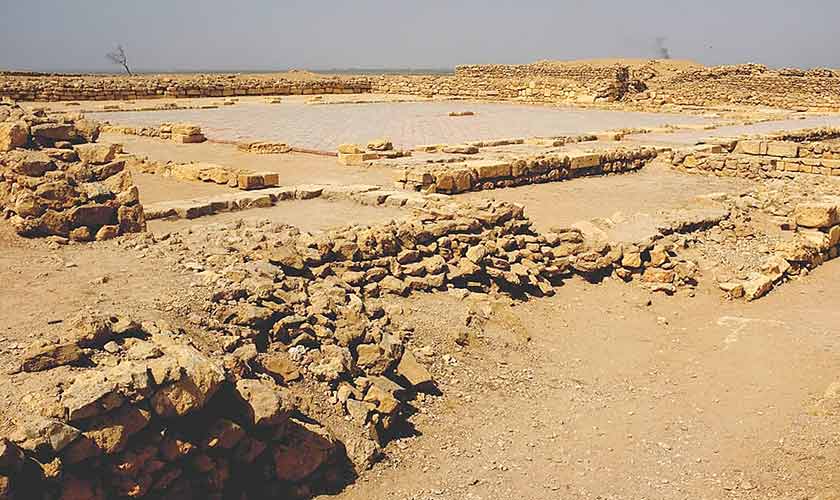
ecently, the Aror History Wall was created at Aror University of Art, Architecture, Design and Heritage, Sukkur. The wall showcases the history of Aror, which was the capital of Sindh until the last Hindu ruler, Raja Dahir. The wall features various panels that include sculptures of Raja Dahir and Mohammad bin Qasim, as well as a map of Sindh from the 7th and 8th Centuries.
A controversy arose when a few people visited the wall and posted photos with the statue of Dahir on social media. This action upset a group of people who view Dahir as a usurper.
These individuals launched a social media campaign arguing that a public sector university should not glorify a Hindu ruler. It is important to note that a sculpture of Muhammad Bin Qasim is part of the installation. A majority of people have supported the university’s initiative, appreciating its efforts to include Dahir’s sculpture as part of the historical context.
The university administration issued a press release stating: “The Aror University of Art, Architecture, Design and Heritage, Sukkur, clarifies that, as a specialised institution in the fields of art and heritage, it is mandated to document, preserve and present the historical legacy of Sindh, particularly in the region of Aror, where the university is located. To fulfill this mandate, the university developed the Aror History Wall. The artwork was created by a team of faculty members and students to depict historically significant aspects of Aror. The wall features a map of Sindh from the 7th to 8th Century and includes representations of historical figures such as Muhammad Bin Qasim and Raja Dahar. It also showcases scenes from the Darbar, battle imagery, forts and the weapons and animals used during that period.”
“Furthermore, it (the initiative) emphasises the historical significance of Aror (also known as Alor) as the capital of Sindh, a structured municipal centre, a minting authority with its own coinage and an important trade hub connected to Central Asian regions. It is important to note that the artwork does not depict any individual as a hero or villain; instead, it presents historical elements solely for the purpose of heritage preservation for future generations.”
In developed countries, universities are intended to foster critical discourse and uphold objective truth. However, in nations like Pakistan and India, university administrations and faculty members often face significant pressure from powerful actors, government officials, religious leaders and local waderas. These influential figures sometimes treat educational institutions as their personal guest houses and seminaries. Such approaches tend to smother creativity, freedom and critical thinking. Such an environment is not conducive to the development of critical thinking. Instead, it produces an abundance of unqualified supporters of a corrupt system and fake researches.
Politics is deeply woven into our daily lives. It is also a controversial and often misused term. Teachers and students in Political Science Departments may find it hard to challenge the anti-people policies of the governments. Historical narratives are also influenced by politics. Various interpretations can label someone a hero while casting another as a villain.
The debate surrounding Raja Dahir and Muhammad Bin Qasim, for instance, presents diverse perspectives. One viewpoint sees Muhammad Bin Qasim as a national hero of Pakistan. This narrative has been widely disseminated through textbooks in schools and colleges across the country and through some history books sanctioned by the state.
Sindhi nationalist leader GM Syed presented a different viewpoint. In his writings, he characterised Raja Dahir as a national hero of Sindh, depicting Muhammad Bin Qasim as an invader. The curricula, from primary school to college, tends to favour the first narrative. Both these narratives are shaped by the politics. How can one then separate politics from the history of Sindh?
The narrative promoted by Sindhi nationalists and intellectuals has recently gained more prominence in Sindh. The university, however, does not endorse any single narrative; instead, it presents history as documented in various books. Ultimately, it is up to the people to interpret or deconstruct the narratives presented through these historical accounts.
Faculty members and students have created a history wall to showcase history through their artwork, emphasising that art should have the freedom to express itself.
The writer is an assistant professor and chairman of the Department of History and Pakistan Studies at Aror University of Art, Architecture, Design and Heritage, Sukkur. He can be reached at qasim_shu2016 @yahoo.com