Print Story
X




The pressure to shift to solar energy is enormous. Small units are struggling with the switch
| S |
heikh Imtiaz Ahmed, a textile mill owner in the industrial area of Khurrianwala, switched to solar energy five years ago to cope with rising electricity tariffs and frequent load-shedding.
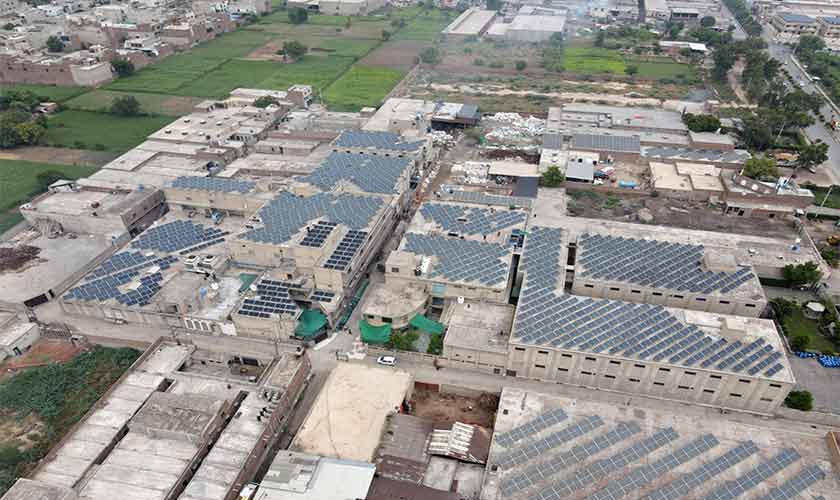
His factory now operates a one-megawatt solar power system, which supplies electricity to over 100 power looms, a stitching unit and offices. The mill also draws around 700 kilowatts of electricity from the FESCO to run its processing unit.
Ahmed says he initially installed a 200-kilowatt solar system. It was later expanded to reach its current capacity.
“We currently generate around 4,000 units of electricity daily from solar panels. This comes to nearly 120,000 units per month and nearly 1.44 million units annually,” he says.
He says the use of solar energy has enabled the mill to save over Rs 5.4 million per month in electricity bills. The initial investment has already been recovered.
Ahmed intends to run the entire operation on solar energy. He says limited rooftop space is the only constraint.
He also highlights the environmental benefits of solar energy. “According to environmental experts, our one-megawatt solar project is equivalent to planting 25,700 trees. It is helping reduce approximately 650 tonnes of carbon dioxide emissions annually.”
Azizullh Goheer, the secretary general of the Pakistan Textile Exporters’ Association, says the survival of the textile industry is increasingly dependent on the adoption of solar energy. He says energy tariffs for the industry have risen by more than 100 per cent over the past 15 years.
“In India, Bangladesh and Sri Lanka, electricity costs do not exceed 7 to 9 cents per unit; in Pakistan, these tariffs have reached 15 cents,” he says.
Goheer says high interest rates—10 to 11 per cent—make it difficult for industries to manage operational costs. Solar energy is one of the few viable options to cut production costs.
He says the high upfront cost of installing large-scale solar systems remains a major barrier for small and medium-sized textile units.
Recent changes in government policy replacing net metering with the new “prosumer” framework have created additional uncertainty.
According to a March 2026 report, titled Impact of NEPRA Prosumer Regulations 2026: A Case Study for the Textile Sector, published by Alternative Development Services, future investment decisions in the industry will depend more on settlement mechanisms and energy storage rules than on the cost of solar panels themselves.
The report warns that these changes could increase the overall cost of transitioning to solar energy, potentially slowing down adoption in the industrial sector. According to the report, recent changes in the net metering policy are likely to have significant implications for Pakistan’s textile sector, particularly for industries that have already made substantial investments in solar energy to cope with rising power costs.
Under the revised framework, reduced compensation for surplus electricity supplied to the grid and stricter regulatory conditions may extend the ROI period, potentially discouraging further investment in solarisation.
As a result, the pace of new solar installations may slow down. Existing users could face increased financial pressure. This, in turn, may raise production costs and undermine the competitiveness of Pakistan’s textile exports in global markets. The report says that policy uncertainty could negatively affect investor confidence, further slowing the transition to renewable energy.
In Faisalabad, 15 to 20 per cent of textile units have partially transitioned to solar power.
To mitigate these challenges, the report recommends that the government introduce a balanced long-term policy framework that preserves the incentives for industrial users. This could include revisiting net metering tariffs to ensure reasonable returns, as well as introducing alternative mechanisms such as net billing or hybrid models. In addition, access to low-interest financing, tax incentives and the promotion of energy storage solutions are identified as critical measures. Continuous consultation between the government and industry stakeholders is also essential to develop policies that stabilise the energy sector while maintaining export competitiveness.
It is important to note that Pakistan’s largest textile export markets - the United States and the European Union - are increasingly enforcing regulations related to renewable and clean energy. This has accelerated the textile sector’s shift toward solar energy. In Faisalabad, an estimated 15-20 per cent of textile units have partially transitioned to solar power.
Currently, solar energy is primarily used in stitching units, offices and other low-energy operations. Heavy machinery still relies on grid electricity. In the past, during periods of severe load-shedding, industries had installed gas-based captive power plants. However, the rising cost of gas has made their option prohibitive.
Some industries are now considering coal or biomass (wood) as alternative energy sources. However, these options are environmentally unsustainable.
According to the Economic Survey 2024-25, the textile sector accounts for around 55 per cent of Pakistan’s exports. Faisalabad alone contributed more than 60 per cent of textile exports. In this context, the transition to solar energy is not only critical for cost reduction but also for sustaining and increasing export volumes.
Energy shortages continue to hamper production. A study conducted by Haider Ali, a PhD scholar at the Pakistan Institute of Development Economics, based on 125 textile mills in Faisalabad, found that power outages result in production losses ranging from 23 to 65 per cent in an eight-hour shift and 21 to 60 per cent in a ten-hour shift.
According to the study, the hosiery and ready-made garments sector has suffered the highest production losses due to the power outages.
The report notes that as far back as 2013, around 65 per cent of the textile industry relied on diesel- and petrol-powered generators as an alternative source to ensure uninterrupted electricity supply.
However, continuous increase in the prices of petroleum products, gas and electricity has significantly raised operational costs, prompting a rapid shift toward solar energy in recent years.
Data from the Power Planning and Monitoring Company shows that Pakistan’s installed solar net metering capacity has grown from 201 megawatts in 2021 to approximately 6,975 megawatts.
In terms of net metering adoption, Lahore accounts for 24 per cent of the consumers, followed by Multan (11 per cent), Rawalpindi (9 per cent), Karachi (7 per cent), Faisalabad (6 per cent) and Islamabad (5 per cent).
Another research study conducted by Alternative Development Services last year across 80 textile mills in Faisalabad and Multan highlighted the urgent need for the industrial sector to transition to renewable energy in order to reduce carbon emissions and meet environmental compliance requirements in global markets. This transition, the report suggests, is critical for maintaining and enhancing export competitiveness.
According to ADS chief executive officer Amjad Nazeer, evolving global carbon reduction targets, changing buyer expectations and stricter supply chain compliance standards are already reshaping industrial production.
He says industries that adapt quickly to these changes are likely to gain significant economic advantages; those that delay the switch risk missing out on emerging opportunities.
It is worth noting that a joint report by the Government of Pakistan and the World Bank (2018) estimated that installing solar panels on just 0.071 per cent of the country’s land area could meet its entire electricity demand. The report also said that by increasing the share of solar and wind energy by at least 30 per cent by 2030, Pakistan could save up to $5 billion in fuel costs over the next two decades.
To achieve this target, Pakistan will need to install approximately 24,000 megawatts of solar and wind energy projects by 2030. Currently, the country’s total installed solar capacity stands at around 18,000 megawatts, indicating both substantial progress and a significant gap.
Mounting pressure from international markets to comply with clean energy standards adds urgency to this transition. A stable and supportive policy environment, coupled with targeted incentives and investment in energy infrastructure, will be critical to ensuring that the industry not only sustains its global competitiveness but also contributes to a more resilient and sustainable energy future for Pakistan.
The writer has been associated with journalism for the past decade. He tweets @naeemahmad876