Print Story
X

| I |
n the late 1950s, a young Pakhtun girl from Peshawar secretly published three works of fiction: Hindara (Mirror), Maat Bangree (Broken Bangles) and Juandi Ghamoona (Living Sorrows). She hid her writing from her family, including her father - himself a poet and writer - out of fear. Her secret only surfaced when the publisher asked her to sign a contract and collect her royalty: Rs 250. Shocked and displeased by what he saw as his daughter’s “unorthodox action,” her father reluctantly went to the publisher, signed the contract, but refused to accept the money, perhaps because of the stigma attached to a daughter earning her own way.
As a student, the girl had been pulled out of school several times: first because the school was far from home and she had to walk; and later, in grade four, because there was no girls-only school in the area. Relatives shamed her family for allowing a girl to sit alongside boys.

While she could not study beyond matric as a regular student, despite every obstacle, she completed two master’s degrees: one in Pashto, another in Urdu literature; and became a school teacher. Her ordeal wasn’t over; she had to quit teaching as well on account of speculation about her honour.
As she narrated the incident in an interview years later, when she became a teacher, her first posting was in a town called Thana. The place name also means a police station in local parlance. Because Thana was far from her hometown and she had to stay there, once a relative visited her house and, knowing she wasn’t at home, quietly asked her niece where she was. “She’s in Thana,” the younger niece replied, without further explanation. The relative woman took Thana to mean the police station. Even without the mobile phones, rumour spread like wildfire. The rumours multiplied so that her mother had to call her home and she was compelled to resign from her teaching job.
But the girl didn’t succumb to the patriarchal norms of the society. She became a TV producer, radio broadcaster, actor and recipient of numerous awards, including the coveted President’s Pride of Performance award and the Tamgha-i-Imtiaz. She came to be recognised as “the first lady of Pashto literature.” Her name was Zaitoon Bano. She was born in 1938 and passed away in 2021.
Bano had dreamt of a Pakhtun society where women could fearlessly pursue their literary ambitions and openly take part in academic and cultural life. Two years after her death, in 2023, another woman, Dr Hamida Bibi, helped transform that dream into reality. With the support of the Dosti Welfare Organisation, she co-founded the first-ever women’s literature festival in Pakistan: the Dosti Peshawar Women’s Literature Festival.
“When I attended the main events of the Peshawar Literature Festival, also organised by Dosti” Dr Hamida recalls, “I would think of the girls who study at Shaheed Benazir Bhutto Women’s University, Peshawar and the girls studying in our affiliated colleges, including those in the merged districts of the former FATA region.” Most of these students come from conservative families that do not permit them to attend mixed gatherings. Some of them have lost their family members to the menace of extremism; some were married off when they were fourteen.
“So I thought, if these girls can’t reach literature, why shouldn’t we bring literature to them?”
She shared her idea with Asif Riaz, then CEO of Dosti, and Dr Safia Ahmad, the VC of SBBWUP, who immediately agreed and extended support. The festival was launched in 2023 under the theme Our Words, Our World. The second edition explored Awareness. This year’s festival was aptly titled Umeed-i-Nao (New Hope). It ran from 10th to 14th November.
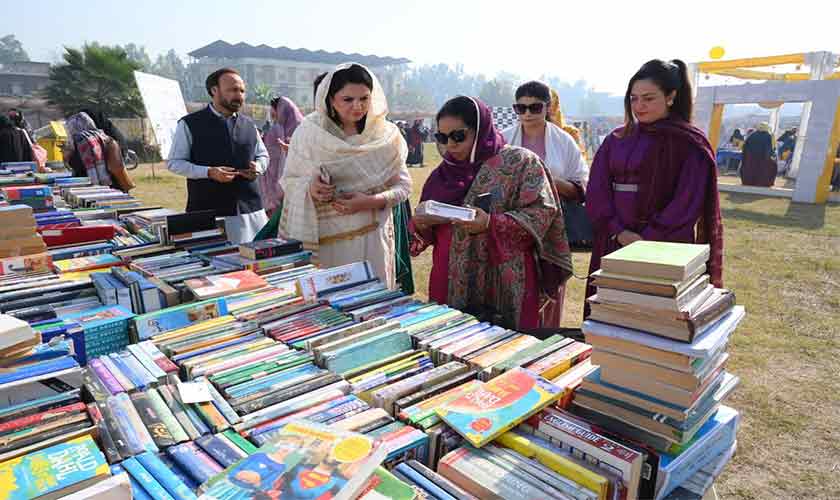
This year, the DPWLF expanded dramatically in its scope, diversity and outreach. To bring the margins to the centre, Afghan refugee women were encouraged to participate. Some Afghan students set up stalls showcasing traditional food, clothing, and crafts. Women from the Sarhad Rural Support Programme came from Abbottabad and Haripur to display their products and meet customers.
Students from twenty-two affiliated girls’ colleges took part - either at the main SBBWUP campus or at designated lead colleges. Most notably, five affiliated colleges from the merged districts also participated, making up audiences that had never before experienced a literary festival of this scale.
To widen gender diversity in the audience, several sessions were held outside women-only campuses: at Nishtar Hall and China Window. A mushaira (poetry recital) was held at the Peshawar Barracks.
“We brought women entrepreneurs to connect directly with their customers,” says Professor Dr Hamida, head of the History and Pakistan Studies Department at SBBWUP and the festival’s lead organiser. “With more than ten thousand visitors, women running stalls had tremendous opportunities to sell their products and build networks.” This year’s festival also featured sports competitions - including events for differently abled girls — tug of war contests and short training courses in digital marketing and entrepreneurship. “In short,” she says, “this festival has brought together everything that supports girls’ socio-economic uplift and the expansion of their worlds.”
There was something deeply symbolic, something not mentioned by the organisers, but by a stall owner, Master Bashir Ahmad, who brought books from Rawalpindi. “All stalls were charged for their three-day display,” he said, “except the bookstalls. They were told to occupy as much space as they wanted, free of cost.”
Students at the women-only campus are glad about this event. They get the chance to learn beyond textbooks. Nida, a law student from Mardan, clad in a grey coat and a maroon dupatta, clutches a slim booklet she had just received as a gift from a teacher: Benazir: Her Speeches and Interviews. She holds the booklet to her chest, like an heirloom. Inspired by figures like Benazir Bhutto and Asma Jahangir, she dreams of becoming a leader and human rights activist. “But that may be impossible if all we do is memorise laws,” she says. “We are confined within these walls. Festivals like this give us new hope and exposure.” She says that students were thrilled to meet authors, academics, poets, community leaders and rights activists.
“Many students at Benazir Women’s University wait for this festival from the moment it ends,” says Ruqia, a student volunteer.
Ijaz Khan, a co-organiser of the festival, quotes a saying attributed to Bacha Khan: “If you want to know what is wrong with a society, ask those who cannot speak.” He praises Dr Hamida for turning the festival into a vanguard of intellectual vibrancy, one that brings the periphery to the centre.
The writer has a background in English literature, history and politics. He can be reached at [email protected] and on X @nadeemkwrites.