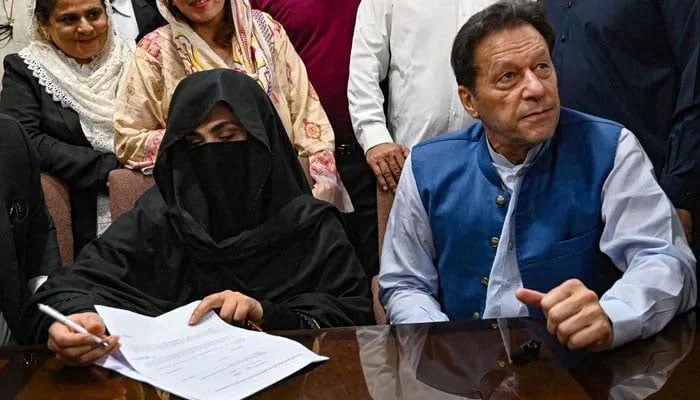
ISLAMABAD: The Islamabad High Court (IHC) on Tuesday reserved its verdict on the maintainability of petitions challenging the alleged solitary confinement of Pakistan Tehreek-e-Insaf (PTI) founder Imran Khan and his wife, Bushra Bibi, at Adiala Jail.Justice Khadim Hussain Soomro heard the petitions filed by Imran Khan’s sister, Aleema Khan, and Bushra Bibi’s daughter, Mubashra Khawar Maneka, who challenged the alleged isolation of the two convicted prisoners. During the hearing, Justice Soomro observed that convictions in National Accountability Bureau (NAB) cases do not carry solitary confinement as a punishment. He noted that the court had examined both judgments and found no sentence authorizing solitary confinement.
The judge remarked that the court would first determine whether the petitions were maintainable before deciding whether notices should be issued to the prison authorities. Counsel for the petitioners, Barrister Salman Safdar, argued that Imran Khan and Bushra Bibi had been kept in solitary confinement for several months in violation of prison rules and applicable laws. He submitted that although the issue had previously been mentioned as part of other proceedings, it had never been raised through an independent constitutional petition.
Safdar informed the court that, following an earlier court order, he had been allowed to meet Imran Khan. However, he claimed that he had been denied access to Bushra Bibi for the past seven months. The counsel further alleged that Imran Khan was being confined for approximately 22 hours a day, while Bushra Bibi was being kept in complete isolation round the clock.
Representing the National Accountability Bureau, Prosecutor Rafi Maqsood opposed the petitions, arguing that Aleema Khan and Mubashra Khawar Maneka were not directly aggrieved parties and, therefore, lacked the legal standing to file the petitions.
He rejected the allegations of solitary confinement, maintaining that both Imran Khan and Bushra Bibi were being held in accordance with prison rules applicable to convicted inmates. He further contended that the petitioners had not first approached the prison authorities for redress before invoking the constitutional jurisdiction of the High Court.
The federal government, NAB, and the Office of the Advocate General Islamabad also requested the court to dismiss the petitions on the grounds that they were not maintainable.
After hearing detailed arguments from both sides, Justice Khadim Hussain Soomro reserved the court’s decision on the maintainability of the petitions.