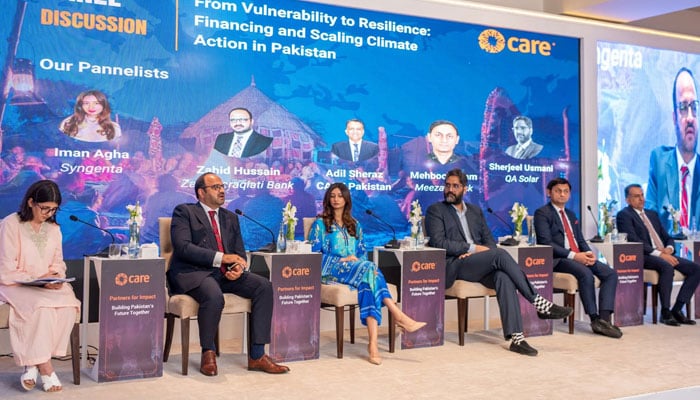
Islamabad:CARE Pakistan has convened senior leaders from the Ministry of Climate Change and Environmental Coordination, corporations, international development partners, financial institutions and civil society for its flagship forum, ‘Partners for Impact: Building Pakistan’s Future Together’, to strengthen collaboration on climate resilience and women’s economic empowerment.
The event served as a platform for dialogue, highlighting how partnerships, innovation, financing and private sector engagement can accelerate sustainable solutions for vulnerable communities across Pakistan.
Opening the forum, Adil Sheraz, Country Director of CARE Pakistan, stressed the need for multi-sector collaboration centred on communities. “The challenges facing Pakistan today, from climate change to economic inequality, are too complex for any one organisation to solve alone,” he said. “Communities cannot become resilient if half their population is excluded from economic opportunities. Likewise, economic growth cannot be sustainable without addressing climate impacts.”
Gul Najam Jamy of the World Bank, in a keynote address, said tackling climate change, creating jobs and advancing women’s economic empowerment requires collective action. “Governments, the private sector, civil society and development partners must work together to mobilise resources and build pathways for inclusive growth,” he noted.
A key feature was two high-level panels. The first, ‘From Vulnerability to Resilience: Financing and Scaling Climate Action in Pakistan’, examined investment, innovation and community-based solutions. Panelists included Mehboob Alam of Meezan Bank, Zahid Hussain of ZTBL, Sherjeel Usmani of QA Solar and Iman Agha of Syngenta. They discussed climate-smart agriculture, renewable energy access, resilient infrastructure and stronger public-private partnerships.The second panel, ‘Accelerating Women’s Economic Empowerment: From Inclusion to Leadership’, focused on digital inclusion, skills, entrepreneurship and leadership. Munawar Sultana of GIZ Pakistan said sustainable employment for women requires demand-driven skills, cross-sector partnerships and gender-transformative approaches to remove structural barriers. Hiba Dar of The Coca-Cola Company added that women’s empowerment is “smart business”, strengthening communities and driving inclusive growth.
Participants agreed that Pakistan’s development challenges demand stronger collaboration between government, business, financial institutions, civil society and development partners. The forum concluded with a commitment to pursue new partnerships for climate resilience, stronger livelihoods and inclusive economic opportunities, particularly for women and vulnerable communities. As Pakistan faces climate change and economic transformation, ‘Partners for Impact’ reaffirmed that progress depends on collaboration, innovation and ensuring no community is left behind.