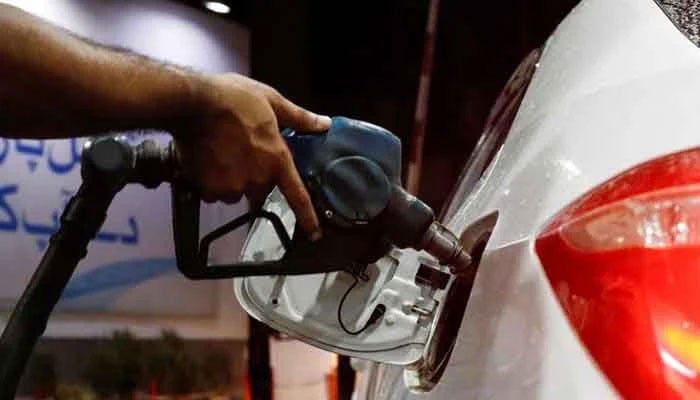
ISLAMABAD: The government kept petrol and diesel prices unchanged despite a sharp drop in global oil prices, drawing criticism that it is pocketing the savings instead of passing on relief to consumers already squeezed by inflation.
The Petroleum Division said Friday that petrol will stay at Rs299.50 per litre and high-speed diesel at Rs311.47 per litre from June 27 “until further orders,” even as international refined fuel prices fell over the past week.
The freeze comes as the government has almost hit its full-year Petroleum Development Levy (PDL) target of Rs1.468 trillion in the first half of June. Rather than easing the levy, officials raised it. Diesel’s PDL climbed by Rs6.57 to Rs79.54 per litre, and petrol’s by 39 paisa to Rs66.64 per litre.
Petroleum Minister Ali Pervaiz Malik defended the freeze on social media platform X, posting international price charts and insisting the government was not favoring any sector or burdening consumers unfairly.
“The government is neither giving preference to any sector nor imposing any undue burden on any other,” Malik wrote, adding that Prime Minister Shehbaz Sharif’s administration has previously cut diesel prices by Rs200 per litre and petrol by Rs155 since taking office. But the same data Malik shared undercut his argument. It showed international petrol prices sliding from $98.35 to $91.68 per barrel between June 22 and June 26, a $6.67 drop in four trading days, while diesel fell from $109.09 to $104.79 per barrel over the same span.
Critics noted that even compared with pre-conflict benchmark levels, when domestic prices stood at Rs258 for petrol and Rs276 for diesel, global crude has since fallen roughly 8 per cent, yet local rates remain stuck near record highs. The disconnect fueled a wave of criticism online, with many Pakistanis asking why falling crude has not reached the pump.
Malik later struck a more conciliatory tone, acknowledging the downward trend and promising more relief ahead. “There has been a significant reduction in crude oil prices, and it is expected that prices of refined petroleum products will follow the same trend, enabling further relief... in the near future, InshaAllah,” he said.
Meanwhile, the Oil and Gas Regulatory Authority (Ogra) reduced the maximum ex-depot price of kerosene by Rs6.85/litre to Rs227.05/litre. However, the government kept the PDL unchanged at Rs20.36/litre being charged from consumers.
Meanwhile, Tehreek Tahaffuz Aiyeen-e-Pakistan (TTAP) and Pakistan Tehreek-e-Insaf (PTI) on Saturday demanded that the government explain why oil prices have not been reduced to pre-war levels, despite a comparable decline in global markets.
The opposition parties also accused the government of protecting the interests of LPG mafia at the expense of vulnerable consumers.
Noting that international oil prices had fallen back to levels seen before the war, the opposition expressed regret that the Pakistani government had not yet adjusted petrol prices accordingly. It asserted that there was no justification for the discrepancy, other than allowing certain mafias to reap windfall profits.
The TTAP and PTI leadership voiced serious concern and demanded that the government immediately announce new prices for petrol and diesel, set exactly at the pre-war levels.
In a separate statement, PTI spokesperson Sheikh Waqas Akram said: “Oil is cheap in the market, but depriving the public of relief is proof of the nexus between the government and oil mafia. The government has also failed to control the LPG mafia.”
He argued that despite a significant drop in crude oil prices globally, the government’s failure to reduce petroleum product prices was clear evidence of economic incompetence, anti-people policies and helplessness in the face of influential interest groups.
Instead of providing relief to a population crushed by inflation, unemployment and taxes, the government had once again chosen to protect the financial interests of oil marketing companies, the oil tanker mafia and big dealers, he claimed.
Akram underlined that it was the government’s constitutional and legal responsibility to ensure LPG availability at fixed prices and to take strict action against illegal profiteering.