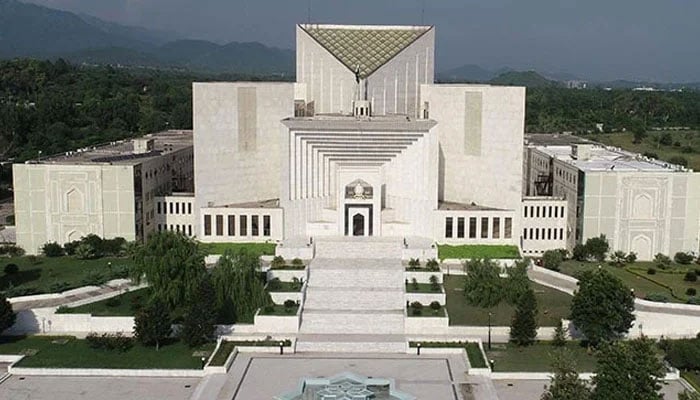
ISLAMABAD: The Supreme Court has dismissed the jail appeal of convict Taimoor Sattar, who was sentenced for murdering his parents with a hammer over a property dispute after they refused to transfer family land in his name.
A three-member bench comprising Justice Muhammad Hashim Khan Kakar, Justice Salahuddin Panhwar and Justice Ishtiaq Ibrahim heard the case and upheld his two life imprisonment sentences. The court directed that both sentences would be served consecutively, meaning one sentence would begin after completion of the other.
According to the judgment, Taimoor Sattar killed his parents, Abdul Sattar and Shamim Akhtar, by attacking them with a hammer in anger over the family property dispute. The trial court had initially awarded him the death penalty, but the Lahore High Court later converted the punishment into two life imprisonments and ordered them to run concurrently.
Taimoor Sattar challenged the high court’s decision through a jail appeal before the Supreme Court, which was dismissed.
In another significant ruling, the Supreme Court partially accepted an appeal filed by accused Fateh Sher in a Khushab murder case, removing the charges under Section 7 of the Anti-Terrorism Act while maintaining his conviction and death sentence under the Pakistan Penal Code.
The case related to a 2008 incident in the Mitha Tiwana area of District Khushab, where three members of a family — Safia Bibi, her daughter Shaheen Kausar and her son Wali Ahad Shahzad — were killed over a dispute involving a marriage proposal.
The accused, Fateh Sher and others, had been convicted under Section 302 of the Pakistan Penal Code and Section 7 of the Anti-Terrorism Act, and were awarded different punishments, including the death penalty.
The Supreme Court observed that the brutality or seriousness of a crime alone does not automatically bring it within the scope of anti-terrorism laws. The court held that prosecution under terrorism provisions requires proof of a direct connection between the offence and an intention to create fear or terror among the public.
The court ruled that crimes resulting from personal enmity, family disputes or private conflicts cannot be treated as acts of terrorism unless evidence establishes an intent to spread terror in society. While removing the anti-terrorism provisions, the Supreme Court maintained the punishments awarded under the Pakistan Penal Code, including the death sentence.