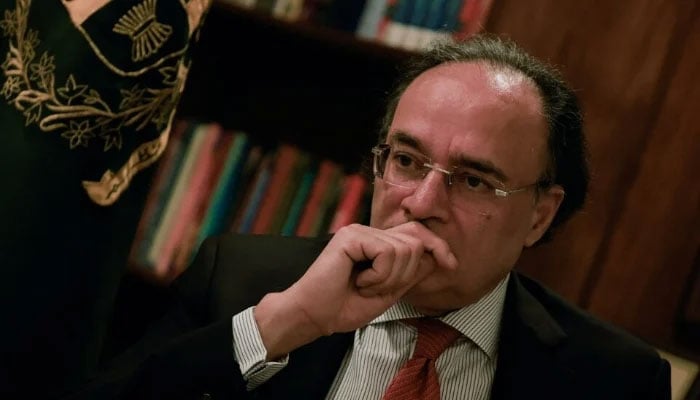
ISLAMABAD: Finance Minister Muhammad Aurangzeb on Thursday conceded in the Senate that Pakistan had missed its GDP growth target, attributing it to global and regional conditions.
Winding up the budget debate in the House, the minister noted that extensive discussions were held on all aspects of the budget with senators and representatives of various chambers and trade organisations, and that some proposals from trade bodies were also incorporated into the document.
He shared with the House that a scheme is being introduced to bring small shopkeepers into the tax net with minimal compliance burden as part of efforts to document the economy. He added that the government was also carrying out fundamental changes in the structure of Federal Board of Revenue (FBR).
“Human intervention in FBR’s role is being minimised and the system is being digitised. These reforms are aimed at helping the nation stand on its own feet,” he emphasised.
Referring to recent floods in three provinces, he explained that the government had the resources to cope with the situation and therefore did not seek international aid. The minister also announced key concessions, noting that advance tax on the export sector has been abolished to improve cash flow for exporters, markup rates on various financing schemes have been reduced, and Customs duties have been cut in different categories.
He continued that no new taxes have been imposed on the IT sector, adding that the government is taking steps to provide a better ecosystem for freelancers and arranging training to improve their professional skills. The move aligns with the Senate committee’s recommendation to extend IT tax incentives for 10 years.
With regard to the agriculture sector, he noted that the government is simplifying loan disbursement for small farmers, while tax on the import of agricultural machinery has been abolished to reduce input costs. Moreover, he announced that Rs10 billion have been earmarked for the Youth Loan Scheme for the agriculture sector.
Earlier, PPP Senator Waqar Mehdi came down hard on the budget and charged that the minister for finance has perhaps never spent a day with a poor person, questioning whether the budget truly considered the plight of low-income households. He lamented that the salaried and low-income classes brace for impact every June, saying, “When June comes, the poor class gets scared.”
Senator Mehdi also decried, what he called, the burden on motorcycle users, noting that around 30 million motorcycles are used in the country, and if even two litres of petrol are used daily, the monthly expense comes to Rs22,000.
He criticised the FBR’s performance and lamented that the revenue collector never meets its target while provinces collect more revenue than it does. He added that if the FBR is not doing its job, then the government should bring in a better economic team.
On the issue of water scarcity in Sindh, he said there are huge water problems in the province, which never receives its share of water.
Taking part in the budget debate, MQM Senator Khalida Ateeb lashed out at the Sindh government over the shortage of water in Karachi and the “collapsing health and education sectors.” She remarked, “With extreme regret I say that the Sindh government itself does not want the people of Karachi to get relief. Forget Karachi, the condition of schools across Sindh is bad and there are serious health problems.”
The MQM lawmaker referred to the rabies vaccine shortage as an example of the crisis and claimed that in Sindh’s hospitals, there is not even a vaccine for dog bites.
Meanwhile, talking to the media outside the Parliament House, Leader of the Opposition in the Senate Allama Raja Nasir Abbas said that they had outright rejected what he termed an extremely cruel budget. He accused the government of needlessly piling up a massive burden of loans and, despite that, failing to deliver on the economic front.
He alleged that the public mandate has been robbed in Gilgit-Baltistan, and if this trend continues, the government there too will soon face a public action committee, indirectly referring to the Joint Awami Action Committee in the AJK.
Regarding regional and global developments, he welcomed the deal between Iran and the United States as an important development, stressing that Tehran’s sovereignty and peace in the region are urgent needs of the hour. He paid tribute to Pakistan’s role in establishing a ceasefire and reducing tensions, adding that the diplomatic efforts of all relevant figures, including the prime minister, foreign minister, Field Marshal and interior minister, are commendable for playing a positive role in establishing peace.