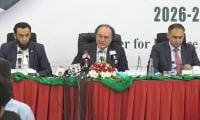
ISLAMABAD: Renowned experts and business leaders on Sunday said despite tax relief for various sectors, investment and industry would continue to face significant challenges.
During a special transmission on Geo News, host Shahzeb Khanzada initiated the debate and said there was growing criticism that those already in the tax net were being burdened further, while those outside the tax net continued to avoid sharing the burden. He noted that the government had provided tax relief to the salaried class and abolished super tax for exporters.
He said the government was making efforts to revive the economy, but there could be slippages in achieving macroeconomic targets.
Pakistan Business Council PBC chairperson Dr Zeelaf Munir said the government had moved in the right direction by reducing the tax burden on the formal sector. She noted that the FBR itself had acknowledged the existence of an undocumented economy.
Pakistan exports nearly 800 products to various destinations. Investors will only be attracted when there is a clear and credible roadmap before them, she said.
Lucky Cement CEO Muhammad Ali Tabba said the budget contained several positive measures and that the government deserved credit for them. He highlighted the decision to abolish duties on the shipping industry and reduce tariffs on hundreds of imported items.
He said the reduction of tariffs on nearly 500 items would improve the investment environment and enhance competitiveness. According to him, Pakistan’s manufacturing sector faces significant disadvantages compared with regional competitors, and lower duties would help local industries.
Tabba said Pakistan’s economic progress had remained slower than expected because productivity growth had been insufficient. He added that discussions on economic reforms had continued since 2018, but implementation had often lagged.
He welcomed the government’s decision to continue tariff reforms over several years rather than making abrupt changes.
According to him, investors need policy consistency and predictability. Businesses are more likely to invest when they are confident that reforms will continue and not be reversed. He noted that steel and cement production had remained stagnant in recent years. He stressed that economic policies should focus on long-term growth rather than short-term revenue collection.
He also emphasised the importance of improving relations between the government and the private sector. He said food inflation was a rising risk and called for consistent economic policies to achieve positive economic outcomes.
Arif Habib, Chairman of the Arif Habib Group, said the government had taken difficult but necessary decisions. The government’s direction was correct, but the perception that everything would be rectified immediately was unrealistic. He added that if implemented properly, these measures could help improve Pakistan’s investment climate.
He argued that investors look for consistency and confidence. The key question for investors, he said, is whether policies will remain stable over time. If confidence improves, investment can increase significantly.
He said the reduction in withholding taxes and the easing of certain tax measures were steps in the right direction. He welcomed efforts to simplify regulations and encourage economic activity.
According to him, Pakistan’s economy has the potential to grow rapidly if barriers to investment are removed. He said investment creates jobs, increases productivity and ultimately improves living standards.
He emphasised that both domestic and foreign investors need a predictable policy environment. He also stressed that exports must increase substantially if Pakistan is to achieve sustainable economic growth.
Gul Ahmed Textiles director Ziad Bashir said the government had taken steps within its capacity to improve the economic situation. He praised the government for providing relief at a time of geopolitical uncertainty. He suggested focusing on value addition to increase productivity.
He said there was a need to address infrastructure bottlenecks and pursue economic policies consistently. The government, he said, plays a pivotal role in overcoming economic challenges.
Economic expert Muhammad Sohail said the government had kept the budget deficit below 4 percent of GDP in the previous budget, which was a right decision because it created buffers through the accumulation of foreign exchange reserves and fiscal space.
He said if the US-Iran war ended, Pakistan’s buffers could strengthen further. The government had absorbed external shocks, but if fuel prices rose to $150 per barrel, the economy would come under pressure. The government, he said, had kept the ongoing conflict and the IMF’s stringent conditions in mind while preparing the budget.
He said exports and remittances had crossed important benchmarks and called for consistency in economic policies. He also urged the government to focus on productivity and population control.
Macroeconomist Ammar Habib from IBA said that unless the NFC structure was overhauled, fiscal problems would remain unresolved. He noted that a major share of resources was transferred to the provinces under the NFC Award.
Pakistan’s investment-to-GDP ratio was insufficient to support strong growth and would need to double or even triple to achieve the desired results.
He warned that if remittances were diverted towards real estate, their economic benefits would remain limited. Pakistan is not part of the global value chain, and without value addition, this objective cannot be achieved, he added.