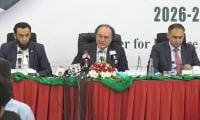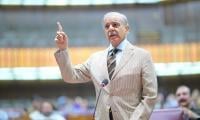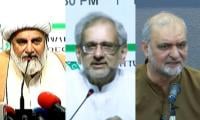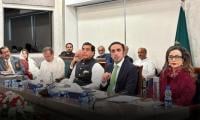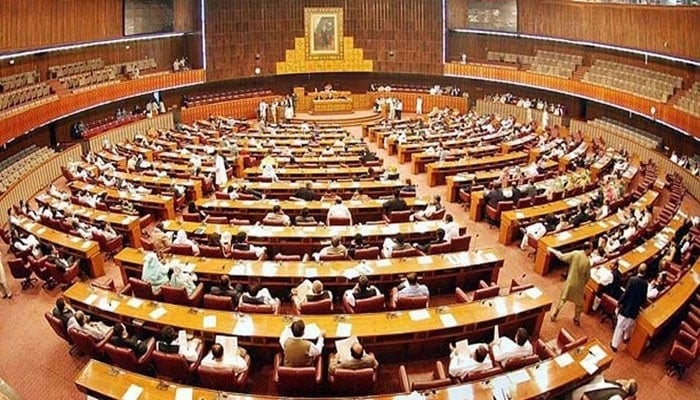
ISLAMABAD: Minister for Information and Broadcasting Attaullah Tarar on Sunday reminded the PTI that its leaders had conspired against the economy by writing letters to the IMF opposing approval of loans.
“Not only were letters written to the IMF, but a narrative was also built and a campaign was run. It is on record that the PTI leadership wrote letters to the IMF,” he said while speaking in the National Assembly during the budget debate.
He said while Prime Minister Shehbaz Sharif was holding meetings with IMF officials in Paris, letters were being written from Pakistan urging that the country should not be assisted.
Without naming Imran Khan, Tarar said his statements were on record claiming that Pakistan was about to default within a couple of months and that bets were being placed on it.
He said it was the opposition’s right to criticise the government, but positive measures introduced in the budget should also be appreciated.
He recalled that Prime Minister Shehbaz had offered a Charter of Economy more than once in the larger national interest, which would have benefited the country had the offer been accepted.
Tarar said the PMLN government assumed power in extremely difficult economic circumstances and successfully steered the country away from economic uncertainty.
“There was a time when political leaders openly predicted Pakistan’s default and discouraged investment in the country, while some even wagered on the country’s economic collapse,” he said. He added that Shehbaz demonstrated courage and determination by preferring the state over politics.
“At that time, the inflation rate was 38 percent, the exchange rate was highly volatile, businesses faced difficulties in opening letters of credit and exporters struggled due to uncertainty in the market,” he said.
He added that the government’s economic reforms and stabilisation measures had created the fiscal space required to provide relief to the salaried class, exporters, retailers, the housing sector and other segments of society in the Federal Budget 2026-27.
Tarar said the present economic stability was the result of collective efforts by institutions and stakeholders, while Prime Minister Shehbaz Sharif and his team worked tirelessly to improve economic indicators.
The minister described the budget as one for all segments of society, including farmers, labourers, shopkeepers, retailers and salaried people. Describing the budget as relief-oriented, he said Pakistan was entering a period of economic prosperity as a result of sustained reforms and prudent economic management. He said Pakistan was receiving increasing recognition at the international level and that the world was acknowledging the efforts of Prime Minister Shehbaz Sharif and Field Marshal Syed Asim Munir for peace and stability.
“Prime Minister Shehbaz Sharif spent every moment of the past year striving to create fiscal space for public relief and fulfilled his commitment to providing relief whenever economic conditions permitted,” he said.
Tarar urged all political stakeholders to place Pakistan’s dignity and prestige above partisan interests. He said the world acknowledged Pakistan’s economic stabilisation and the government’s efforts to restore confidence in the economy.
The minister said inflation had fallen to single digits, while the policy rate had been brought down from over 22 percent to 11 percent. He said GDP growth, which stood at minus 0.2 percent when the previous government left office, had increased to 3.7 percent, while per capita income had risen from $1,751 to $1,901. Tarar said foreign exchange reserves had increased to $17.2 billion and now covered nearly three months of imports.
He said workers’ remittances had reached $33.9 billion, registering a nine percent year-on-year increase and setting a new record. The minister said IT exports had reached $3.8 billion, including a contribution of $995 million from freelancers.
Highlighting reforms in the Federal Board of Revenue (FBR), he said the government had eliminated the culture of recommendations and introduced a transparent posting and transfer mechanism. He said the finance ministry and FBR teams had collected Rs800 billion through enforcement measures in the previous year, creating fiscal space for relief to salaried and underprivileged segments of society.
The minister said previous governments also had the opportunity to implement such measures but remained focused on political narratives instead. He said billions of rupees remained tied up in tax litigation in the past due to collusion and stay orders, but the government established merit-based tribunals and appointed legal professionals on merit, leading to substantial recoveries.
He said sectors such as sugar, tobacco, cement and beverages had previously escaped effective monitoring, but technology-based systems had now improved oversight.
Tarar said Rs60 billion had been recovered in taxes from the sugar industry alone. He said the FBR had introduced a faceless appraisal system that would eventually be expanded nationwide, eliminating direct interaction between taxpayers and tax collectors and reducing opportunities for corruption and leakages.
Tarar said FBR reforms had introduced transparency and helped establish a fair system under which tax-compliant citizens would no longer bear the burden of tax evaders. He said around 3.6 million retailers who were previously outside the tax net were being brought into the formal system through a fixed-tax mechanism. The minister said the Bill & Melinda Gates Foundation had provided free support for the digitalisation of FBR, while the government continued to engage international partners for institutional reforms and investment promotion. Referring to the prime minister’s recent visit to China, he said agreements were reached with Alibaba, and the company subsequently announced investment in Pakistan.
Tarar said special relief had been provided to the housing and development sector through the budget, which would benefit not only homeowners but also a range of allied industries. He said the Apna Ghar scheme was providing major relief to low-income and middle-class families and helping deserving citizens secure housing opportunities.
The minister said export-led growth would significantly benefit the national economy by promoting industrial expansion, employment generation and economic activity. He said exporters’ longstanding demand regarding advance tax had been addressed, while the government had also reduced minimum tax and abolished super tax for all exporters on the directions of Prime Minister Shehbaz Sharif.
Tarar said these decisions followed an extensive consultation process involving industrialists, chambers of commerce, IT sector, agriculture stakeholders and other sectors of the economy.
He said customs duty on imported agricultural equipment had been reduced, while sales tax on shipping services had been cut from 18 percent to zero percent. He said the government had abolished the so-called “pink tax” by reducing taxes on women’s hygiene products from 18 percent to zero percent. Tarar added that taxes on contraceptives had also been reduced from 18 percent to zero percent to support efforts related to population management.
Meanwhile, Minister for Planning, Development and Special Initiatives Ahsan Iqbal advised opposition members to focus on discussing the federal budget with facts instead of misrepresentations.
Responding to points raised by former National Assembly speaker Asad Qaiser, he said the PTI government undermined democratic values during its tenure. He alleged that during the PTI tenure, production orders for detained members of parliament were often delayed despite repeated requests from the-then opposition.
“There was a time when opposition members even went to the extent of pleading for the issuance of production orders for arrested parliamentarians, yet those orders were not issued,” he said.
Talking about PTI’s criticism of the judiciary, Ahsan said the former government failed to implement the Supreme Court orders for nine months after local governments were restored in Punjab. He also accused the PTI administration of politically victimising opposition leaders through what he termed fabricated cases.
He said several leaders of the Pakistan Muslim League-Nawaz (PML-N), including former prime minister Nawaz Sharif, Shehbaz Sharif, Maryam Nawaz, Khawaja Asif, Khawaja Saad Rafique, Hamza Shehbaz and Rana Sanaullah, faced imprisonment during that period. He said the incumbent government had undertaken development initiatives in Swabi, the constituency of Asad Qaiser, and had also established a university there.
Earlier, Asad Qaiser challenged the government to compare its budgetary and fiscal figures with those of the PTI government. “I challenge you to compare the present dollar rate, inflation, tax collection and relief provided to the salaried class during our tenure,” he said.
He also criticised the federal budget, saying it had failed to provide relief to the masses. He reiterated PTI’s willingness to engage in dialogue on a Charter of Economy and called for the formation of an Election Commission acceptable to all political stakeholders.
Responding to the allegations made by the information minister, Asad Qaiser said PTI had written a letter to the IMF but maintained there was nothing objectionable in its contents. He said his party supported judicial independence and a stronger parliament and urged political forces to work together to strengthen democratic institutions.
PPP lawmaker Dr Sharmila Faruqi criticised the government’s budgetary figures, saying the government had set the poverty threshold at a monthly income of Rs8,483. She asked whether a person earning Rs8,483 a month could run a household. “As per the government’s data, every fourth Pakistani is living below the poverty line,” she said.
Opposition member Shahid Khattak said the PTI government was removed and replaced by a 13-party PDM coalition through what he described as a staged change. He said the PTI government performed exceptionally well during the Covid-19 period and protected the middle class from hardship. He added that had the PTI government not been removed, the country would have progressed further.
PPP MNA Hussain Tariq said the FBR had repeatedly failed to meet its revenue targets and suggested that collection targets should be assigned to the provinces. He supported Bilawal Bhutto Zardari’s proposal regarding tax collection, saying it appeared that the target might once again not be achieved.
JUI-F MNA Shahida Akhtar Ali said the budgetary figures did not reflect the budget of an independent state and instead appeared to be an IMF-dictated document. She questioned how the government would achieve significantly higher revenue targets when it had failed to meet the previous targets.
Amir Dogar demanded a reduction in the petroleum levy to provide relief to the common man. He also called for increased allocations for the construction of water reservoirs.
Shahida Begum said the government should consider reducing GST to provide relief to poor people.
Syed Waseem Hussain highlighted the problems faced by Karachi and stressed that they should be addressed. He also regretted delays in the completion of Hyderabad-Sukkur Motorway, which were causing inconvenience to commuters.
Responding to Syed Waseem Hussain’s points, Minister for Planning and Development Ahsan Iqbal said the Hyderabad-Sukkur Motorway would be completed within the next three to four years. He added that work had begun on the new alignment of M-9 Karachi-Hyderabad route. He said the K-4 project would be completed by the end of this year, after which the provincial government would undertake its augmentation.