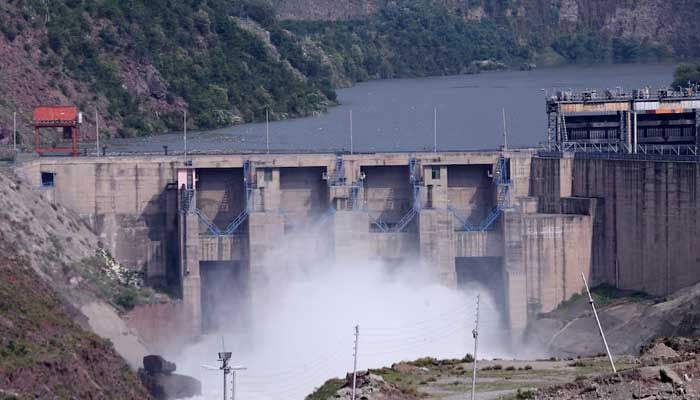
ISLAMABAD: Pakistan on Thursday sent a strong warning to India’s Modi government that any deliberate attempt to block water essential to Pakistan’s survival and development would constitute an extremely grave act with far-reaching consequences, possibly an act of war.
It rejected any notion that water can be treated as a political tool or instrument of coercion or a weapon as this threatens not just regional peace and security of South Asia and beyond – the responsibility of such consequences would fall squarely on India’s shoulder.
Reacting to threats from New Delhi that “on the directives of Prime Minister Modi not a single drop of water will go to Pakistan in the coming years”, Spokesperson at the Foreign Office Tahir Andrabi responded, “Any attempt to block or substantially curtail water, vital to livelihood, agriculture and well-being of more than 250 million Pakistanis, would be a deeply irresponsible act contrary to established international obligations concerning transboundary rivers and indeed India’s own bilateral agreement.”
The spokesperson warned that any such act would be treated with utmost seriousness and could possibly amount to an act of war. Under Article 51 of the UN Charter, every state retains the inherent right to self-defence. Accordingly, Pakistan will take all necessary measures to safeguard its economy and its vital national interest and lives of its 250 million people.
“We call upon India to act responsibly, honour its international commitment and refrain from statements and actions that could further escalate tensions in the region. Pakistan remains committed to safeguarding its interests, as I said, and we will closely monitor developments on the ground in Indian Illegally Occupied Jammu and Kashmir, and elsewhere from where these water resources emerge,” he asserted.
Reacting to Indian statements related to the ongoing situation in Azad Jammu and Kashmir, the FO spokesperson said Pakistan rejected these as it was untenable for a state like India, which has consistently denied the people of Jammu and Kashmir their right to self-determination, to claim concerns over the rights of Kashmiris.
“We also reject any insinuation of the false equivalence between the situation in Indian Illegally Occupied Jammu and Kashmir and matters relating to Azad Jammu and Kashmir. Indian Illegally Occupied Jammu and Kashmir is an illegally annexed, internationally recognised disputed territory whose people have suffered systemic abuses under draconian laws and have been denied their rights, including the right to self-determination, as affirmed by the relevant UN Security Council resolutions, and as promised by the Indian founding fathers to the Kashmiri people. Situation in Azad Jammu and Kashmir, on the contrary, we are addressing issues arising within the democratic and constitutional framework. Any attempt to conflate the two is misleading and does not withstand objective scrutiny,” he added.
To a query in which Sipri suggested that India might have altered its traditional nuclear posture by reportedly deploying around 12 nuclear warheads during peacetime alongside indications of missile system, and a more operationally ready nuclear force, the spokesperson said that while not wishing to “endorse or lend credence to Sipri’s methodology and its findings, Pakistan is not surprised.
“These findings broadly corroborate concerns which Pakistan has consistently been raising regarding India’s continued vertical proliferation. We also believe that open-source estimates, such as Sipri, may not fully reflect the actual scale of India’s nuclear arsenal that may actually be higher than the existing estimates. Pakistan is also cognisant of developments in India’s strategic capabilities, including canisterisation of the missile systems, expansion of sea-based nuclear capable submarines and pursuit of increasingly a longer range of intercontinental ballistic missile systems that go far beyond India’s periphery neighborhood or its legitimate defence needs,” he pointed out.
Commenting on the renewed hostilities between Iran and the United States, the spokesperson continued to sound optimistic. “If a mediator and facilitator loses hope, or becomes pessimistic, this does not augur well for the peace process. So, Pakistan remains engaged. We understand the challenges, we understand how the diplomatic space has shrunk because of these hostilities. But I will certainly say that we have not lost hope. Challenges of ceasefire, and cycles in an armed conflict – where you have space for peace, space for dialogue and then you have a cycle of hostilities are expected in all international conflicts. Situations [in many conflicts] do recur where the peace/ceasefire is interspersed with hostilities and attacks. This is natural progression in conflict situations,” he explained.
About Pakistani nationals in the captivity of Somali pirates for almost over 50 days, he said early next week relevant ministries and stakeholders will hold meetings in Islamabad to further streamline the ongoing efforts and better coordinate the initiatives for the release of Pakistani hostages.
To queries on Pakistan’s attack on June 9 along the Pakistan-Afghanistan border areas, the spokesperson said these were aimed at hideouts of safe havens of terrorist mastermind and the planners belonging to Fitnah Al Khwarij, who had perpetrated these attacks in Bannu and earlier in North Waziristan. “We acted on credible intelligence with selective targeting of camps and hideouts. The targeting was with precision and accuracy. You have seen and referred to the statement by the minister of information – this is what the situation on the ground was,” he said.
Pakistan continues to be engaged at the UN regards listing of BLA and Majeed Brigade as a terror organisation. “Action taken by certain permanent members in the UN Security Council, the United States and probably the UK as well, were technical in nature. Both these countries have listed the BLA as designated terrorist organisation within their domestic systems. Australia has listed the BLA, a number of European countries have also listed the BLA. The fact is that the action in the Security Council was a result of a technical/ procedural issue. Our mission to the United Nations in New York is engaged with the UN Secretariat and with relevant delegations on this issue,” he said.