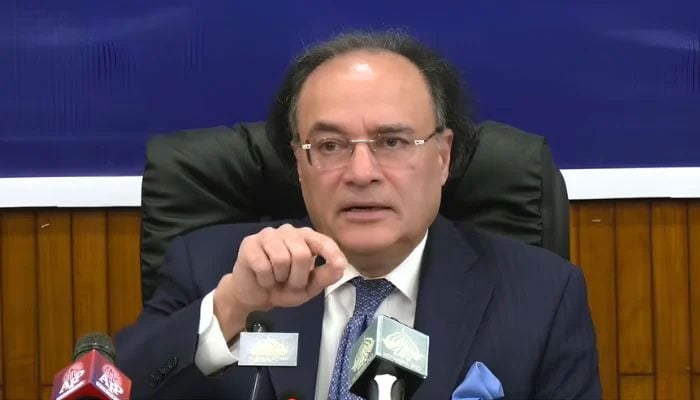
ISLAMABAD: Highlighting three major factors negatively affecting Pakistan’s economy — the eruption of a tariff war, super floods and regional conflict in the wake of US-Iran fight — Minister for Finance Muhammad Aurangzeb on Thursday unveiled the Economic Survey for 2025-26, whereby the government failed to achieve the majority of macroeconomic targets.
Investment and savings as a percentage of GDP remained stagnant, hovering around 14.3 percent and 14.1 percent respectively in the outgoing fiscal year.
Foreign Direct Investment (FDI) plummeted despite the much-trumpeted Special Investment Facilitation Council (SIFC). The fiscal deficit and primary balance related targets agreed with the IMF were largely achieved. The current account deficit remained within manageable limits in the outgoing fiscal year.
The GDP growth rate was at 3.7 percent against the envisaged target of 4.2 percent. Inflation rebounded in the aftermath of US-Iran war and entered double digits. Exports declined, imports surged, the FBR’s tax collection target was missed and public debt in absolute figures ballooned in 2025-26. Per capita income rose to $1,901 in 2025-26 compared to $1,751 in the previous fiscal year. The size of Pakistan’s economy in dollar terms touched $452 billion in FY26 against $408 billion in the previous fiscal year. In rupee terms, the size of the economy stood at Rs126.9 trillion, showing an 11.3 percent increase from the previous year’s Rs114 trillion. The exchange rate remained stable at Rs280.65 per US dollar compared to Rs279.35 per US dollar in FY2025.
Net foreign direct investment recorded inflows of $1.4 billion, led by China and Hong Kong, with the power sector and financial services attracting the largest shares. As of April 17, 2026, foreign exchange reserves stood at $20.6 billion, including $15.1 billion held by the State Bank of Pakistan (SBP), reflecting strengthened external buffers. During July to March, the fiscal deficit stood at 0.7 percent, while the primary surplus was 3.2 percent. During July to March, the current account surplus stood at 72 million dollars.
“This Economic Survey for 2025-26 narrates the story of the outgoing fiscal year. Three major factors tested Pakistan’s resilience — tariff war, floods hitting the largest province of the country and ME conflict — resulting in lower growth, which stood at 3.7 percent against the target of 4.2 percent, while inflation also rebounded,” Aurangzeb stated while launching the Economic Survey here on Thursday.
The poverty rate in Pakistan stood at 28.9 percent, and the unemployment rate went up to 7.1 percent in 2024-25.
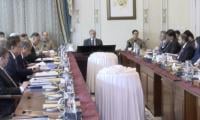
Flanked by Minister for Planning Ahsan Iqbal, Minister for Information & Broadcasting Attaullah Tarar, Minister of State for Finance Bilal Azhar Kiani, Finance Secretary Imdad Ullah Bosal, FBR Chairman Rashid Mehmood Langrial and Economic Advisor Dr Raja Hasan Mohsin, the finance minister stated that the fiscal arrangement undertaken between the Centre and provinces would continue to stay for one year. He praised the role played by the Khyber Pakhtunkhwa chief minister and his Adviser on Finance, Muzammil Aslam, for sticking to the IMF programme’s targets.
With regard to the retailers’ fixed tax scheme, he said that there were 3.5 to 4 million small retailers and the government had to start bringing them into the tax net from somewhere.
Pakistan, the minister said, would stick to the path from stabilisation to growth, and he termed the 3.7 percent GDP growth as broad-based, which was the highest in the last four years. He also shared that the Tax Operations Model would be implemented in the next fiscal year. The minister said that FDI could not be attracted until and unless domestic investment was promoted.
The minister said that Pakistan would have to avoid a boom-and-bust cycle, as accelerated growth resulted in the creation of twin deficits; however, the government did not repeat this kind of higher growth. He said that there were no sacred cows and everyone would have to pay their due taxes.
The minister for finance stated that out of 22 LSM sectors, 16 have recorded growth. Demand in the cement sector increased by 10 percent, fertiliser demand by 17 percent, petroleum by 5 percent, auto sector by 31 percent and mobile phone demand by 9 percent. Tax revenue increased by 10.1 percent.
He said that while some international companies have left the country, many companies have either come in or expanded their investments. Regarding loans, he informed that 30 to 40 percent of the country’s loans are concessional.
On the issue of taxation, he said that due to digital monitoring, an additional Rs60 billion in taxes has been collected from the cement and sugar sectors. During the current year, digital monitoring will also be carried out in tobacco, beverages and textile sectors.
Regarding transformation in the FBR, he said that the culture of any institution cannot be fixed within two years. Eliminating the culture of recommendations (sifarish) is not so easy. To eliminate corruption, human intervention will have to be reduced.
In response to a question about exports, he said that the closure of the border with Afghanistan has caused a decline of one billion dollars in exports.
The finance minister said that the UAE has supported Pakistan for a long time. “We have longstanding, durable relations with the UAE. A large number of Pakistanis are working in the UAE. We are grateful to the UAE for this.”
The FBR chairman stated that the tax collection in dollar terms stood at $32.6 billion in June 2024, which increased to $41.9 billion in 2025 and $46 billion in June 2026, thus resulting in a revenue increase of $14 billion. The culture of ‘sifarish’ (favouritism) and patronage has been eliminated from the FBR, he added.
On the economic front, Pakistan’s GDP grew by 3.7 percent, supported by growth across all major economic sectors. The agriculture sector recorded a growth of 2.89 percent, driven by important crops and livestock. The industrial sector posted a growth of 3.51 percent, supported by sharp growth (6.11 percent) in large-scale manufacturing (LSM). The services sector, as the largest contributor to GDP (58.42 percent of GDP), expanded by 4.09 percent, supported by strong growth in information and communication services (7.52 percent).
During 2025-26, the agriculture sector recorded a growth of 2.89 percent, compared to 1.53 percent during the same period last year. Government initiatives and timely support measures helped the crop sub-sector demonstrate resilience in the wake of 2025 floods, enabling it to perform better than expected. The sub-sector recorded growth of 1.44 percent, compared with a contraction of 1.01 percent in 2024-25, mainly on account of better production of important crops. Important crops, including cotton, rice, sugarcane, maize and wheat, registered overall growth of 0.65 percent compared to last year. Better performances in sugarcane, wheat and rice ultimately offset production declines in cotton and maize. Sugarcane registered the highest growth at 6.2 percent (rising from 84.24 to 89.45 million tonnes), followed by wheat at 4.3 percent (increasing from 28.40 to 29.61 million tonnes), and rice at 2.8 percent (up from 9.72 to 9.99 million tonnes).
Other crops recorded growth of 2.43 percent despite flood-related disruptions, mainly supported by higher production of pulses, vegetables and fruits, which increased by 31.4 percent, 12.6 percent and 2.8 percent respectively. Cotton ginning and miscellaneous, which have a share of 1.04 percent in agriculture and 0.24 percent in GDP, registered a marginal growth of 0.07 percent mainly due to lower cotton production.
The livestock sub-sector expanded by 3.75 percent, compared with 2.95 percent in 2024-25. This performance was supported by a 3.46 percent increase in output, notwithstanding a 4.5 percent decline in green fodder availability.
The manufacturing sector recorded a growth of 6.6 percent on the back of a robust performance by the LSM during FY2026. The Quantum Index of Manufacturing (QIM) during July-March FY2026 recorded a growth of 6.5 percent over the corresponding period last year. Based on QIM data, the growth of LSM (FISIM adjusted) has been estimated at 6.1 percent for FY2026. This revival was supported by favourable macroeconomic conditions, a stable exchange rate, contained inflationary pressures and a relatively easing monetary policy. Out of 22 manufacturing sectors, 16 reported growth, including food, textiles, wearing apparel, coke & petroleum products, non-metallic mineral products, automobiles, beverages and electrical equipment.
Investment posted growth of 11 percent, with the investment-to-GDP ratio remaining stable at 14.4 percent. Private sector contribution to growth remained higher than that of the public sector, indicating a gradual recovery in capital formation and improving investor confidence.
Although, net exports remained under pressure due to external headwinds, including the Middle East conflict and a slowdown in global trade, the demand-side recovery was mainly supported by domestic factors. This reflects the economy’s increasing reliance on internally anchored growth, supported by improved macroeconomic stability and continued policy efforts to revive investment.
Total public debt stood at Rs634 billion in 1971, which has now ballooned to Rs83,285 billion in 2026. External public debt was recorded at $92.2 billion at the end of March 2026, showing an increase of around $364 million during the first nine months of the current fiscal year compared to an increase of $883 million during the same period of the last fiscal year.
Official data shows that domestic debt stood at Rs57.6 trillion, while external debt amounted to Rs25.7 trillion. During July–March FY2026, the government paid Rs4.95 trillion in interest expenses, including Rs4.29 trillion on domestic debt and Rs660 billion on external debt, highlighting the significant fiscal burden of debt servicing.
The government financed its fiscal deficit entirely through domestic borrowing during the period, primarily using medium- and long-term instruments such as Pakistan Investment Bonds (PIBs) and Government Ijarah Sukuk, reducing dependence on short-term financing.
In a major debt management initiative, authorities conducted buybacks of approximately Rs2.1 trillion worth of government securities under strategic liability management operations. The move was aimed at rationalising debt servicing costs and improving the maturity profile of public debt.
To diversify investment options and attract institutional investors, the government introduced a 15-year zero-coupon Pakistan Investment Bond, raising Rs263 billion on a realised value basis. Authorities also expanded Shariah-compliant financing avenues through the launch of a 10-year zero-coupon fixed-rate Sukuk.
Demand for Islamic financing instruments remained strong, with the government mobilising approximately Rs2.25 trillion through Sukuk issuances during the first nine months of the fiscal year.
On the external financing front, Pakistan received $6.1 billion in budgetary disbursements, including $2.7 billion from multilateral lenders, $1.1 billion from bilateral development partners, $2.0 billion through Naya Pakistan Certificates and $200 million from commercial banks.
The country also received $1.2 billion under the International Monetary Fund’s Extended Fund Facility (EFF) during July-March FY2026, providing additional support to external financing needs and economic stabilisation efforts.
Meanwhile, the Pakistan Tehreek-e-Insaf (PTI) Information Secretary Sheikh Waqas Akram rejected outright, what he called, the government’s “Fake Progress” Economic Survey as a cruel charge-sheet against Pakistan’s poor people.
“Pakistan Tehreek-e-Insaf demands transparent, verifiable data using consistent baselines, including the PTI era, and rejects this survey as a politically motivated document designed to mislead the nation and international stakeholders,” he contended.
Reacting to the release of the document, he termed it a masterpiece of statistical manipulation, selective storytelling and shameless political propaganda that completely ignores the grinding realities faced by the masses.
“This document is not an Economic Survey, it is an anti-poor manifesto wrapped in fancy tables and self-congratulatory claims. It is a formal charge-sheet against the suffering people of Pakistan,” he alleged.
He pointed out that while the government proudly flaunts a 3.7 percent GDP growth, it conveniently forgets the PTI era’s robust 6.5 percent growth under Imran Khan.
He also ridiculed the claims of rising per capita income from $1,700 to $1,900 (now touted at $1,901), questioning the opaque methodology and dubious sources behind these figures.
He “exposed” the inflated agriculture growth figures (claimed at 2.89 percent), heavily propped up by unverifiable livestock numbers that constitute a suspicious 60 percent share and act as the main driver.
Dismissing the much-touted 6.1 percent LSM growth, he said that factory closures, industrial shutdowns and fleeing investors tell a completely different story on the ground. “Their 6.1 percent is as real as their promises of ‘good days’.”
The PTI leader slammed the government for “shamelessly” taking credit for initiatives like the Roshan Digital Account and Naya Pakistan Certificates, originally launched by Imran Khan in 2020.
The PTI spokesman criticised the narrow comparisons limited to the current regime’s tenure, ignoring the full picture and PTI’s superior performance.
Waqas Akram shredded the government’s inflation narrative: while the survey claims “price stability broadly preserved” with average CPI inflation at 6.2 to 6.7 percent during July-April FY26 (compared to 4.5-4.7 percent last year), the reality is a fresh spike to 11.7 percent year-on-year in May 2026 — the highest since June 2024 — driven by surging food, energy and transport costs amid external shocks they conveniently blame on others.
He said: “This Economic Survey is a declaration of war on the poor. While elites celebrate manipulated debt-to-GDP ratios (68.5 percent) and fictitious growth, the common man faces record inflation pressures, joblessness, sky-high electricity bills and vanishing livelihoods. This survey is not about progress — it is about protecting a failed regime at the expense of the people.”