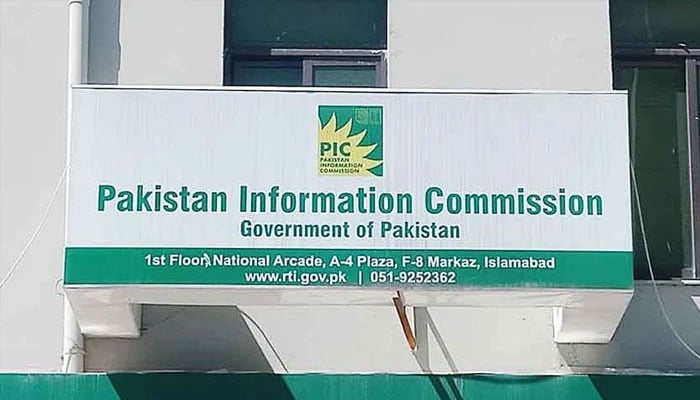
LAHORE: In a far-reaching decision with significant implications for transparency and public accountability, the Pakistan Information Commission (PIC) has declared the Islamabad Club a public body under the Right of Access to Information Act, 2017, holding that the institution is subject to public scrutiny owing to its occupation of hundreds of acres of state land on highly concessional terms and its statutory links with the federal government.
In a detailed order issued by the Chief Information Commissioner Shoaib Ahmad Siddiqui and Information Commissioner Ijaz Hassan Awan directed the Islamabad Club to provide a wide range of information sought by citizen Saddia Mazhar, including details relating to the club’s membership, land holdings, audit reports, commercial activities, lease agreements and any public funds received.
The commission directed the secretary of the Islamabad Club to furnish the information within 10 days to both the applicant and the commission, ruling that the information constituted public record and did not fall within any exemption provided under the transparency law.
The appeal arose after Ms Mazhar filed an information request seeking details of the club’s total membership, membership criteria, leased properties and commercial outlets, names of tenants, rental income, details of coaches and trainers along with their remuneration, information regarding the club’s last audit and a certified copy of the audit report, total land acquired on lease, land converted to commercial use, copies of lease agreements executed with the government and details of grants or funds received from the state since January 2024.
The Islamabad Club opposed the request, contending that the applicant was neither a member of the club nor an aggrieved person and therefore lacked the legal standing to seek such information. It also argued that access to information under Article 19-A of the Constitution was restricted to matters of public importance and maintained that the information sought did not fall within that category.
The club further claimed that it was not a public body within the meaning of the Right of Access to Information Act, asserting that it neither received government funding nor enjoyed budgetary allocations from the federal government. It also contended that the club itself lacked an independent juristic personality and therefore could neither sue nor be sued in its own name.
In its reply, the club pointed to several writ petitions pending before the Islamabad High Court concerning previous orders of the commission and requested that proceedings be deferred until those matters were decided.
However, the commission rejected all objections and proceeded ex parte after the club failed to appear at the final hearing despite prior notice and did not file a response to the applicant’s rejoinder.
The order notes that the applicant had placed on record information suggesting that the Islamabad Club occupies approximately 352 acres of land, including land leased by the Capital Development Authority in 1967 at the nominal rate of Re1 per acre for the first ten years, with lease terms reportedly remaining highly concessional thereafter. The applicant further asserted that an additional 108 acres had subsequently been acquired, bringing the total area under the club’s control to around 352 acres.
The commission observed that these factual assertions had not been rebutted by the club.
“In the present case, undisputedly, state land measuring 352 acres is retained by the Islamabad Club under a lease agreement at a nominal rate of Rs1 per acre,” the commission observed, concluding that the club squarely fell within the statutory definition of a public body.
The commission also took exception to what it described as the management’s failure to present the true legal status of the institution.
The order points out that a notification issued by the Cabinet Division on April 14, 2020 categorises the Islamabad Club as an autonomous body working under the Cabinet Division, a fact which independently attracts the provisions of Section 2(ix)(a) of the Act.
The only exception made by the Commission concerned information relating to private events held at the Rawalpindi Gymkhana Club and revenue generated from such events. The commission ruled that Rawalpindi Gymkhana constituted a separate legal entity and that records pertaining to it could not be sought from the Islamabad Club.
Consequently, the appeal was partially allowed and the Islamabad Club was directed to provide all remaining information requested by the applicant within 10 days.