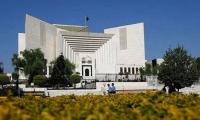
ISLAMABAD: The Supreme Court has observed that the shield of juvenility cannot be invoked to mitigate punishment for the inhumane act of acid throwing on people, and strongly recommended that the federal and all provincial governments ensure that the sale of acid to private individuals be completely banned wherever such unregulated retail trade still persists.
A three-member bench of the apex court, headed by Justice Muhammad Hashim Khan Kakar and comprising Justice Salahuddin Panhwar and Justice Ishtiaq Ibrahim, announced judgement in an acid-throwing case.
Petitioner Abdul Manan had filed an appeal in the apex court against the judgement passed by the Lahore High Court on November 21, 2022, upholding his sentence of rigorous imprisonment for life.
After hearing the case, the court upheld the verdicts of the trial court and high court and dismissed the appeal of the petitioner. “The prosecution has successfully established the petitioner’s guilt beyond a shadow of reasonable doubt, and the circumstances of the case offer no grounds for a reduction in the quantum of sentence,” said the 14-page judgement authored by Justice Kakar.
The court dismissed the appeal of the petitioner, maintaining the conviction and the sentence of life imprisonment passed against the petitioner by the courts. As per the case, the petitioner had challenged the LHC judgement dated November 21, 2022, whereby the conviction and sentence awarded to the petitioner, Abdul Manan, were upheld.
The petitioner had earlier been convicted by the Anti-Terrorism Court, Faisalabad,on February 1, 2020, for causing acid burn injuries to Ms Iqra Perveen, and was sentenced to imprisonment for life along with compensation of Rs1,000,000.
In its judgement, the Supreme Court noted that the prosecution alleges the petitioner intentionally threw acid on the victim on September 4, 2019, while she was cooking, causing severe burns to her face and body, permanent disfigurement, and leaving her bedridden since the incident.
According to the judgement, the petitioner’s counsel argued for leniency on the basis that he was 17 or 18 years old at the time of crime, had no criminal record, and had chances of reform.
However, the additional prosecutor general opposed the plea, arguing that the offence was brutal, premeditated and ruined the victim’s life, contending that young age cannot justify such a barbaric act.
The court held that the act was intentional, with the intention of disfiguring the victim — a common motivation in gender-based violence. “The seamless synergy between the confidence-inspiring ocular account and the medical evidence, specifically the ‘smoking gun’ evidence of acid burns found on the petitioner’s own fingers, leaves no room for any hypothesis of his innocence,” said the judgement.
The court further noted that it has repeatedly emphasised the gruesome and barbaric nature of acid attacks. In landmark observations, former Chief Justice of Pakistan Asif Saeed Khan Khosa described acid attacks as “an offence worse than murder. While murder ends life, an acid attack destroys the quality of life, leaving the victim in perpetual agony, social ostracism, disfigurement and dependency,” said the judgement.
The court noted that the victim suffers not only physical pain but also profound psychological trauma, loss of self-esteem, and economic marginalisation, adding that acid violence is one of the worst forms of gender-based violence in our society.
“In determining the quantum of sentence, we have given anxious consideration to the petitioner’s plea of juvenility; however, the sheer gravity and calculated brutality of this offence preclude any possibility of leniency,” it said.
“We find that the shield of juvenility cannot be invoked to mitigate a punishment for such an inhumane act for the following reasons: “The record confirms that the petitioner did not act on a sudden impulse; rather, he arrived at the victim’s residence equipped with a ‘can’ of acid, demonstrating a premeditated and cold-blooded plan to cause irreparable harm.
“The petitioner, despite his age, demonstrated the capacity to handle a dangerous corrosive substance with lethal precision. “The reasons stated above depict an exceptional depravity where the victim is consigned to a ‘living death,’ due to which we believe that the minimum sentence of 14 years is grossly inadequate,” the court held, adding that the punishment must be proportionate to the atrocity of the crime and the permanence of the scars on the innocent.
Therefore, the court held that a life sentence for the perpetrator is not excessive but is the only penalty that matches the life-long sentence of disfigurement imposed upon the victim. Consequently, “We find the petitioner entirely undeserving of a lesser penalty and deserving of the maximum penalty provided by the statute as a matter of absolute justice,” the court held.
The court strongly recommended that all the worthy high courts should actively monitor and ensure that in all cases of vitriolage, the statutory timelines provided by relevant laws for the completion of trials are strictly adhered to, as the prime intent of the legislature was to provide swift, summary adjudication to prevent secondary victimisation.
Ensuring strict adherence to these legal timelines is vital to translating legislative intent into a powerful, living deterrent against this offence deeply rooted in gender-based violence, deep-seated misogyny and patriarchal aggression.
Similarly, the court also strongly recommended that the federal and all provincial governments ensure that the sale of acid to private individuals be completely banned wherever such unregulated retail trade still persists.
The court further recommended the creation and implementation of a centralised digital system governed and monitored by the authorities concerned in real time to process all legal acid sales and purchases.
Similarly, the court also recommended that the federal and provincial governments take necessary steps for accommodating acid attack victims under disability quotas, along with enactment and enforcement of specialised legislation for the establishment of a National Acid Survivors’ Rehabilitation Fund.
“Accordingly, it is recommended that this statutory fund shall provide: comprehensive medical coverage for financing exhaustive reconstructive surgeries and specialised physical therapy; psychological and social rehabilitation through mandatory access to professional trauma counselling, psychotherapy and psychiatric care to combat the ‘social death,’ depression, and PTSD that frequently follow such attacks; and economic security through a mandatory monthly stipend for survivors who, due to the nature of their injuries or ongoing medical condition, are rendered incapable of financial self-support,” said the judgement.