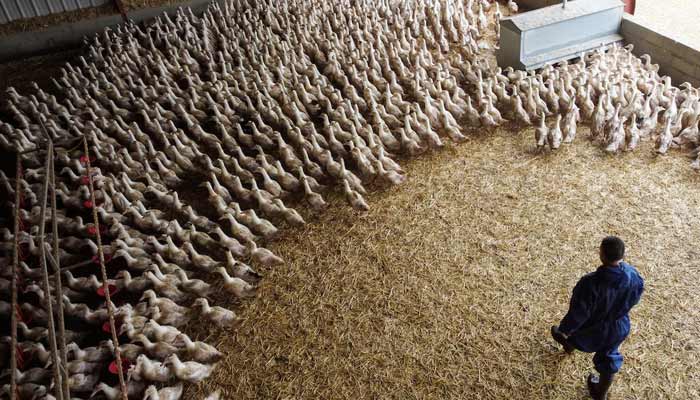
France's extreme heat has killed hundreds of thousands of poultry, overwhelming carcass collection services and prompting authorities to consider on-farm burial in the country's top two poultry-producing regions, agricultural bodies said.
The losses come as Western Europe is gripped by a deadly, record-setting heatwave that has killed dozens of people, closed schools, knocked out electricity and forced farmers to harvest grain at night, with France hitting 44.3℃ (111.7 degrees Fahrenheit) on Tuesday and the extreme temperatures set to persist over the coming days.
"In our two largest poultry-producing regions, we are seeing excess mortality due to the heat," the head of French poultry industry group Anvol, Yann Nedelec, said, adding that this was happening on both indoor and outdoor farms.
He estimated at least several hundred thousand poultry had died, but said it was too early to give a definitive number.
France is the European Union's third-largest poultry producer behind Poland and Spain. Together, Brittany and Pays de la Loire account for nearly 60% of France's poultry flock.
The Chambers of Agriculture of both regions issued notices warning of "massive" poultry deaths.
Dead farm animals are usually collected and taken to a rendering facility, but the Chambers of Agriculture said there are too many for the service to cope.
Farmers awaiting collection or burial were advised to pour sawdust or wood shavings on the carcasses to absorb liquid, and on-farm burials could be carried out only after technical and environmental checks, the industry bodies said.
A typical poultry house in France holds about 20,000 birds, and poultry farms have two poultry houses on average, according to farm office FranceAgriMer.