Today is World Environment Day. Its theme this year, ‘Inspired by Nature. For Climate. For Our Future’, asks the world to treat nature as the foundation of climate resilience. It is the right theme. It lands, for Pakistan, on a day that carries weight: June 5 is effectively the start of flood season.
The pre-monsoon systems are already moving. The NDMA recorded a significant weather event in mid-May, driven by Arabian Sea moisture and Bay of Bengal inflow, generating widespread rainfall across Punjab, Khyber Pakhtunkhwa, northern Balochistan, Gilgit-Baltistan and Azad Kashmir. The formal monsoon follows in weeks. This year, the NDMA’s own projections indicate the 2026 monsoon season may be 22-26 per cent more intense than 2025, compounded by accelerated glacial melt.
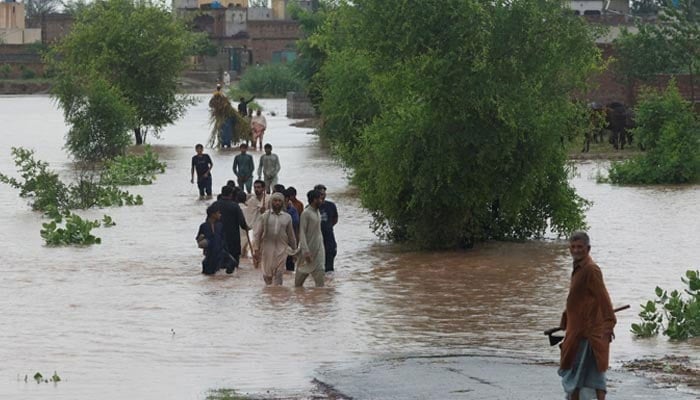
That projection deserves a moment of stillness. The 2025 monsoon was not a mild baseline. It began at the end of June and lasted through mid-September, causing over 1,000 deaths, displacing three million people, destroying 229,700 houses, 790 bridges and 2,811 kilometres of roads. An estimated 2.2 million hectares of cropland were lost. Punjab experienced its worst flooding in four decades. The 2026 season is projected to be worse.
This is Pakistan’s climate reality, stated plainly. We are the country ranked first globally by Germanwatch for climate impact in 2022. We rank 41st for climate vulnerability on the ND-GAIN Index and 154th for readiness. That gap is not a number in a report. It is the distance between a warning and a response, measured in lives.
The pattern has become familiar enough to describe in advance. Glaciers in GB and KP are melting faster than models predicted. Flash floods arrive first in mountain districts, where early warning coverage is thinnest. Then, riverine flooding reaches Punjab’s plains, where drainage infrastructure has not been substantively upgraded in decades. Then the rains hit Sindh, where coastal exposure and inadequate embankments make every heavy monsoon season a negotiation with catastrophe. And then, after the waters recede, come the pledges.
Pakistan has become extraordinarily good at the politics of climate vulnerability. We secured the Loss and Damage Fund at COP27. Our 2022 floods were the defining image of the adaptation finance argument for three consecutive years of negotiations. The Geneva conference in January 2023 generated $10.57 billion in pledges.
What has not followed is absorption. Of those pledges, roughly $2.8 billion had been disbursed by late 2025: a 28 per cent disbursement rate, two and a half years on. Pakistan holds direct accreditation with the Green Climate Fund through very few domestic entities. The entire GCF portfolio for Pakistan stands at $304.2 million across 10 projects within a global fund of $16 billion. Bangladesh and the Philippines, countries with comparable economic profiles, draw down international climate adaptation finance at rates that put Pakistan’s record to shame. The explanation is not diplomatic failure but rather institutional failure. The money is not unavailable. Pakistan cannot reliably create bankable projects or absorb it.
The structural diagnosis is not complicated. Fiscal responsibility for climate funds sits at the federal level. Implementation sits in the provinces. The two are connected by systems never designed for climate finance at scale, staffed by departments never given the technical capacity the task requires. The 18th Amendment devolved the environment to the provinces in 2010. The devolution was constitutionally correct. But it transferred responsibility without transferring fiduciary systems, technical staff, or the institutional capacity required for climate finance access. Sixteen years later, provincial climate departments continue to operate with thin technical benches and no direct pathway to the global funds nominally available to them.
There are signs of motion. The Pakistan Climate Change Authority became operational in October 2024. Pakistan submitted its third NDC in September 2025, committing to a 50 per cent economy-wide emissions reduction target by 2035. The finance ministry has introduced Green Budget Tagging and issued a Green Sukuk. The pipeline of available funds is growing. But the gap between the institutional ambition of Pakistan’s climate commitments and the capacity of the bodies tasked with delivering them is not narrowing quickly enough.
World Environment Day exists to prompt governments to act on their environmental commitments rather than simply announcing them. The 2026 theme calls on us to be inspired by nature. Pakistan’s nature, right now, is preparing to send a message written in river levels and rainfall totals that will require no translation.
The answer to the preparedness question is honest: a bit more ready than last time, far less ready than we need to be, and not enough to prevent significant loss of life when the heaviest spells arrive. The floods do not operate on a medium-term timeline.
The damage figures from September 2026 will answer the real question. They always do.
The writer is a partner at Tabadlab and runs their climate portfolio. He can be reached at: [email protected]