Pakistan’s transport and logistics sector has, over the past 20 years, accumulated a long list of completed projects. The Karachi-Lahore-Peshawar motorway spine is largely built. Port Qasim has been expanded and Karachi Port has been modernised and added a new deep-water port. Gwadar exists.
Since 2021, the Pakistan Single Window has become one of the more institutionally consolidated cross-border electronic clearance arrangements regionally. The Pakistan Airports Authority has been carved out of the old Civil Aviation Authority under the 2023 Act. PIA’s roughly Rs660 billion of legacy debt and pension liabilities were absorbed into the PIA Holding Company in May 2024, and the operating airline was sold in December 2025 for Rs135 billion. Design and external financing for the ML-1 Karachi-Rohri railway upgrade are in place; the Asian Development Bank’s $1.2 billion package is committed, and groundbreaking is targeted for July. By the test of physical and legal build-out, Pakistan has not been idle. The transport platforms are, in their bones, present.
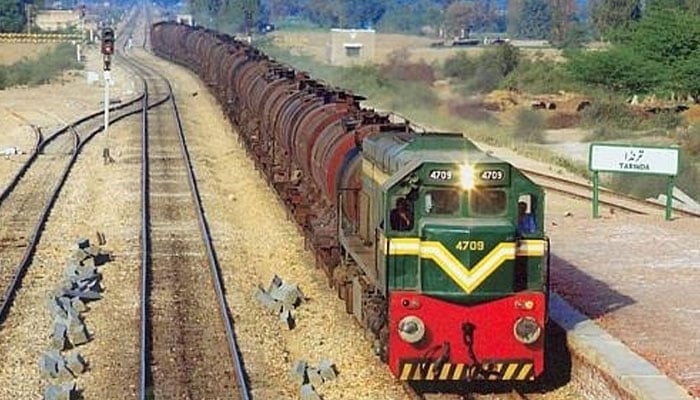
Yet by every measure of how those platforms actually serve the country, the picture is rather inglorious! The FPCCI Policy Advisory Board’s October 2025 brief estimates Pakistan’s logistics cost at 15.6 per cent of GDP, against an OECD reference range of 6 to 8 per cent. Container dwell at the Karachi cluster runs at five and a half to six and a half days, compared with two to three days for India’s import dwell, one to two days for Bangladesh’s export dwell, and 4 days for Vietnam. The terminals operate at roughly one-third of their notional capacity. Rail’s share of inland freight remains below 5.0 per cent against the federal Vision 2025 target of 20.
Pakistan was excluded from the redesigned World Bank Logistics Performance Index for 2023, itself a finding. And on the fiscal side, the Central Monitoring Unit’s State-Owned Enterprises Annual Report for FY25 records a combined loss of Rs355 billion across the National Highway Authority and Pakistan Railways alone – more than the entire cost of the ML-1 Karachi-Rohri package. The NHA’s sovereign-guaranteed debt stands at Rs3.1 trillion and grows by about Rs300 billion a year.
The conversation Pakistan is having about all this is not the conversation Pakistan needs. The standard debate – road versus rail, more highways versus more train modernisation, NHA bonds versus ML-1 financing – accepts the binary in the framing and asks only which side to weigh more heavily. It is the wrong question. The right question is what each mode is good at, what each is currently being asked to do that it shouldn’t and what institutional architecture would allow them to work together. The deficit is not infrastructure. The deficit is institutional. The deficit is the absence of holistic policies.
Three patterns surface during analysis. The first is that platform capability has consistently outpaced operational consolidation. Pakistan moved from PaCCS to WeBOC to the Pakistan Single Window with reasonable institutional success. It produced the National Transport Policy of 2018 and the National Freight and Logistics Policy of 2021. It built motorways, expanded ports, modernised airports and designed ML-1. It has not, in the same period, built the operating routines and cross-modal coordination that would convert that infrastructure into reliable, cost-competitive service.
The platforms exist. The consolidation does not. This is the diagnostic point that successive World Bank, Asian Development Bank and JICA studies have made for decades, and that the federal Government’s own diagnostic record echoes.
The second pattern is that the binding constraint is governance, not investment. Successive coordination committees – the National Trade Corridor Management Unit of the mid-2000s, the National Trade Facilitation Committee under WTO obligations, the Cabinet Committee on Transport and Logistics – have come and gone without the required authority or the secretariat depth to outlast a political cycle. India built the Empowered Group of Secretaries, the National Planning Group and the Technical Support Unit underneath the PM Gati Shakti platform. Vietnam, Thailand and Malaysia each have their own equivalents. Pakistan has been studying these comparators for 15 years. None of them has been adopted with the institutional standing it would require. The result is the picture in the data: the platforms are built, and then nobody is responsible for ensuring they deliver across modes.
The third pattern is that Pakistan has, in the last three years, built the legal templates it now needs to apply. The State-Owned Enterprises (Governance and Operations) Act of 2023 established a federal framework for SOE governance, and the IMF Extended Fund Facility requires the government to extend it to Pakistan Railways by August 2026, a deadline now less than three months away. The Pakistan Airports Authority Act 2023, passed by the current National Assembly and operational as of August 2024, demonstrated that Pakistan can separate a regulator from an operator.
The PIA Holding Company arrangement of May 2024 demonstrated that Pakistan can carve legacy liabilities – Rs660 billion absorbed, the operating airline cleaned and sold. The Federal Government Defined Contribution Pension Fund Scheme of 2024 is in force for new federal hires. None of these instruments has yet been applied where they would do the most good: the railways’ legacy pension liability of approximately Rs600 billion, based on a preliminary actuarial estimate; the NHA’s commercial-developmental split; and the absence of a federal apex body with cross-modal scorecard authority.
These three patterns produce a single conclusion and a window that is now unusually open. The next twelve months contain three events that very rarely align: the ML-1 Karachi-Rohri groundbreaking, targeted for July; the binding IMF deadline in August for the SOE Act extension for Pakistan Railways; and the federal budget cycle for FY27 in October and November. The reform package that converts these into a coordinated programme is, on the analytical record, both sequentially doable and supported by domestic precedent.
Three structural decisions could significantly improve Pakistan’s transport and logistics sector: extending the SOE Act to Pakistan Railways with a PIAHCL-style pension carve-out, splitting the NHA into commercial and developmental entities, and creating an empowered federal apex body for transport and trade logistics. Three operational measures are equally important: enforcing axle-load limits on the motorway network, reducing container dwell times at Karachi to regional benchmarks and introducing standard-gauge interchange on the western corridor. Available evidence suggests these reforms would cost no more than the current approach while delivering substantially better results.
Road or rail is not the question. Pakistan’s transport problem is not a problem of bricks, mortar and steel. We have built more than enough of those. The problem is that we have not built the institutional architecture – the apex governance, the cross-modal scorecard, the sequenced legal carve-outs – that converts what we have built into reliable, cost-competitive service. The instruments to fix this are already in our hands, drafted by our own parliament in the last three years.
The next twelve months will decide whether Pakistan keeps having the wrong conversation.
The writer is a development professional working on intersectional issues in society, economics and climate. A former World Bank staff member, he is currently running his own social impact advisory, Reenergia.