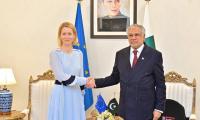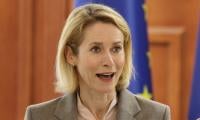
ISLAMABAD: European Union High Representative for Foreign Affairs and Security Policy Kaja Kallas on Monday paid glowing tributes to Pakistan, calling it a “major regional partner” and an “important partner for the European Union”, while also noting that Pakistan’s diplomatic efforts as “the main mediator”, helped prevent a full blown war between Iran and the United States.
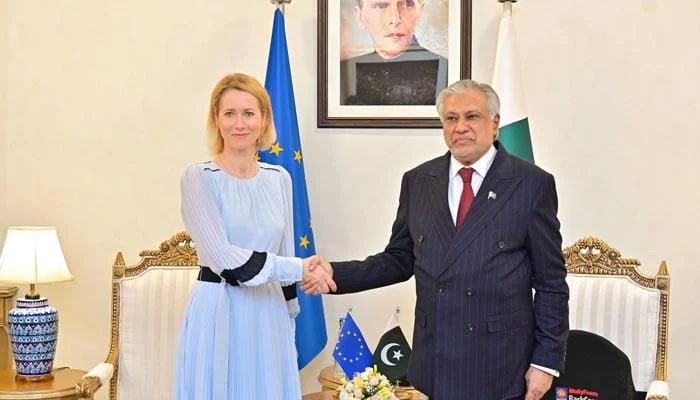
On her first visit to Pakistan Ms Kallas and Foreign Minister Mohammad Ishaq Dar co-chaired the 8th Round of the Pakistan-EU Strategic Dialogue, addressed a joint press conference, while the visiting EU dignitary also called on Prime Minister Shehbaz Sharif and Chief of Army Staff and Chief of Defence Forces (COAS & CDF) Field Marshal Syed Asim Munir.
“Pakistan is a major regional power and an important partner for the European Union. Today, in our strategic dialogue, we affirmed our shared commitment to strengthening EU-Pakistan ties even further,” Kallas told the media. While appreciating Pakistan’s role as a mediator in the ongoing Peace Dialogue between Iran and the United States, she remarked, “Your diplomatic efforts have helped prevent a return to full-blown war on several occasions and these efforts are much recongnised and appreciated across Europe. With your support, there is now a tenuous diplomatic opening to extend the ceasefire and reopen the Strait of Hormouz. Yet, any temporary understanding between the US and Iran must be followed by deeper talks about Tehran’s nuclear stockpile and other critical issues.” Commenting on Afghanistan she said that Pakistan had been “locked in a conflict with Afghanistan”, and called upon both sides to exercise restraint and de-escalation.
“Pakistan has the right to defend itself and its people in line with international law…..but dialogue and not air strikes, are the best – off ramp in this situation,” she added. On Pak-EU trade, Ms Kallas said that the EU remains Pakistan’s largest export market, bigger than the US and China combined with 2026 offering an important opportunity to move EU-Pakistan relations onto a stronger, forward-looking footing as both the sides share priorities on global and regional stability, a rule-based international order, free and fair trade, investment and sustainable connectivity.
“Pakistan is the world’s leading beneficiary of EU trade preferences the GSP+. But GSP+ has clear conditions continued preferential access to the EU market. It depends on progress in implementing the international conventions underpinning the scheme. This includes good governance, environmental protection and particularly labour and human rights. We look to Pakistan to demonstrate the tangible progress on these issues,” she remarked.
Foreign Minister Dar said Kallas’s visit signifies the growing momentum in EU-Pakistan partnership. “We have been constantly in touch during the last year’s India-Pakistan war and so are we in touch during the regional conflict between the US and Iran. We believe that the EU as an institution embodies the universal ideas of peace, diplomacy, democracy and commitment to human rights,” he said.
He also briefed Kallas on Pakistan’s principal position on the Jammu and Kashmir dispute, and Pakistan’s position on Indus Waters Treaty. “Pakistan’s position on IWT stands vindicated after the court of arbitration’s supplemented award in the IWT proceedings arising from the Ratle and Kishanganga hydroelectric plant disputes. The Award affirms Pakistan’s central position that the treaty places substantive limits on India’s water control capability on the western rivers,” explained Dar.
Later, Kaja Kallas called on Shehbaz Sharif at the Prime Minister House. According to the PMO press release, the prime minister welcomed the EU High Representative and stated that Pakistan was keen to further strengthen the multifaceted partnership between Pakistan and the European Union.
While expressing satisfaction at the 8th round of the EU-Pakistan Strategic Dialogue, he reaffirmed Pakistan’s commitment to enhancing cooperation with the EU in key areas including trade and investment, climate change, security, migration, sustainable development and connectivity.
In this regard, he highlighted the important role of GSP+ in ensuring stronger trade ties between Pakistan and the EU. Discussions also focused on the regional and international situation.
The prime minister thanked the EU leadership for its strong support for Pakistan’s peace efforts in the Gulf region. He said that Deputy Prime Minister Ishaq Dar and Field Marshal Syed Asim Munir were playing a crucial role in these efforts. He laid special emphasis on the need for the international community, including the EU to work collectively to ensure lasting peace in the region.
He also shared Pakistan’s perspective on the regional situation in South Asia, as well as on Afghanistan, with the EU High Representative. He also conveyed his best wishes to EU Council President Antonio Costa as well as to EU Commission President Ursula von der Leyen and reiterated his cordial invitations to both leaders to visit Pakistan soon.
EU High Representative Kallas appreciated the role played by Pakistan for regional peace and conveyed the EU’s strong interest in deepening strategic engagement with Pakistan. Meanwhile, as per the Joint Press Communique, Eighth Round of the Pakistan-European Union Strategic Dialogue meeting discussed the broad contours of Pakistan-EU bilateral relations, with special regard to cooperation in political, diplomatic and multilateral avenues under the Pakistan-EU Strategic Engagement Plan 2019. Both the sides agreed to continue exploring opportunities to further strengthen relations in all areas of common interest.
Both the sides exchanged views on the evolving global landscape and underscored their shared resolve to strengthen multilateralism, to uphold the principles and purposes of the UN Charter as the cornerstones of global governance, as well as to promote peace, prosperity and respect for human rights.
They welcomed the positive momentum in Pakistan-EU relations, marked by increasing high-level exchanges and timely convening of dialogue mechanisms. They welcomed the holding of the First Pakistan-EU Business Forum, 28-29 April 2026, in Islamabad. The forum was a reflection of the two sides’ commitment to trade and investment opportunities and attracted significant interest by businesses from both sides. They agreed to consider holding the Business Forum periodically. The forum also launched the EU-Pakistan Business Network to help foster Pakistan-EU economic cooperation.
Underscoring the value of strong economic ties, the EU and Pakistan reiterated the importance of continuing cooperation within the framework of the Generalised Scheme of Preferences (GSP+). The HR/ VP briefed on the EU’s new GSP+ regulation. Pakistan expressed its keen interest in joining the new scheme. Both sides agreed to continue working closely to fulfil the relevant conditions in this regard. Both the sides also reaffirmed the importance of promotion and protection of human rights and fundamental freedoms, as enshrined in international obligations.
The two sides discussed cooperation on counterterrorism, as part of their wider engagement on security matters within the framework of the 2019 Strategic Engagement Plan. They appreciated the growing level of co-operation on the issue of migration and labour mobility and agreed to continue to work closely towards the implementation of the Pakistan-EU Talent Partnership Roadmap for mutual benefit, while reaffirming their commitment to continue working together on countering migrant smuggling and trafficking in human beings in the context of the Global Alliance, as well as on returns and readmission. The two sides reiterated their commitment to cooperate within the framework set by the UN’s Global Compact for Safe, Orderly and Regular Migration.
They also agreed on the need for supporting effective multilateralism and the rules-based international order, with the United Nations at its core, in their shared interests of stability, peace and prosperity across the globe. They will continue working together with the UN and all partners in driving forward the UN80 initiative to ensure that the United Nations remains effective, cost-efficient and responsive. They re-affirmed commitment to maintain close coordination on regional and global issues based on their shared values and common objectives.
Both the sides reiterated their unwavering support for upholding the fundamental principles of the UN Charter, notably sovereignty, territorial integrity, non-interference, as well as non-use of force or threat of force in international relations, welcomed the unanimous adoption of resolution 2788 (2025) under Pakistan’s Presidency of the UN Security Council in July 2025, which reaffirmed the Council’s collective commitment to diplomacy, mediation, preventive diplomacy, peaceful settlement of disputes and confidence-building.
They agreed on the importance of respecting international treaty obligations, bilateral and regional agreements, as well as international law and international humanitarian law. The EU High Representative commended Pakistan’s constructive and meaningful role in its mediation efforts between the US and Iran, including by hosting the Islamabad Talks. Both the sides highlighted the importance of committing to a negotiated resolution of all outstanding issues, including to ensure free and safe passage through the Strait of Hormuz. The Pakistani side acknowledged with appreciation the support extended by the EU for its mediation efforts and the frequent exchanges between EU and Pakistani leadership on this matter.
The Pakistan side briefed on the issue of Jammu and Kashmir. The EU side briefed on Russia’s war against Ukraine. Both the sides expressed support to peaceful resolution of conflicts through dialogue and diplomacy, in accordance with the principles of the UN Charter.
The two sides exchanged views on the situation in Afghanistan. They reaffirmed the importance of combating terrorism in all its forms and manifestations, in accordance with international law and relevant UN Security Council resolutions. They expressed serious concern over the presence of terrorist entities in Afghanistan and reiterated that Afghan territory must not be used to threaten or attack other countries. They called on the Afghan de facto authorities to take effective and verifiable action against all terrorist groups operating in or from Afghanistan. The EU side encouraged reduction in tensions, resolving security concerns and upholding of international law.
Both the sides also noted with concern the deteriorating situation in Afghanistan of human rights, particularly the rights of women and girls, including restrictions on fundamental freedoms, access to education and participation in public life, as well as freedom of expression and freedom of the press.
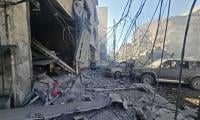
Both the sides discussed the situation in the Occupied Palestinian Territory, and welcomed international efforts to end the war in Gaza. They emphasised the importance of ensuring that all parties adhere to the ceasefire commitments, allow for safe, rapid and unimpeded access to humanitarian assistance and work towards a permanent end to hostilities that can allow for efforts to ensure the stabilisation, recovery and reconstruction of Gaza. They also expressed concern at the developments in the Occupied West Bank and called for an end to violence and illegal settlement activities. They reaffirmed their support for practical and concrete steps for long term and sustainable peace based on a two-state solution in accordance with international law, the Charter of the UN and relevant UN resolutions.
They also discussed the situation in Lebanon. They reaffirmed their support for the sovereignty and territorial integrity and stability of Lebanon and agreed on the need for coordinated international efforts for a peaceful and lasting resolution.
Meanwhile, speaking on ‘Geo News’ programme ‘Capital Talk’, European Union High Representative for Foreign Affairs and Security Policy Kaja Kallas expressed hope that the first phase of a Pakistan-mediated US-Iran agreement would be formally signed, saying the ongoing Middle East conflict was costing the “world a very high price”.
Kallas said that an end to the war in the Middle East and the reopening of the Strait of Hormuz was in everybody’s interest. “We are all paying a very high price, some with the higher energy costs, some also with fertilisers missing the market, and that is also causing famine maybe next year,” she added.
Emphasising the importance of Hormuz’s being opened, she said that a lot of things were dependent on the key waterway. Kallas also lauded Pakistan for acting as a mediator between Washington and Tehran and helping prevent a full-blown war between the two sides.
“I really commended Pakistan for being the mediator to try to bring the parties together, but eventually they [US and Iran] have to agree, and of course everybody is hoping for the signature for the first phase talks because then it will be followed by talks regarding the more difficult topics like nuclear,” she said.
Kallas emphasised the importance of stability in the region, saying “our neighbour’s problems today are our problems tomorrow”. Responding to a question on human rights violations by Israel in Gaza and Lebanon, Kaja Kallas said such actions undermined international law.
Citing the UN Charter, she said no country can attack another and must respect the sovereignty and territorial integrity of other states. Kallas emphasised the need for the ongoing crisis in the Middle East to help further develop international law so that accountability can be ensured. She added that international rules have eroded not because the principles were flawed, but because states have failed to enforce them.