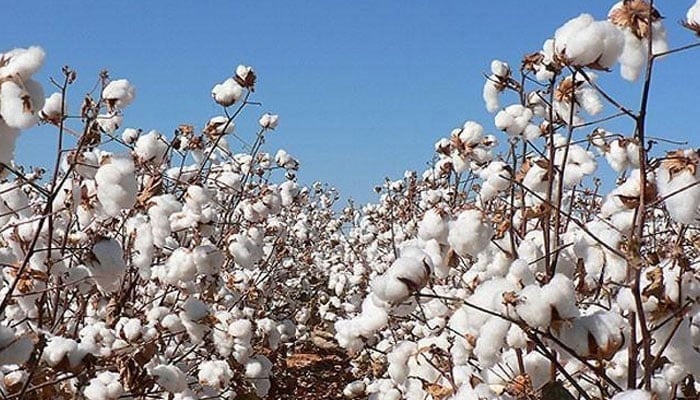
LAHORE: The area under cotton cultivation in Punjab during the 2026–27 season has fallen to one of the lowest levels since 1967, due to multiple challenges, including what has been described as “indifferent attitude towards growers”.
According to estimates, Punjab planted cotton on nearly 2.71 million acres out of the overall target of 3.2 million acres in the ongoing season. In comparison, the area under cotton in Punjab stood at 2.964 million acres in 1966–67, followed by 3.291 million acres in 1967–68. On this basis, available data indicates that cotton cultivation in Punjab has fallen to its lowest level in terms of crop area in nearly six decades.
Early sowing in the province typically ends by March, while late sowing continues through May. Despite efforts to bring more area under cotton cultivation, sowing remains well short of both early and late planting windows. The province’s failure to achieve its cotton sowing target for the current season by a wide margin raises serious concerns about the future of the province’s cotton sector.
According to Cotton Outlook, an international cotton resource, the low acreage has further reduced production estimates for the ongoing season in the country. The provincial government had set an overall target of 3.2 million acres, but cultivation has fallen significantly short. Initial reports suggest a shortfall of approximately 15%. Even more concerning, the area under cotton cultivation this season is said to be the lowest since 1983–84, according to estimates.
The provincial government had specifically set a target of bringing at least 700,000 acres under early-sown cotton by March 31, 2026, but this target was also missed, as cotton was sown on only about 560,000 acres. Many large-scale farmers opted not to sow cotton this year, a trend that agriculture officials describe as alarming.
Professor Dr Iqbal Bandesha, a well-known cotton breeding expert, observed that cotton sowing has significantly declined in the province this year. He noted that cotton planting used to be a common sight in South Punjab at this time of year; however, little cultivation can now be seen even in core cotton districts stretching from Bahawalnagar to Rahim Yar Khan in South Punjab. When asked for comment, a spokesperson for the Punjab Agriculture Department did not respond on the worrying development of the significant shortfall in cotton sowing targets. Regarding cotton sowing, Khalid Khokhar, President of Pakistan Kissan Ittehad, said cotton growers have expressed frustration over persistent crop failures. He attributed the shortfall to a combination of factors, including price uncertainty faced by farmers, poor-quality seeds, high input costs, water shortages, and policy inconsistencies.
Meanwhile, fresh forecasts from Cotton Outlook show Pakistan falling behind major cotton producers, with the country’s import dependence expected to deepen. Data for the August/July 2025/26 and 2026/27 seasons paints a weak picture for Pakistan at a time when global production is rising.
The outlook has worsened for 2026/27, according to the latest revision in estimates. Pakistan’s output has been cut by 35,000 tonnes to 1.165 million tonnes, compared with the April estimate of 1.2 million tonnes. In contrast, global production is projected to rise by 79,000 tonnes to 25.45 million tonnes. Brazil, the United States, and Turkey are all expected to record gains for 2026/27. Pakistan is the only major producer with a downward revision.
Consumption tells another part of the story. Pakistan’s cotton use remains steady at 2.285 million tonnes. With production stuck near 1.16 million tonnes, the country must import over 1.1 million tonnes annually to supply its textile mills. The country’s production has not kept pace with demand or global peers. The 35,000-tonne cut for 2026/27 reflects poor sowing and weak field conditions already visible this year. For Pakistan, low output means higher import bills, pressure on foreign exchange, and risks for the textile sector that drives exports, the report concludes.