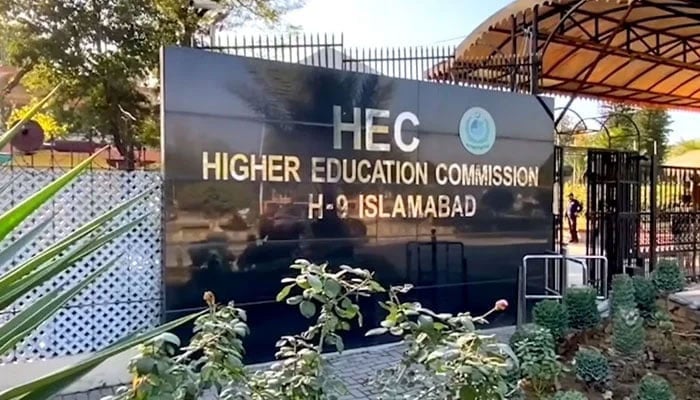
Despite a 170 per cent increase in faculty salaries, soaring utility expenses and a doubling of student enrolment over the past eight years, the recurring budget of the Higher Education Commission (HEC) has remained frozen at Rs65 billion since the 2017-18 fiscal year, triggering a severe financial crisis across Pakistan’s public universities.
During the period, the overall student enrolment in higher education increased from approximately 1.4 million to nearly 3 million nationwide. Economic data shows that inflation and depreciation of the Pakistani currency have reduced the real value of the HEC’s recurring grant by nearly half, bringing its effective worth down to around Rs32bn.
The prolonged stagnation in varsities’ funding has been adversely affecting teaching quality, research output, academic development and the day-to-day operations of universities. The federal government is scheduled to announce the budget for the fiscal year 2026-27 on June 5 amid growing concerns from academia over the future of higher education financing.
Currently, around 2.1 million students enrolled in more than 157 public-sector universities and 94 sub-campuses and constituent centres rely on institutions funded through the HEC’s recurring grant.
While the provincial governments have significantly enhanced their support for higher education, the federal allocation has remained largely stagnant. Provincial budgetary allocations increased from Rs9bn in 2017-18 to Rs75.94bn in 2025-26, whereas the federal contribution remained almost unchanged at around Rs40.58bn.
University officials say the widening gap between institutional needs and available resources has pushed several leading public-sector universities into financial distress. Some institutions are even facing difficulties in paying faculty and staff salaries on time.
In view of the worsening situation, HEC Executive Director Dr Ziaul Haq has formally requested the federal government to increase the commission’s recurring budget to Rs100bn for the upcoming fiscal year.
According to officials, the HEC has warned that continued underfunding could further erode academic standards and research capacity across the country. Meanwhile, the Federation of All Pakistan Universities Academic Staff Associations (Fapuasa) has urged the country’s top leadership, including the president, prime minister and finance minister, to take immediate measures to address the financial challenges confronting the higher education sector.
In an open letter, Fapuasa Federal Chapter President Prof Dr Aamir Ali said stagnant funding despite a substantial increase in the number of universities and students had been undermining academic excellence, research productivity, faculty retention and institutional quality.
The association called for a substantial increase in both the recurring and development budgets of the HEC. It also demanded the immediate approval of a long-pending salary revision for faculty members serving under the Tenure Track System (TTS), including the provision of death benefits.
Fapuasa further sought the restoration of the teachers’ income tax rebate, which had gradually been reduced from 75 per cent to zero by 2025, and the implementation of a uniform promotion policy for Basic Pay Scale (BPS) faculty members, a matter pending since 2022.
“Investment in higher education and academic human resources is essential for Pakistan’s scientific advancement, economic stability and sustainable development,” the association said, warning that prolonged financial constraints, rising inflation, increasing taxation and policy delays had created widespread uncertainty and frustration among university teachers and researchers.