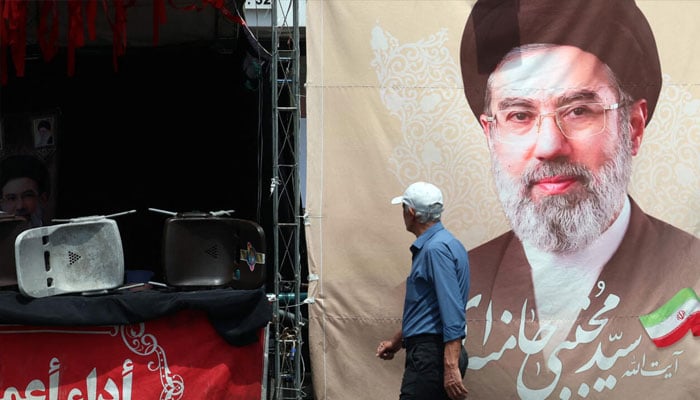
DUBAI: Mohsen Rezaei, an adviser to Iran’s Supreme Leader Mojtaba Khamenei, said on Saturday that US President Donald Trump was “betraying diplomacy for the third time” by continuing a naval blockade imposed on Iran and making what he described as excessive demands in negotiations.
The statement came as the United States warned it was “more than capable” of resuming war with Iran after President Donald Trump said any peace deal must adhere to his red lines, including Tehran never being able to develop nuclear weapons.
The White House had signaled Trump was close to a decision on a potential deal, though Tehran denied there was a final agreement on ending the conflict.
US sources had told AFP the deal was waiting on Trump’s sign-off, but he made no decision after a White House Situation Room meeting on Friday.
Meanwhile, Pentagon chief Pete Hegseth, while attending a defense summit in Singapore, said on Saturday that Washington was “more than capable” of restarting the war “Our ability to recommence if necessary is (that) we are more than capable, our stockpiles are more than suited for that, both there and around the globe because of how we balance exquisite and more plentiful munitions,” Hegseth said.
US Central Command (CENTCOM) posted on X that American forces “remain present and vigilant across the region.”
The efforts to reach a deal were thrown into question this week by US strikes on the Iranian port of Bandar Abbas, countered by retaliatory Iranian fire.
Iran’s IRNA state news agency said air defenses shot down a drone “belonging to the US-Zionist aggressor enemy” on Saturday, citing a statement from the army.
Nevertheless diplomacy continued, including to stop fighting in Lebanon, which Iran has insisted be included in any end to the war and where Israeli forces advanced further even as military delegations from both nations met at the Pentagon.
Trump said his priorities in any deal include Iran agreeing to never develop nuclear weapons and the re-opening of the blockaded Strait of Hormuz.
”President Trump will only make a deal that is good for America and satisfies his red lines,” a White House official told AFP, adding: “Iran can never possess a nuclear weapon.”
Iran’s ISNA news agency on Saturday cited lawmaker Alireza Salimi as saying a plan “to implement Iran’s management and sovereignty over the Strait of Hormuz will soon be approved by parliament.”
Meanwhile, Iran’s Tasnim news agency said the US blockade in the strait remains in place and its ships “are receiving warnings from CENTCOM to stop and not cross the blockade line.”
The US military said Saturday it had disabled a Gambia-flagged cargo vessel attempting to sail to an Iranian port by launching a missile into its engine room.
US Central Command (CENTCOM), which oversees forces in the Middle East region, said the strike occurred on May 29 after the M/V Lian Star failed to respond to more than 20 warnings. “A US aircraft disabled the vessel by firing a Hellfire missile into the ship’s engine room after Lian Star’s crew failed to comply. The ship is no longer transiting to Iran,” CENTCOM said on X.
The statement did not mention if there were any injuries aboard the Lian Star following the strike. “US forces have disabled five commercial vessels and redirected 116 to fully enforce the blockade as a ceasefire with Iran remains in effect,” CENTCOM said.
Meanwhile, Oman’s maritime security centre urged vessels to exercise caution due to sighting of floating object suspected to be naval mine west of inshore traffic zone in Strait of Hormuz within Omani territorial sea.
Iran’s Khatam al-Anbiya Central Headquarters warned that any military vessel attempting to interfere with Iran’s management of the Strait of Hormuz or disrupt shipping traffic would be targeted by Iran’s armed forces, Iran’s Tasnim news agency reported. “Management of the Strait of Hormuz is being exercised with full authority by the armed forces of the Islamic Republic of Iran.”
Meanwhile, Iran’s state TV on Saturday released details of what it said was an unofficial draft of the Islamabad agreement, saying the text would give Tehran broad authority over traffic through the Strait of Hormuz and require the United States to provide Iran full access to $12 billion in frozen assets within 60 days.
The report said one of the most important parts of the draft is the “redefinition of navigation rules” in the Strait of Hormuz, with Iran designated as the “exclusive authority” to determine the nature of passing vessels.
Under the reported text, any vessel whose cargo is deemed threatening, or whose final beneficiary is considered hostile to Iran, “will not be recognized as a commercial ship” and would not be allowed to use designated routes. Iranian state TV said the draft also gives Tehran authority over routes, navigation service fees, security arrangements and costs related to repairing environmental damage. Each vessel would be required to provide information to a relevant naval centre and complete forms detailing its cargo, ownership and destination, according to the report. The information would be used to assess whether a vessel poses a threat and could allow physical inspection if needed.
The report said the draft also includes a financial provision under which Washington would commit to giving Iran full access to $12 billion of its blocked assets within 60 days. The funds would be “transferable and spendable” in destination banks chosen by Iran “without restrictions,” according to the unofficial text cited by Iranian state TV. Iranian state TV said the text remains an “informal understanding” and is still subject to review, negotiation and revision.
Qatar’s Deputy Prime Minister Sheikh Saoud bin Abdulrahman bin Hassan bin Ali Al Thani told the Shangri-La Dialogue that his country would oppose a permanent toll for passage through the Strait of Hormuz, Aljazeera reported.
He added that Qatar would find a temporary fee negotiable, if it was to be used to help reopen the waterway, by removing sea mines, for example.