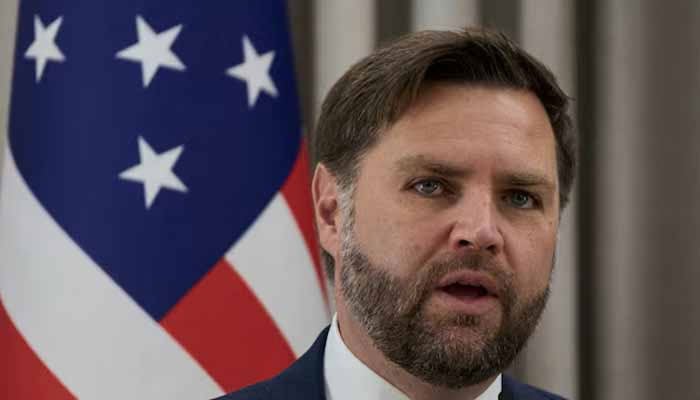
WASHINGTON: President Trump appears to see the matter of his heir as unsettled, adding a layer of tension to his relationship with Vice President JD Vance, according to an analysis published by The New York Times on Saturday.
In recent conversations with aides and allies, President Trump often interjects with a question about his vice president: Does JD Vance have what it takes to go all the way? He usually answers his own question: He’s not so sure.
It is not that Trump is abandoning Vance. He involves him in major decisions, has given him high-profile opportunities to position himself for 2028 and trusts the 41-year-old vice president to wage partisan warfare on his behalf. In a cabinet meeting this week, Trump compared Vance to Eliot Ness, the mob-busting federal agent, for working to ferret out fraud in mostly Democratic controlled states.
Trump has long conducted running focus groups on his closest aides and appears to enjoy needling them and keeping them off balance as a way of asserting his dominance. Several people in the president’s inner circle have been subject to his quasi-public questioning of their performance and their future.
But when it comes to Vance, the stakes are higher. As the default front-runner for the Republican nomination and would-be inheritor of the president’s political movement, Vance’s fortunes ride to a substantial degree on the enthusiasm of the support he gets from Trump. And Trump’s regular polling of people on whether they prefer Vance or Secretary of State Marco Rubio has become one of the most closely watched early indicators of how power in the Republican Party might pass to the next generation.
When he conducts those polls in private, Trump often compares Vance’s performance to his own achievements. He has told several allies that Vance has never won a tough race without his help. (Trump’s endorsement got Vance over the finish line in a tight race for an Ohio Senate seat) He has brought up the number of vacations Vance has taken as vice president. (Trump does not generally take them.)
He has repeatedly mentioned the vice president’s initial opposition to starting a war with Iran and has done so in front of Vance. (“I’m more of a peace person than you are — but I had to do it,” he has said to him) The president has also questioned his decision to send a Vance-led delegation to a negotiation session in Pakistan that failed to end the war.
Trump, always keenly attuned to the optics of the presidency, has zeroed in on moments when Vance might not look the part. He has repeatedly brought up a moment from last spring, when Vance fumbled Ohio State’s national football championship trophy on the White House South Lawn. (Trump has said he is happy it wasn’t him)
This account of Trump’s relationship with his vice president is based on interviews with more than a dozen people who are directly familiar with the dynamic between the two men. Some of them were granted anonymity to speak about Trump’s thinking.
“Vice President Vance has done a remarkable job of helping implement the president’s America First agenda,” Steven Cheung, the White House communications director, said in a statement.
“There has been no vice president in history who has been more empowered, and that is a reflection of the strong trust and relationship between the two.
Any false media narratives from unknown and unnamed sources fabricating stories clearly do not have any knowledge of the truth.”
Trump, who turns 80 next month, is generationally and stylistically different from Vance, a Midwestern millennial who rose out of a hardscrabble upbringing and made that struggle the animating force of his political brand.
The president, a Queens-born real estate developer raised in wealth, prefers to be ensconced in gilded surroundings. When Vance is not in Washington, he enjoys taking his family home to Cincinnati or to Camp David, the woodsy presidential retreat that Trump has only visited once in his second term.
In meetings, Vance frequently scrolls his phone, and he uses social media to fight with his critics. The president frequently posts to Truth Social, but he does not spend time replying to people online, as Vance does.
Through it all, Vance has exhibited the one quality that Trump most prizes: loyalty. He has put aside his reservations about the war to back the president’s handling of the conflict and carried out the traditional No. 2 attack-dog role against Trump’s critics, even Pope Leo XIV.
However, in November, the president wondered aloud why Vance was not more subservient, like the officials who work for President Xi Jinping of China. “Why don’t you behave like that?” Trump asked Vance during a breakfast for Republican senators. “JD doesn’t behave like that! JD butts into conversations! I want to have that for at least a couple of days. OK, JD?”
People close to the president say that Vance is in Trump’s good graces.
“My father always brings up how JD is a savage and annihilates the fake news, like the made-up narrative of this story,” Donald Trump Jr, the president’s eldest son, said in a statement relayed through his spokesman. “Interviews, rallies, podcasts — he shows up and performs and that’s what my father cares about.”
Despite his misgivings about the war with Iran, he has loyally defended Trump’s decision to start the conflict. And he has backed another politically fraught action, the creation of a $1.8 billion fund to compensate victims of what the administration contends is political persecution.
Compounded by Trump’s recent retribution efforts against Republican lawmakers, that fund has sent Republicans into open revolt.
Allies of Trump and Vance say that the vice president is still best positioned to be Trump’s successor. Despite widespread concern over affordability and the cost of the Iran war, Trump remains popular with Republican voters.