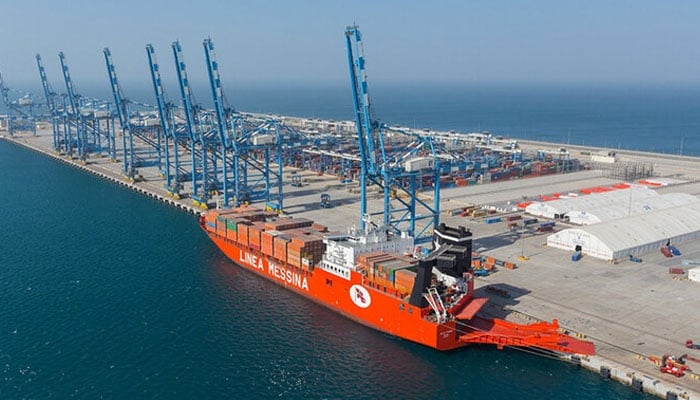
ISLAMABAD: China and Pakistan have reached a “new broad consensus” on deepening strategic ties to beef up development of a joint economic corridor and establish the port of Gwadar as a regional connectivity hub, the neighbours said on Tuesday.
The remarks came in a joint statement as Prime Minister Shehbaz Sharif wrapped up a visit to Beijing at a time when Islamabad is seeking investment while navigating tension with Afghanistan and mediating in the Iran war. “Both sides welcomed third parties to participate in the development of China-Pakistan Economic Corridor under the model agreed,” they said in the statement, issued after Sharif met Chinese President Xi Jinping and Premier Li Qiang.
The visit was held at the invitation of Chinese Premier Li Qiang, during which Prime Minister Shehbaz Sharif met President Xi Jinping while Li Qiang held formal talks with him. The discussions covered bilateral relations as well as regional and international developments of mutual interest. The statement said both sides agreed to promote the “high-quality development” of China-Pakistan Economic Corridor (CPEC) 2.0 and welcomed third-party participation in projects under mutually agreed arrangements.
On economic cooperation, the two sides agreed to advance Belt and Road cooperation and upgrade CPEC into its next phase. They committed to convening the CPEC Joint Cooperation Committee meeting and advancing key infrastructure projects, including the phased realignment of Karakoram Highway between Thakot and Raikot. Gwadar Port was reaffirmed as a future regional connectivity hub, while the Khunjerab Pass would be further utilised to enhance land connectivity.
Both sides reaffirmed the long-standing Pakistan-China friendship as a “strategic asset” built by successive leaderships, stressing that ties have remained “rock solid” despite global and regional shifts. They agreed to accelerate efforts to build a closer “China-Pakistan Community with a Shared Future in the New Era” and to implement the 2025-2029 action plan aimed at deepening cooperation. High-level exchanges, political trust, practical cooperation, defence collaboration, and coordination on international issues were emphasized as key pillars of the partnership.
On global issues, both countries reaffirmed support for a UN-centered international system and advocated for a multipolar, inclusive global order. They opposed unilateral actions and efforts to revive fascism or militarism, emphasizing the importance of safeguarding the post-World War II international order. China praised Pakistan’s role in facilitating the temporary Iran-U.S. ceasefire and hosting the Islamabad Talks. Both sides expressed commitment to contributing to peace and stability in the Middle East while Islamabad supported the early implementation of a five-point peace initiative of President Xi Jinping.
Pakistan reiterated its support for China’s broader global initiatives, including the Global Development Initiative (GDI), Global Security Initiative (GSI), Global Civilization Initiative (GCI) and Global Governance Initiative (GGI). It also reaffirmed its commitment to the one-China principle, stating that Taiwan is an inalienable part of China and opposing any form of “Taiwan independence.” China, in turn, reiterated its support for Pakistan’s sovereignty, territorial integrity, stability and development.
Security cooperation featured prominently in the talks. Pakistan assured China of enhanced security arrangements for Chinese nationals, projects and institutions operating in Pakistan. Both sides agreed to strengthen counter-terrorism cooperation and opposed double standards or politicisation of counter-terrorism efforts. They stressed that groups such as the Tehreek-e-Taliban Pakistan and Eastern Turkistan Islamic Movement must not be allowed to use any territory to threaten regional peace and stability.
The Pakistani side spoke positively of the successful holding of informal talks among China, Afghanistan and Pakistan in Urumqi, Xinjiang, China, in April 2026, and welcomed the Chinese side to provide a dialogue platform for communication between Pakistan and Afghanistan. Both sides agreed to stay in close communication and coordination on the issue of Afghanistan.
Industrial cooperation, mining, agriculture, energy, digital economy and science and technology were also identified as priority sectors. China will continue to expand training and development opportunities for Pakistani professionals and youth.
The joint statement also highlighted growing cooperation in emerging fields, including artificial intelligence. Pakistan supported China’s proposal to establish the World Artificial Intelligence Cooperation Organisation and agreed to work jointly on global AI governance regionally. Both sides reaffirmed support for stability in South Asia and emphasised peaceful resolution of disputes through dialogue. China reiterated that the Jammu and Kashmir issue should be resolved in accordance with the UN resolutions, the UN Charter, and bilateral agreements. Pakistan briefed China on developments in the region.
China also supported Pakistan’s upcoming role as rotating president of the Shanghai Cooperation Organisation and leveraging Pakistan’s term as a non-permanent member of the UN Security Council from 2025 to 2026 to further strengthen coordination and collaboration in the multilateral context.
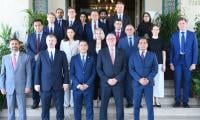
The visit also marked the 75th anniversary of diplomatic relations, with both sides reviewing high-level exchanges, including visits by senior Pakistani officials and recent bilateral dialogues. Multiple cooperation agreements were signed, and Prime Minister Shehbaz Sharif thanked the Chinese leadership and people for their hospitality during the landmark visit.