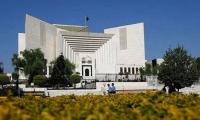
ISLAMABAD: The Supreme Court (SC) has held that the question of jurisdiction is the portal through which the petitioner knocks at the door of courts and if he enters in the wrong one, the court must redirect him rather than closing the door on their rights.
A two-member bench of the apex court comprising Justice Muhammad Ali Mazhar and Justice Musarrat Hilali announced a judgment on appeals filed against the judgment passed by Federal Service Tribunal, Islamabad on November 3, 2025 in a service matter.
The court set aside the judgment of Federal Service Tribunal and remanded the matter to FST to first decide the question of jurisdiction and maintainability vis-à-vis the status of petitioners whether they are civil servants or not.
And if they were locally hired as observed in the impugned judgment, if there was any embargo and whether they cannot be appointed as civil servants, the court further directed the FST.
Any adjudication by a court or tribunal without jurisdiction is coram non judice and may prejudice right to a fair trial and due process,” says a six-page judgment, authored by Justice Muhammad Ali Mazhar.
The court held that returning a plaint under Order 7 Rule 10 CPC preserves the party’s right to seek a decision on the merits in the proper forum rather than ending their legal journey prematurely.
“Touching upon the merits without jurisdiction may prejudice right to a fair trial and due process under Article 10A of the Constitution and result in a failure of justice,” says the judgment.
As per the case, petitioners Muhammad Afzal and Usama Mehmood were appointed as Naib Qasid in the GEO Information Center, Survey of Pakistan, in April 2019.
In April 2022, they were assigned field duties in Chilas until May 2022. Later, an inquiry dated 16.05.2023 was initiated on allegations of fake appointment letters without issuing show-cause notices or statements of allegations.
Despite submitting replies and relevant documents, including their appointment letters, their services were terminated on 31.08.2023 retrospectively from 15.04.2019.
Their departmental appeals remained undecided within the statutory period, after which they filed service appeals before the Federal Service Tribunal (FST), which were dismissed through the impugned judgment.
The court noted that the learned counsel for the petitioners argued that the major penalty was imposed without considering the relevant documents by the inquiry committee. Moreover, the court noted that the counsel for the petitioners argued that the learned tribunal nonsuited the petitioners on the ground that they were local persons and not civil servants.
Similarly, the court noted that the learned Additional Attorney General for Pakistan argued that the petitioners were appointed through fake appointment letters and lawfully terminated after proper inquiry. He further contended that while dismissing the appeals on maintainability, the FST should not have given findings on the merits of the case.
“In our view, even, the status of appellants as civil servants or not was not properly adverted to by the learned FST except an observation that they were locally hired persons but failed to expound the relevancy of phrase “local person”, moreover, as to why a local person cannot be appointed or why a local person cannot be a civil servant,” says the judgment.
On the contrary, the court held that according to the plea of the petitioners they were appointed without any violation of recruitment rules or recruitment policy and their appointment letters were not fake.
In the scenario of having no jurisdiction, the best suited remedy and solution is provided under Order 7 Rule 10 CPC which puts the accent on the principle that if a court lacks jurisdiction, it should not dismiss or reject a case but return the plaint/case for its presentation before the court conferred with the jurisdiction to deal and decide,” the court held.
The court further held that if a court or tribunal reached the conclusion that it lacks the jurisdiction, then the finest legal option is to return the case. Any adjudication on the merits by a court or tribunal without jurisdiction is “coram non judice” and therefore void.