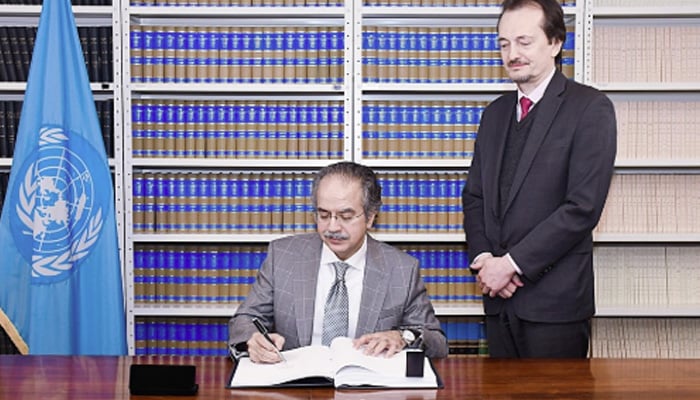
Exactly one year ago today, on May 23 2025, Pakistan made waves on the global legal stage. By officially signing the United Nations Convention on International Settlement Agreements Resulting from Mediation, the Singapore Convention, we signalled a bold departure from our notoriously sluggish legal past.
The federal cabinet had given its nod, the Supreme Court had passionately championed it, and the international business community watched with renewed interest.
Yet, here we are – one year later – and the treaty remains unratified. Even before Pakistan became a signatory, the judiciary was advocating for the promotion of mediation. If you read the judgment of one of my favourite justices, Honourable Justice Jawad Hassan, in citation 2024 CLD 1, he affirms that mediation will save our struggling justice system. If we jump to 2026, the voice of Honourable Justice Mian Hassan Gul Aurangzeb echoes the call to encourage mediation.
While our policymakers indulge in the classic state pastime of bureaucratic foot-dragging, our economy continues to pay the price. In a country desperate for foreign direct investment (FDI), letting this convention gather dust in the corridors of power is economic sabotage.
Let us bypass the diplomatic pleasantries: international investors are terrified of Pakistan’s legal system. With a staggering backlog of over 2.4 million cases clogging our courts, a standard commercial civil dispute can easily drain a business’s resources for years. For a foreign multinational, entering into a contract in Pakistan feels less like a business venture and more like a high-stakes legal gamble.
The Singapore Convention offers a structural antidote to this fear through the mechanism of direct execution. Historically, if an international commercial dispute was settled amicably through mediation, the resulting agreement was legally treated as nothing more than a private piece of paper: a contract. If a local partner defaulted, the foreign investor had to file a brand-new, exhausting lawsuit just to enforce that settlement.
The Singapore Convention completely obliterates this redundancy. Under its framework, an international mediated settlement bypasses the entire trial process. An aggrieved party can take that settlement straight to a high court and execute it immediately against local assets.
What exactly are we waiting for? The Ministry of Law and Justice has conducted training sessions, the judicial academies are on board, and the senior judiciary, led by visionaries like Honourable Justice Syed Mansoor Ali Shah, has repeatedly warned that the traditional adversarial trial must become the exception rather than the rule. The infrastructure is ready, but the legislative will is missing.
By failing to transition from a mere signatory to a fully ratified state party, we are actively broadcasting our hesitation to the global market. We are telling international businesses that while we like the publicity of signing global treaties, we lack the institutional discipline to enforce them.
Meanwhile, our regional competitors are not standing still. While the European Union is bogged down in internal sovereignty debates, South Asia remains a wide-open playing field. If Pakistan moves aggressively to finalise this ratification, we instantly become the region’s premier, forward-thinking safe harbour for cross-border commercial dispute resolution.
We do not have the luxury of time. Our economic indicators demand radical, frictionless paths for commerce. Mediation provides resolution in an average of 75 days compared to decades of litigation, and the Singapore Convention gives those 75 days international teeth.
The legislative spearhead must stop treating this convention as a low-priority legal luxury. It is a core pillar of economic survival. Let us not allow May 23 next year to become another anniversary of missed opportunities. If parliament ratifies the convention, it would show the world that Pakistan is open for business.
The writer is an international lawyer.