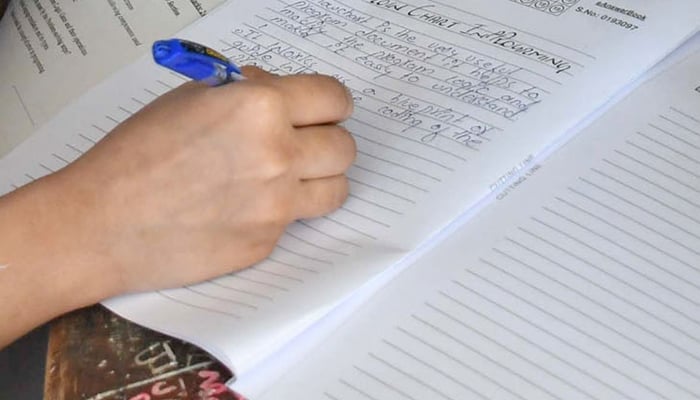
We recently saw the controversy over the twice-leaked Cambridge Assessment International Education papers in Pakistan, exposing an unsettling and deeper institutional truth: a sovereign state like Pakistan, with a population of over 240 million, has outsourced educational objectives and failed to build a credible national alternative.
The middle and upper classes are the main customers of this foreign-branded education. More than 100,000 Pakistani students sit Cambridge examinations every year, generating over 350,000 subject entries and collectively spending around $70 million annually on examination fees alone – more than the country’s higher education budget. When we add school tuition fees, imported textbooks, equivalence certificates and overseas admissions testing, the total exceeds $250 million. This is what Pakistan’s elite and aspiring middle class spend each year to sustain a parallel foreign-certification economy.
In Pakistan, 15 per cent of students attend private schools, while 85 per cent attend public schools. This private outflow of $250 million coexists with a vast public spending system of $7.8 billion (Rs2.2 trillion) that should, in theory, render such dependence unwarranted.
In Pakistan, combined federal and provincial education allocations in FY2025–26 exceed Rs2.2 trillion: Punjab allocates Rs812 billion to education; Sindh Rs520 billion; Khyber Pakhtunkhwa around Rs370 billion; and Balochistan about Rs150 billion. Despite all this spending, according to Unicef and Unesco, 26 million children are out of school and 75 per cent of 10-year-olds cannot read a simple sentence. This is among the highest rates in the world and reflects a crisis of state priorities.
It is even more shocking when we analyse not how much we spend on education, but how we spend it. If we analyse Punjab’s Rs812 billion budget, Rs680 billion to Rs700 billion goes to salaries and pensions; Rs80 billion to Rs100 billion goes to development; and Rs10 billion to Rs12 billion goes to teacher training. However, the intellectual core of any education system – curriculum development – receives only Rs2 billion to Rs4 billion.
We spend less than 1.0 per cent of the largest provincial education budget on shaping what children actually learn. Other provinces follow a similar pattern: 80-85 per cent of education budgets go towards salaries, while less than 2.0 per cent is directed to teacher development, curriculum modernisation and educational technology combined. The state is financing administration, not transformation. The education budget is not an investment in our children but the maintenance of a broken system.
Then comes higher education. Pakistan produces roughly 800,000 university graduates each year, whereas the UK produces 900,000, India produces 10 million, China produces 12 million, the US produces four million and Saudi Arabia produces 350,000 graduates annually. The UK, with a population of around 68 million – less than one-third of Pakistan’s – produces around 900,000 graduates annually.
The Higher Education Commission (HEC) receives an annual budget of approximately Rs120 billion for universities, research and scholarships. Yet Pakistani parents privately spend nearly Rs70 billion ($259 million equivalent) through the so-called foreign schooling ecosystem, and this is before their children even enter university. Parents are effectively taxed twice: once through the state and then through private education. This is due to a lack of confidence, as they do not trust the institutions funded by their own taxes.
Perhaps the greatest indictment is that we are producing graduates with degrees of little market value. A degree from the UK is globally recognised, trusted by employers and linked to a system that produces research, innovation and economic value. By contrast, our system is producing certificates but not capabilities; our graduates struggle to find jobs that match their qualifications, and companies regularly complain about weak technical, analytical and communication skills. The issue, therefore, is not only access or unemployment but unemployability.
The story does not stop there, as this division starts much earlier than university. We do not have a national education system or a single national curriculum. Our education system is producing different social classes. The child of an affluent family in Lahore, Karachi or Islamabad studies under Cambridge or IB, speaks fluent English and prepares for universities in the UK, Europe or the USA. The child in a government school in rural Sindh or southern Punjab studies under a provincial board with outdated textbooks, overcrowded classrooms and often no science laboratory. The child in a madrassa follows a separate educational route altogether. These are not diversifications or educational choices but separate citizenship pathways. Our classrooms, not income, are therefore becoming the first institution of inequality.
This apparatus of inequality imposes a direct economic cost on all of us. Around 60 per cent of Pakistan’s population is under the age of 30, and every year around two million young people enter the labour market. We spend 1.7-2 per cent of GDP on education, far below the international average of 4-6 per cent. The tragedy is that even this spending is not safe from corruption, as audit reports suggest that Rs70 billion to Rs120 billion is lost annually to procurement distortions, ghost schools, absentee staffing and governance failures. This is more than we spend collectively on teacher training and curriculum development.
There is no way we can improve our literacy standards while remaining within such a structure. In the UK, education remains free and universal until age 16, and public schools are often better than private schools. In Scandinavian countries, especially Finland, state-funded public education is far superior, leaving little room for private schooling. In the UAE, Saudi Arabia and Qatar, domestic educational capacity was strengthened over the last two decades before campuses of foreign universities were allowed. Pakistan imported these so-called prestige foreign education brands before building credibility and trust in its own education system.
We certainly do not lack resources; rather, we are facing a serious governance crisis. The acceptance of three different educational mediums has normalised inequality as acceptable. We spend over Rs2.2 trillion annually on education, yet millions remain out of school; we produce nearly as many graduates as the UK but cannot ensure equivalent quality. The tragedy is that we allow our affluent classes to spend hundreds of millions of dollars in foreign exchange on foreign certifications while our own curriculum receives only a few billion rupees in reform funding. What a deplorable state of affairs, where accent determines opportunity and foreign transcripts determine legitimacy within the system.
The unfortunate reality is that we are not under-educating our population but miseducating it through fragmentation, uneven quality and weak accountability structures within governance. Equality cannot be built with an unequal system, nor can we achieve global competitiveness, because the crises we are facing are not educational but institutional.
Here, we need a statecraft and leadership approach rather than another temporary reform package. Pakistan needs a charter of education that guarantees a single core curriculum for every child, at least through the secondary level, regardless of class or province. We must respect provincial autonomy under the 18th Amendment, but national standards in science, mathematics, digital literacy and civic reasoning must be enforced through an independent regulatory authority such as a National Education Authority. Teacher training is critically important and must not be left to bureaucracies, media managers or event-hosting contractors; it must not be treated as an afterthought but as a national priority. The charter of every university must prioritise employability and research output rather than enrolment figures.
Our children’s future must not be determined by birth, income, classroom inequality or whether they entered a Cambridge classroom, a government school or a madrassa corridor. It should be determined by talent, effort and opportunity within a unified national framework.
The real challenge before the state of Pakistan is not whether it can build another motorway, negotiate another IMF programme or announce another laptop scheme, but whether it can create one classroom where the child of a labourer in Karachi and the child of a banker in Islamabad receive the same intellectual foundation, the same chance to compete and the same right to dream.
The writer is a political economist, public policy commentator and advocate for principled leadership and regional cooperation across the Muslim world.