PESHAWAR: Speakers at a one-day conference on Wednesday stressed the need for practical measures to overcome the challenges of climate change, including strict enforcement of environmental laws, institutional tree plantation drives, and the elimination of plastic waste from public spaces.
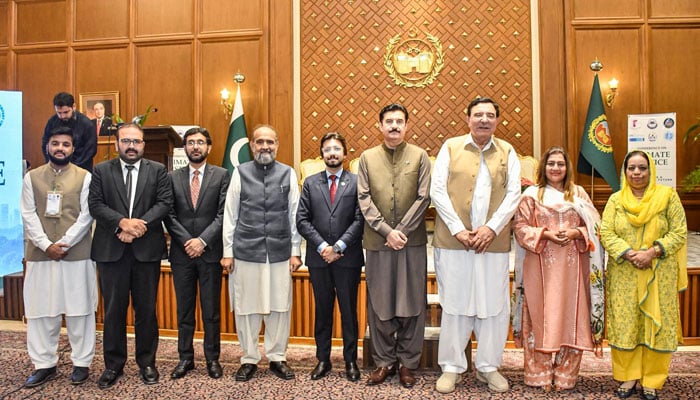
The conference titled “Climate Justice and Mobilizing Climate Finance for Pakistan” was organized under the patronage of Governor Khyber Pakhtunkhwa Faisal Karim Kundi as a joint initiative of the Pakistan Development Foundation (PDF), Shaheed Benazir Bhutto Women University, Peshawar (SBBWUP), Institute of Management Sciences Peshawar, Women University Mardan, and Oil and Gas Development Company Limited.
A panel discussion on “For a Better Tomorrow: Uniting Stakeholders towards Mobilizing Climate Financing for Pakistan” was addressed by noted academician and jurist Prof. Dr. Qibla Ayaz, Member of the Shariah Appellate Bench of the Supreme Court of Pakistan, who stressed the importance of establishing Quranic gardens as sustainable environmental solutions in view of the religious sentiments of Pakistani society.
Member of the Khyber Pakhtunkhwa Assembly Amna Sardar said that several bills had been passed in recent years for environmental protection but lamented that none had been properly implemented.
Prof. Dr. Safia Ahmed, Vice Chancellor of SBBWUP, and Prof. Dr. Usman Ghani, Director of IMSciences, highlighted how their respective institutions were shifting towards green energy to reduce carbon emissions.
Dr. Ghani informed participants that IMSciences had received plastic shredders from the United Nations Development Programme on the day of the conference and had already installed a rainwater harvesting system to irrigate the institute’s gardens and meet other water needs.
The session, moderated by Dr. Muhammad Waqas, Assistant Professor at Kohat University of Science and Technology, also included virtual participation by Prof. Dr. Muhammad Rafiq, Member Climate Finance at the Pakistan Climate Change Authority. He presented the newly approved Climate Finance Policy of Pakistan and outlined the country’s strategy for mobilizing climate finance.
Legal expert Advocate Tariq Afghan emphasized the need to move beyond rhetoric towards practical measures, including strict enforcement of environmental laws, institutional tree plantation drives, and elimination of plastic waste from public spaces. He stressed the importance of strong political will to achieve climate justice.
Prof. Dr. Razia Sultana, Vice Chancellor of Women University Mardan, said climate change was not merely an environmental issue but also a violation of human rights and a cause of social and economic marginalization. She called for urgent system-level collaboration between federal and provincial governments to address the escalating climate crisis.
Member of the KP Assembly Kiramat Ullah Khan Chagharmatti, in his address, highlighted the historical transformation of the region’s climate and landscape.
He underscored the need for infrastructure development and recalled efforts to secure approval for the Kurram Tangi Dam project to irrigate six lakh acres of fertile tribal land, which, he said, remained hindered due to incomplete canal systems.
The MPA warned about environmental and health hazards, including the spread of the asthma-inducing “Spingulay” weed following the 2010 floods, and urged academic institutions to conduct comprehensive studies on regional pollution challenges.
Chairman of the Pakistan Development Foundation Muhammad Bilal Sethi called for a unified strategy to internationalize Pakistan’s climate justice case, noting that despite contributing less than 0.1 percent of global greenhouse gas emissions, the country continued to face severe environmental damage.
He said the conference was conducted as a 95 percent plastic-free and paperless event using recycled materials, seed pencils, and green energy initiatives.
Bilal Sethi criticized society’s indifferent attitude towards environmental preservation and the lack of timely governmental response to climate change challenges.
Governor Faisal Karim Kundi, in his keynote address, described climate change as a major economic, social, and humanitarian crisis for Pakistan despite the country contributing less than one percent to global emissions.
He emphasized the need to transition towards a sustainable green economy through investment in renewable energy, climate-resilient infrastructure, and afforestation initiatives.